Sustainable Aviation in Cascadia
Pictured below: Panelists and audience members for a presentation on sustainable aviation in Cascadia. L-R, standing: John Creighton, President, Port of Seattle Commission (audience member); Dr. Frans. C. Verhagen, Sustainability Sociologist and Principal Associate, Earth And Peace Education Associates International (workshop presenter); Heather Trim, People for Puget Sound; Alec Fisken, Port of Seattle Commissioner (audience member); Paul Schlossman, columnist for the Port Observer (audience member); Christopher Cain, The Port Observer. L-R, kneeling Debi Wagner, US Citizens Aviation Watch; Fred Felleman, Friends of the Earth.
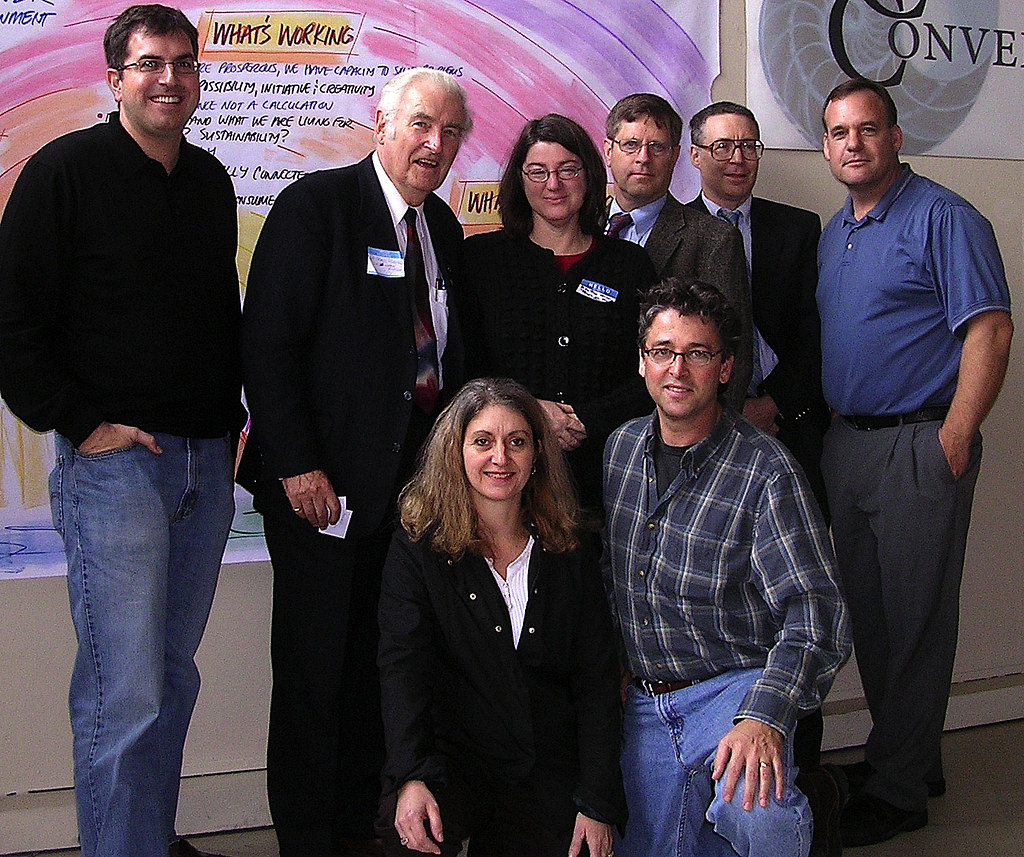 At the invitation of Christopher Cain, publisher of The Port Observer, Dr. Frans Verhagen presented at last month's Cascadia Convergence on the topic of Sustainable Aviation in Cascadia. Dr. Verhagen's comprehensive vision for aviation fit well with the big-vision goal of the Convergence -- to launch "a 5-year initiative to catalyze collaboration aimed at achieving sustainability across our bioregion."
Dr. Verhagen's presentation was a call for citizens to demand an integrated, intermodal transportation system grounded in values of sustainability and equity. He noted key national and international organizations (1) and initiatives in the sustainable aviation movement. And he made the case that aviation issues are a critical element of any regional sustainability initiative and merit the attention of advocates for a sustainable Cascadia.
INTEGRATING AVIATION INTO INTERMODAL TRANSPORTATION PLANNING
Aviation is a major contributor to greenhouse gas emissions and other pollutants and its contribution relative to that of other modes of transportation is rising. (2) According to Dr. Verhagen, aviation is largely neglected in intermodal systems planning and, in a number of ways, held to lower standards of public accountability. Fully integrating aviation into intermodal transportation planning would capture transportation efficiencies across all the modes. It would spark new avenues of technological development. It would allow for the discovery of hidden costs and assumptions. It would put all our transportation options on the table at one time allowing us to make more intelligent systems-level decisions. It would bring considerable ecological benefits at a time of ecological vulnerability. The growth in the aviation industry that appears to be touted as an unmitigated boon (3) appears in a different light when it is considered that this sector may be out of balance in relation to the other transportation sectors -- perhaps placing them, and all of us living beings as well, at a competitive disadvantage.
A CASCADE LEGACY: FRAGMENTED TRANSPORTATION POLICY AND PLANNING
Policy and planning fragmentation is perhaps the central transportation challenge for our region. From the recent Regional Transportation Commission Final Report commissioned by Governor Gregoire:
"The absence of a unified system for governing transportation has created a patchwork quilt of agencies that cooperate to a large degree but ultimately compete to get local or modal projects funded and built."The Roads and Transit proposal now on our ballot addresses this fragmentation head on. However, it shares a feature that characterizes even the most advanced intermodal transportation planning: an exclusive, or nearly exclusive, focus on surface modes of transport.
From today's perspective: in a region that depends heavily on the aviation industry for its economic well-being, with our history of defeating big-vision transportation measures, and with Proposition One balancing between victory and defeat, Dr. Verhagen's thesis that regions should approach an even more comprehensive level of intermodalism -- one that fully integrates aviation, scales it down relative to other modes, and holds it more accountable -- well, that may seem a bit quixotic.
But Dr. Verhagen is inspirational at the big-vision pep-talk. He quotes Johann Goethe: "Boldness has genius, magic and power in it." He quotes Washington's own William D. Ruckelshaus:
"Can we move nations and people in the direction of sustainability? Such a move would be a modification of society comparable in scale only to two other changes: The Agricultural Revolution of the late Neolithic, and the Industrial Revolution of the past two centuries. These revolutions were gradual, spontaneous, and largely unconscious. This one will have to be a fully conscious operation, guided by the foresight that science can provide. If we actually do it, the undertaking will be absolutely unique in humanity's stay on earth."Business and government will not change unless citizens demand it, Verhagen says. He suggests a process for organizing and carrying out this demand that envisions working with business and government as well as challenging them and holding them to account. I see it as a proposal for assertive activism -- a persistent strategic demand for ethical and sustainable practices.
Washington State does have a modestly-funded mandate to integrate some aviation planning into multimodal policies. This requirement is seen in the Washington Transportation Plan 2007-2026. But we may not be meeting even that modest level of integration. WashDot's recent Multimodal Concurrency Study, for example, appears to contain no mention of aviation.
Federal policies -- which have greater power than state and regional laws to mandate and fund integrated intermodal transportation -- also appear to accord slight attention to aviation as part of the intermodal mix. The federal law that addresses transportation integration is the 2005 Safe, Accountable, Flexible, Efficient Transportation Equity Act. It appears to consider intermodal transportation as a matter only of surface transportation. SAFE, Inc., is working to have aviation included as an integral part of the intermodal mix in this federal law. (3)
It is not unreasonable to call for a more integrated intermodal transportation system. In fact, it could be said that we have been stuck in a transportation tangle in part because our vision has been too small. Neither is it inappropriate to pursue this on the regional as well as on the federal level. State and regional level innovation is often the spark for national action.
CHRISTOPHER CAIN INTRODUCES DR. VERHAGEN

Sustainability means, the equation between development and environmental degradation is balanced.
As our society expands in every way - population, water, land and air use, the really inconvenient question - will there be enough for everyone? - looms poised to be answered one way or another. It is our obligation and our duty to recognize and mitigate the effects of what we're doing. And to stand up and take responsibility to ensure that our share of resources consumed does not adversely affect others. This is not just about what we leave behind for future generations, it is also about how we define what is acceptable policy now. In simple terms it can be stated; is it right for one man to live in a castle while another lives in the mud? - in more complex terms - should corporations have the right to use any amount of resources necessary to turn a profit, regardless of the environmental effect? - or should government subsidize development schemes that primarily benefit the wealthy, while acid rain and toxic runoff from deforestation undermine our fragile ecosystem and economy? -
In the capitalism, corporatism, consumerism model we find the word feasibility as the old standard. The word sustainability, the sustainable movement, is the antithesis of the former. It is a direct confrontation to and the complete reversal of the basic premise underlying the old way.
In the old model, feasibility reports are continuously conducted while entire ecosystems collapse and toxic clean up sites are the norm. I suggest, the first step in reaching our goal is to do away with the feasibility study and instead continuously conduct sustainability studies in order to balance the aforesaid equation. Instead of watching the Dow Jones Industrial Average we should be watching the Sustainable Industrial Average published in clear and easy to read graphs and charts to explain the minutia and complexity to every stake holder. Children should be taught how to balance the equation in sustainability class.
The invisible hand of free market economics isn't wearing any clothes anymore. In other words, it ain't working folks. Now we must take on the challenge of forging into existence alliances which challenge the status quo and act as think tanks to propel new ideas into action.
If we are to be successful in this endeavor of Sustainability in a Single Generation, we must understand that direct collaboration and unwavering steadfast dedication and hard work to bridge political divides are the keys to reshaping the American ideal into a SUSTAINABLE beacon of hope for all people and nations to aspire.
The Port Observer newspaper recognizes the urgency underlying this endeavor and has taken one first step by inviting a special guest here today. To help us take our first steps towards a sustainable future Frans Verhagen is an environmental/sustainability sociologist who has been directing the metro New York citizens sustainable movement for the last ten years. He became president of the national organization Citizens Aviation Watch, USA, Inc. three years ago. He teaches a course on sustainable aviation at Vaughn College of Aeronautics and Technology and is working on a book length publication entitled "Revamping Aviation: Working towards Sustainability in the Transportation Sector, Particularly in the USA".
It is an honor to welcome Frans Verhagen.
The text of this introduction was provided to the author by Christopher Cain.
DR. VERHAGEN'S PRESENTATION
Click here for a Powerpoint of Dr. Verhagen's presentation.
HTML version: Sustainability within a Generation for the Aviation Industry in the Cascadia Bioregion
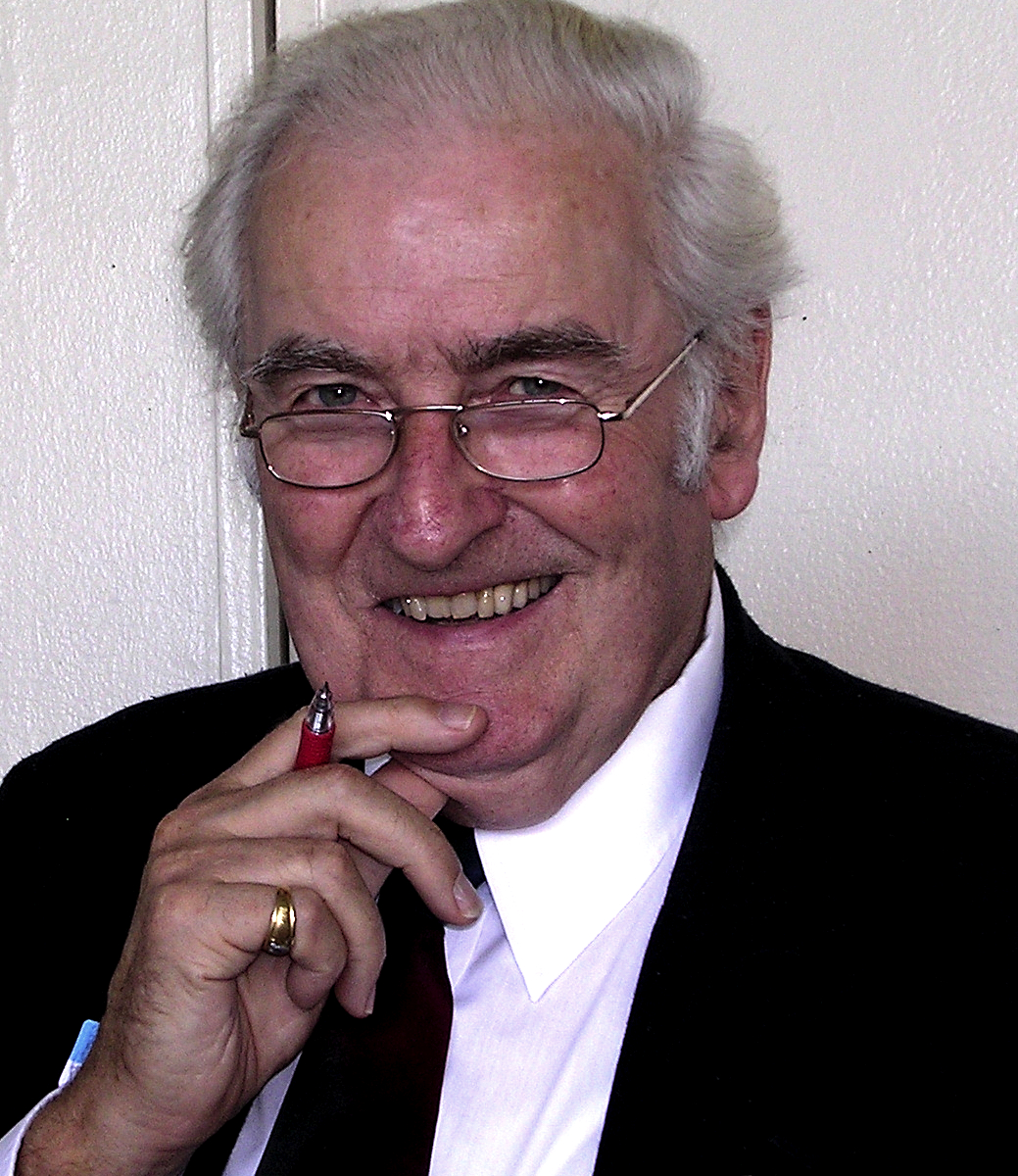 I'm honored to be here, Dr. Verhagen said, at this gathering in support of sustainable aviation in Cascadia. Many thanks to The Port Observer for inviting me. When I think of aviation in Seattle, New York, the United States, and internationally, one word springs to mind: growth.
Everywhere, people are up in arms because there is runway expansion, growth in the number of flights, the number cargo planes taking off late at night. We should understand these issues in the larger context of the international economic system. If we don't, we can easily become discouraged because, no matter how hard we work, it will take decades to get where we need to go. We are up against powerful international forces. The growthism in our international economic system enriches the few, impoverishes the many, and endangers the planet. It can't get any worse than that.
The growth we see in aviation has hidden and unacceptable assumptions. For example, our planning fails to distinguish differences between efficient and premium transportation. (6) Social and ecological costs are not internalized but instead are pushed out to society. We see this kind of thinking in relation to Paine Airport. Little accounting is made of the costs associated with the airport expansion to the people who live nearby -- the disturbed sleep, the noise, the total impact on health. An article in the September 19th Seattle Times, No Paine No Gain, gives us an example of this.
The imbalance of growth in the aviation sector is also supported by our unwarranted separation of policy and planning for the aviation sector and for surface transportation. Intermodal transportation is a hot topic. But it refers primarily to surface transportation. They don't include air transport! The Integrated Intermodal Transportation System (IITS) Initiative, of Sane Aviation for Everyone (SAFE, Inc.), proposes a 15-year, $300 billion push to achieve a truly integrated transportation system. (5)
SUSTAINABLE AVIATION IN CASCADIA: A CITIZEN PERSPECTIVE AND PLAN OF ACTION
How to fight expansionism and get to a sustainable aviation structure and process in the US and Cascadia within a generation
To develop a plan of action, it is necessary to start with values. People say that theory is not practical. But it is; it underlies most of what we do. Government and business do not want to change their underlying values. They will make these changes only if citizens force them to. There is a history of the concept of sustainability in the United States. In the early 1970s, sustainability was conceived in a more integrated way, as incorporating the ideas of limits to growth and social and ecological sustainability. In the 1980s and 90s business and governments became involved and these concepts became more constricted to the ideas of sustainable growth and development. We face a challenge now of moving back to a more integrated understanding of sustainability: contextual sustainability. This includes four challenges: social justice; active nonviolence; participatory decision-making; and inter-generational equity.
Beneath these challenges are foundational values. There is a need to shift from an anthropocentric to a biocentric understanding of our place in the world. We must think also in terms of bioregionalism. And we must understand that we are part of the cosmos, our physical structure is made of the stuff of "star dust". We are universe beings, as well as earth beings.
The concepts of contextual sustainability are in accordance with what we find in The Earth Charter, which is a document that is as significant in the 21st century as the Magna Carta was in the 13th century and the Universal Declaration of Human Rights in 1948.
It is important that, as citizens, we try to come to an agreement on our world view before getting the specifics of a plan of action.
Action on eight levels
Dr. Verhagen outlined proposals for aviation sustainability on eight levels: ethical, political, legal, ecological, economic, media, educational, and military. These proposals appear in detail in Sustainability within a Generation for the Aviation Industry in the Cascadia Bioregion. Here are selections:
- Jointly develop for your region a contextual sustainability framework with a vision in accordance with the Earth Charter.
- Create an Integrated Intermodal Transportation System Initiative (IITSI) for your region. Citizens Aviation Watch, US has such an initiative in the planning phases. (5)
An IISTI would integrate air transportation with an efficient intermodal surface transportation system that includes an expanded and efficient rail system (mostly for freight), and a national modern coach network. Short-haul air flights would be replaced by fast, not necessarily, high speed trains or maglev. Preference would be given to the less energy-intensive and less polluting surface modes of transportation. Costs for implementing IITSI would approach $300 billion, an order of investment known to drive economic revitalization and technological development.
- Rejuvenate the Pacific Northwest Rail Corridor. (7) It is important to start pushing this again in the Northwest. The Mineta Institute issued a study in 2005 that summarizes where this stands: High Speed Rail Projects in the United States: Elements for Success. This corridor would allow the trucks that travel on I-5 to move on trains instead and I-5 then can become part of an efficient network for cars and coaches. Politicians and business have great difficulty in pushing these improvements unless there is enough popular pressure. I'm hearing instead there are proposals for a new 183-mile long highway through rural Washington. Crazy! (8)
- Work to demand that social and ecological costs of aviation transportation are internalized, not shifted onto society but considered as part of the cost of aviation. The cost of air travel needs to be 30% higher to reflect the costs that are now being externalized.
- Consider civil and military aviation together. Nitrogen oxides fumes emitted by highflying military aircraft exert 30 times the impact on the climate as the same fumes from industrial processes on the ground.
- Prepare to stop the National Airspace Redesign Program. (9) We don't need more planes to go to the supermarket. These air taxis are an increasing factor in congestion, forcing the big airplanes to wait while they clear out. There is a "5th alternative" that the industry is not considering: "Doing more with less."
- Beware of the sustainable aviation discourse by governments and industry that looks reasonable but is a means of avoiding fundamental change. For example, Sustainable Aviation in Great Britain is backed by oil companies, government, and airlines.
- Connect sustainable aviation and climate change to the 2008 elections
- Continue to pressure for the SEA-TAC airport's good noise abatement program by demanding that airport communities receive Part 150 funds for soundproofing their homes and not only their schools and hospitals.
- On legal issues, have a strategy and get assistance/consultation with those from expertise in the arena.
The Citizen has a Right and Responsibility to Demand Change
As citizens, it's not our choice to demand change, it's our right and responsibility. We should not be begging policymakers to do the right thing. We must demand that they do the right thing. This is a matter of justice. It is a matter of distributional justice, which refers to the equitable sharing of costs and benefits. It is a matter of procedural justice, which means that there must be accountability and that decision making must be participatory.
Given the climate crisis, aviation is going to be pushed to change drastically. There are a number of estimates as to how much aviation is contributing to greenhouse gas emissions. It is clear that, while other transportation sectors are reducing their contribution, that of aviation is increasing. (2) Doing more with less will come to pass because there is no other option. It is not so much a question of slowing the rate growth of this industry; it is a question of reducing its size. You can imagine that this is not a popular view.
But people, faced with the kind of iconic photos such as the shot of the earth showing the wildfires in California will start to question things. The evidence of extreme climate change is growing stronger. You can think of this in terms of a farmer in Central Africa starving and people in Bangladesh drowning. In this perspective, when you are making a decision whether or not to fly, it becomes a question: do you want to kill people? Do you want to drown people? There are quite a lot of hopeful signs. People are really starting to see there's a crisis and responding to this with action. Humanity's ethical systems are developing. If we can provide value frameworks to move us to sustainable systems, this will be a unique occurrence in our stay on earth.
PANELIST PRESENTATIONS
This section should be read as my understanding of the panelists' presentations. It is not a complete account and may contain errors.
FRED FELLEMAN, FRIENDS OF THE EARTH
I'm a marine biologist, so I see things from that perspective. I'm focused on "dockside", so I'm not going to speak much on the topic of aviation.We now have a much more receptive Port Commission to work with on environmental issues than we have had previously. The leadership of the two commissioners here today, Alec Fisken and John Creighton, should not be ignored. We are also fortunate here in the Northwest, to be represented by Jay Inslee and Maria Cantwell, who are backing the goals of the New Apollo Alliance.
I just got back from Bunkerworld 2007 (an annual marine fuel sustainability conference). Bunker is the main fuel that ships burn. It's basically a waste product. There's a joke out there: "you pay for this stuff?".
There is no mode of transportation more efficient per ton than shipping. But the largest engines are burning the dirtiest fuel. When a big ship comes to dock at the Port of Seattle it can produce as much sulfur dioxide per hour as 350,000 cars. At the Port of Seattle, cruise ships, as a condition of lease, are now required to use either low-sulfur diesel fuel (1.5% sulfur or less) or or alternative hookups while at dockside. This will significantly reduce the impact of these ships on the environment.
MARPOL Annex VI has not been ratified by the US. (Last March, H.R. 802, which would amend the Maritime Pollution Prevention Act of 2007 to Prevent Pollution from Ships to implement MARPOL Annex VI, passed the US House. It's now in the Senate Committee on Commerce, Science, and Transportation.) Senator Cantwell is a member of the committee that will decide whether to ratify it.
The United States needs to be part of Annex VI. If we don't start getting serious, responding to the urgency here, significant cuts in per-ship emissions will be eclipsed by the rate of growth in the industry. One take-home idea from today: call Senator Cantwell and ask her to support Annex VI.
A second take-home idea: get a copy of the Northwest Ports Clean Air Strategy. The next draft is due to come out November 15. The shipping industry offers great potential to reduce pollution. Forty percent of all installed power on ships is expected to be replaced in the next 10 years or so. We need to have our regulatory framework in place.
HEATHER TRIM, PEOPLE FOR PUGET SOUND
There is a huge disconnect between the Port commission, which is publicly accountable, and the culture of fear among port staff. The new CEO, Tay Yoshitani, has a lot of potential to change this. There needs to be a top-to-bottom reassessment of how the Port does sustainability -- from composting to the taxis that deadhead at the Port. (11)The Port itself is a community leader and has a lot more room to be a sustainability leader. Here are some action items:
- Airplane emissions. We're told: 'We don't control this. It's the FAA and Boeing.' Why not have the Port look at working with Boeing in a partnership on airplane emissions?
- De-icing chemicals. These are required on plane wings. But the ingredients are proprietary. We don't even know what's in there. These chemicals go through sewage into the Sound and we can bet that they're not all cleaned up before they get into that water. Let's find out what's in there.
- Transit needs more funding and support. The best ways to help the environment are in our transportation choices.
- How do big changes happen in society? We are at the cusp of an energy revolution. We can't get people to change by saying: "Decrease your quality of life." We need technology development. We need government to support technological development. The Port can help promote this.
DEBI WAGNER, US CITIZENS AVIATION WATCH
I became involved because I was personally affected by aviation emissions in 1993.Nine to fifteen percent of greenhouse gas emissions come from aviation and this sector is greatly increasing its capacity without adequate advances in efficiency and emission reductions. Engines are getting bigger and hotter. The public is not getting the whole story. All other modes of transportation have increased their emissions by 3% since the 1970s. Aviation has increased its emissions by 133%. This is unacceptable for society as a whole. Everyone else is forced to cut their emissions. It's unfair and it's unbalanced that aviation is not held to the same standards.
What are the solutions? Each of us needs to change our mindset on how we are living. We need to consider when we travel, can we take other modes? The IITS Initiative is important to look at. We should consider whether we can take some of the money we plan to invest into expanding SeaTac and put it into other investments. Can we create a panel of experts in science, economics, and transportation to look at the options for our region and do a study on the best course for our region?
How can we turn the mindset of people from expansion to sustainability? It's difficult. We've made foolish investments and those aren't easy to undo. But our children, our resources, our health and wellbeing depend on our ability to make better decisions regarding how we are going to move people and cargo in this region.
NOTES
- Dr. Verhagen is President of Sane Aviation for Everyone (SAFE, Inc.), a coalition of citizens' groups and individuals in the greater Metro New York region that was established in 1994. SAFE, Inc.'s place in the growing international network of organizations working for sustainable aviation helps provide an overview of this movement's network. It is a founding member of Citizens Aviation Watch (CAW, Inc.), a national group. It is also a member of the International Coalition for Sustainable Aviation, which has consultative status at the Committee for Aviation Environmental Protection (CAEP) at the International Civil Aviation Organization, the UN agency charged with promoting understanding and security through cooperative aviation regulation."
According to the European Federation for Transport and Environment, the International Coalition for Sustainable Aviation currently consists of Aviation Environment Federation (UK), Center for Clean Air Policy, (US) Coalition for Clean Air, (US) Dutch Society for Nature and Environment, Friends of the Earth-Europe, German League for Nature and Environment, GermanWatch, European Federation for Transport and Environment, World Wildlife Fund-US."
- From The International Coalition for Sustainable Aviation in a 2003 position paper entitled, Aviation and its Impacts on the Global Atmosphere:
"Currently representing 3,5% of total anthropogenic radiative forcing (this is as much as the total contribution of the UK to global warming), aviation's total human-induced climate change impact could represent as much as 15% by 2050 if no measures are taken to reduce these emissions, even after accounting for expected technological improvements, according to the IPCC Special Report on Aviation and the Global Atmosphere (adopted in April 1999)."
- Commercial Aircraft Design Characteristics -- Trends and Growth Projections, International Industry Working Group, R1, 5th Edition, 2007. This document reports typical forecasts of revenue increases per passenger kilometer/mile at about 4% annually and 50% worldwide for cargo between 2003 and 2010. Significant increases in airplane size -- at all design dimensions are predicted. Improvements in fuel efficiency and emissions are also predicted -- but those charts do not seem to indicate the metrics or context for those improvements.
- Boeing's Current Market Outlook 2007 predicts that, between now and 2026, the world economy rise by 3.1%, the number of airplane passengers by 4.5%, and the amount of air travel by 5%. The air cargo market is projected to grow 6.1% per year. There is also predicted an easing of government regulation and a "liberalization" of markets. 28,600 new airplanes will be delivered over the next 20 years. These new airplanes will make up 80 percent of the 36,400 airplanes in service in 2026.
- The Intermodal Surface Transportation Efficiency Act of 1991 (ISTEA, pronounced Ice-Tea) is a United States federal law that posed a major change to transportation planning and policy. It presented an overall intermodal approach to highway and transit funding with collaborative planning requirements, giving significant additional powers to metropolitan planning organizations. Signed into law in 1991, it expired in 1997. It was followed by the Transportation Equity Act for the 21st Century (TEA-21) and most recently in 2005, the Safe, Accountable, Flexible, Efficient Transportation Equity Act: A Legacy for Users (SAFETEA-LU). All of these appear to focus on surface transportation nearly exclusively. (This information is adapted from WIKI entry on ISTEA).
SAFE, Inc is pushing for new legislation that integrates aviation into ISTEA, so that ISTEA would become ISATEA.
- I understood Dr. Verhagen to mean premium transportation as being the more costly services, like air taxis, that may produce more profit for the airlines, but are less efficient in cost for society as a whole when considering factors such as pollution, high noise levels, and congestion in air travel.
- The IITS Initiative, Dr. Verhagen wrote in a 11/2/07 to me, is in the conceptual stage. Its second draft will soon be completed. It is briefly described in Demand #2 of Ten Sustainable Aviation Demands issued by SAFE, Inc.
- High Speed Rail Projects in the United