Washington's Presidential Caucuses and Primary: Access, Democracy, Relevancy
|
As a Precinct Committee Officer I've been getting questions about Washington's presidential primary and caucuses: are we having both this year? Where and when are they? Is it worth participating?
The way we do the primaries and caucuses has been changing in recent years. The process also differs by political party. And the recent contentious public debate on related partisan issues has caused more confusion. It's complex enough that, even though I took part in the 2004 presidential caucuses and am helping to help organize local caucuses this year, I've had to do a bit of work to feel confident that I'm answering people's questions without misinforming them. I'm guessing others are on a quest similar to mine -- judging from how many people are Googling into previous Washblog stories on the issue.
The big question I hear from people on Washington's primary and caucuses is whether there's a point to participating. Does the primary mean anything? Are the caucuses open to the input of regular people -- or only to party insiders? If you vote in one, should you vote in the other too? Is the whole process manipulated by the party elites to produce a foregone conclusion? Is everything scheduled so late that it won't matter what we do in Washington anyway?
I've asked the same questions myself, although my starting assumptions are somewhere between those of unquestioning Democratic Party supporters (there aren't many of those around, actually) and the most disillusioned people I've talked with. I'm skeptical of the Democratic Party as an organization, but I see that it is grounded in principles of democracy and sustainability, operated with significant grassroots participation, and generally run for public benefit. I'm not happy with the way the process has been set up this year. But I believe my participation in the caucuses will be meaningful. I may skip the Democratic primary in protest. If I were voting Republican, I might decide differently. More on all this, below.
CAUCUSES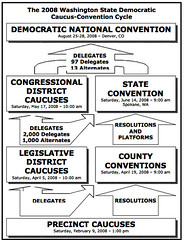
The image to the left, from the Washington Democratic Party, lays out the Democratic caucus-convention cycle with nice parsimony. It is, perhaps, a bit West-Washington centric. I understand that some areas in eastern Washington may select delegates to the state convention at the County Convention. Click on the image for a larger version.
The Republican cycle is organized differently, but the general idea for both parties is similar. A large number of delegates and alternates are elected at the neighborhood caucuses on February 9. Those delegates then attend subsequent caucuses where they vote amongst themselves to elect smaller numbers of delegates. By the end of the caucus-convention cycle a small number of Washington delegates, 97 Democrats and 40 Republicans, attend their respective national conventions to join with other delegates from around the country to elect the parties' nominees.
The caucus v. primary democracy question
The caucuses have been criticized as events that exclude large numbers of voters, while the primaries have been extolled as inclusive. This is a view put forward by people I respect, including Greg Rodriguez, the former Chair of King County Democrats who wrote here on Washblog that the caucuses are a futile attempt at democracy, and by Steve Zemke of Majority Rules blog, who was the campaign organizer for Initiative 99, which brought us the primary system to begin with. With due respect, I believe that this a mischaracterization -- at least in terms of the Democratic caucuses.
I'll go with the view of Krist Novoselic of US Fair Vote (and formerly bassist for Nirvana), who was one of the Democratic committee members who voted for the caucus process this year. Novoselic wrote on Washblog back in May that the 2008 caucuses will be a real exercise in democratic participation. "These local events," Novoselic wrote, "will fill with citizens eager to nominate candidates for president. We're in an age of apathy and we should not assault this process of civic engagement."
I believe that any defense of the caucuses against the charge that they are elitist has to start with an acknowledgment that we are struggling to maintain democracy with an electoral system that is seriously messed up. The opportunity to run for President is effectively closed to anyone who presents a serious challenge to the corporate powers that control the media and pay for elections. It is effectively closed to anyone who doesn't run under the label of one of the two major parties. Our elections run on dirty money, dirty tricks, lies, smears, fear-mongering, voter disenfranchisement and voter suppression. The caucuses are part of this dysfunctional system and they have their own additional flaws (2). But they are one of the brightest spots in a faltering system. I believe they are among our most democratic institutions.
Access versus meaning
On the Democratic Party side, at least, caucuses have evolved into a series of events that begin wide open to input from any registered voter who declares as a Democrat. As the cycle progresses, input and participation from all players is narrowed, increasing the relative influence of the party "machine". But our system requires the organization and power that only a party machine can deliver. Absent some profound electoral reform -- which we're not going to get between now and November, 2008, no candidate with reasonable positions on the environment, social justice, and democracy can get elected without that power behind him or her. The caucuses are a major point of entry for the input of regular citizens -- we the people, we the democracy.
Yes, the primaries are more physically accessible because they are conducted by absentee ballot. But there is a trade-off for this access. They are also much more influenced by big-money electoral politics. Washington State Democratic Party Chair Dwight Pelz has said that the caucus system encourages grassroots democracy and dialogue while the primary favors candidates who spend the most money on TV ads and teaches participants that politics is a solitary process. I agree. (3)
Washington's primary and caucuses are scheduled after Super Tuesday. So the presidential nominees may be known by the time we hold the first caucus on February 9. If that's the case, we'll see less citizen participation in the caucuses, and we're not likely to see the presidential candidates traveling to Washington to court us. Would this be cause to stay home on February 9? I believe not!
What if it's all over by February 9?
Why not stay home from the caucuses if the race seems run?
Well, first, it's important to remember that an apparent early result can change. That's a slim - but real - possibility, and I write about it more later on.
Even beyond these horse race considerations, the caucuses are the key event in the presidential election cycle that allows Washington citizens to organize themselves for more impact on both primaries and the November general election for President and for all other candidates. History shows that even small numbers of people who care about their community can have a decisive impact on the outcome of elections.
The caucuses are a key opportunity to organize for a successful general election and for the kind of long-term civic community relationships that are necessary to keep democracy alive. They allow like-minded neighbors to bypass the usual electoral noise of money, power, and prejudice to share political information face to face. These are not symbolic benefits. They allow the kind of neighbor-to-neighbor dialogue that is essential for rebuilding the integrity of our electoral democracy. The 2004 Democratic caucus in my neighborhood was democratically beautiful.
What happens at the caucuses?
There is no need to be an expert or an experienced partisan activist to take part in the caucuses. Most participants are not. The training provided to the caucus organizers by the Democratic Party requires that each person who walks into the building will be welcomed and helped to sign in and find a seat in a section assigned to his or her precinct, and participate meaningfully in the proceedings.
The primary order of business is to elect delegates from the precincts who will go on to the next level, the legislative district caucuses, to elect a smaller number of delegates from among themselves. A larger percentage of people who attend the precinct caucuses on February 9 will have an opportunity to serve as one of these delegates. Delegates can choose to be pledged to a candidate, or can choose to remain unpledged or undecided. The delegate elections take place after everyone is given a chance to speak on behalf of a candidate for a short amount of time (perhaps 2 minutes). At my neighborhood caucus in 2004 I was amazed at how many people got up to speak intelligently, sharing information that was new to me. The process was orderly and very respectful.
Resolutions are also introduced at the precinct caucuses. Any person attending can introduce these resolutions. By way of example, here are two sample resolutions posted by Democracy for Vancouver for impeaching George Bush and Dick Cheney that people can introduce on February 9th.
What if I want to participate and I can't attend the caucus?
Democrats who cannot attend the caucus because of physical disability, religious observance, or military service can file a surrogate form which allows them both to stand for election as delegates and to vote for other delegates (by nominee preference). Republicans who are unable to attend for similar reasons can stand for election as a delegate but can't vote for other delegates. They also must contact the party to arrange for this in advance. (4) The Democrats have a delegate selection and affirmative action plan, which requires considerable outreach to the community and a robust effort to even out the playing field for gender and race. Here's the state Democratic Party page on the Caucus-Convention Cycle. Here's the state Republican Party Caucus and Convention Manual.
PRIMARY
The primary for both parties will be held on February 19. In some areas, there will also be a special election held for other offices at the same time. All registered voters can participate, as in any election. Here's the Washington Secretary of State 2008 Presidential Primary Page. The last day to register to vote for this election (with some exceptions) is January 19. Here's an online registration form, available starting January 7, 2008.
The Democratic and Republican nominees for President are elected by delegates who are appointed and elected through primaries and caucuses. They are not elected directly by the citizenry at large. So what's the primary for?
For Democrats, the answer to that question in 2008 is "not much". That's because the primary is scheduled after the caucuses, when it has the least effect on candidates' momentum -- and because the Democratic Party leadership decided early in the year to not use the primary results in allocating delegates.
There was a suggestion made early in the year that the Washington's primary be moved to February 5, "Super Tuesday". That would have allowed for the momentum established in the primary to feed into the caucuses. It would have allowed for those who voted in the primary to be mailed invitations to the caucuses. (5) Dave Gibney, a Democratic State Committeeman advanced this in a Washblog article in April: Washington Needs to Hold a Presidential Primary. The current configuration leaves the Democratic primary election "orphaned", or isolated from the rest of the political cycle. However, there is still a chance that a strong result for a candidate could get some media attention and add to that candidate's momentum.
The story is a little different for Republicans voting in the February 19 primary - though not a lot.
Washington's Republican Party has 40 delegates, total, to apportion to all presidential primary candidates (out of 2,476 Republican delegates nationally). They've settled on a complex formula to decide how these delegates will be pledged to individual presidential candidates. (6) By using both primary and caucus results to apportion that small number of delegates -- and by electing a quarter of their delegates at the state convention --after the primary and caucuses are all over -- the Republicans are diluting the impact of both the primary and the caucuses. I think their system maximizes party choice over citizen choice so much that I don't see much citizen choice left over. The Democratic use of the caucus system alone allows for caucus votes to have more impact -- enhancing both the advantages and flaws of the caucus system.
It is unfortunate that we're holding a $9.7 million primary that has, practically speaking, very little effect. Many people may remember that, in 2004, the presidential primary was canceled in a special session of the legislature. So we didn't have a primary that year at all. I am hearing that the legislature didn't cancel the primary again because neither party wanted to take the political heat for taking the primary "choice" away from voters. I don't know if that's true. It seems plausible.
A delegate situation
The presidential nominees for the parties are chosen by delegates. So it's worth dwelling for a moment on our state's delegate situation. How many delegates do we get? What does this mean for people backing Democratic or Republican candidates?
Washington has more Democrats than Republicans in statewide and national office -- and we've voted for the Democratic candidate for President in recent elections. So Washington's Democrats get more voice in the matter of choosing a presidential nominee for their party than Washington's Republicans do. Nationally, 4,367 Democratic delegates will vote for their presidential nominee. Ninety-seven Washington State Democratic delegates, about 2.2% of that total, will take part in that process. On the other side of the aisle, we have 2,476 Republican delegates voting for their party's nominee. Forty Washington State Republicans, about 1.6% of that total, will take part.
More on the delegate role
Washington's Democratic and Republican leadership decided back in March to keep the state's primaries and caucuses scheduled late in comparison with those of other states. The Democratic nominee needs 2,184 delegate votes (out of 4,367) to win. It will be possible for one nominee to have that many votes pledged to him or her by February 9. Even if there isn't an outright winner, it's likely that one or two strong front-runners will have emerged. I doubt that, by the time our state finalizes the caucus process on May 17, we won't have an apparent winner or a clear front-runner.
If it happens this way, it's still possible that something unexpected can change everything. A candidate can commit a major political blunder -- or his support can unexpectedly weaken. This happened with Howard Dean early in 2004. That could cause two candidates with close numbers to reverse their positions. Or it could take the race in a completely unexpected direction. Delegates for several different candidates, for example, could pool their votes and put their collective weight behind a compromise choice to squeeze out a suddenly weakened front-runner. In these kinds of fluid circumstances, a single delegate advantage could make all the difference-- and all of this can influence the decisions of people in states who are voting even later in the game.
Staying home because the election seems like a done deal means giving up the chance to help add to the political weight behind a candidate you support -- and his or her platform. Numbers matter. Some attribute Howard Dean's Chairmanship of the DNC, for example, to his strong delegate presence in 2004. If Edwards or Kucinich delegates have a strong contingent at the National Convention -- or even make it possible through vote trading for one candidate to pull ahead of another -- are we are more likely to have a Department of Peace -- or more action on poverty in 2009? Possibly.
The most important reason to participate is that civic participation is what makes democracy work. The antidote to a manipulated electorate and a cheated majority is civic participation. The "party machine" that is so reviled in the media is actually -- on both sides of the aisle -- a major opportunity for ordinary citizens to help revive democracy. The precincts, the precinct caucuses, and the position of Precinct Committee Officer are mandated in Washington state law because they form a democratic foundation for these two parties that have immense political power. This structure is not perfect, but it is an expression of the true political grassroots. Its power is waiting to be claimed by the citizenry.
NOTES
- Selected Washblog Stories on Washington's 2008 presidential caucuses and primary
- Caucus v. Primary, Greg Rodriguez (former Chair of King County Democrats), Washblog, 3/20/07.
- WSDCC Delegate Selection Plan - public comment #1 - simplifying the math, wrog, 3/27/07
Note, this proposed change to the rules, made by wrog, was successful. - Washington Needs to Hold a Presidential Primary, Gibney, Washblog, 4/9/07.
- WSDCC Delegate Selection Plan - public comment #2 - killing the precinct 15% rule, wrog, 4/9/07
Note, this proposed change to the rules, made by wrog, was successful. - Caucus decisions and what two Steves Say, Emmett O'Connell, 4/30/07
- Destructive Rhetoric, knovoselic, Washblog, 5/5/07.
- February Presidential Primary? Nah, m3047, Washblog, 12/5/07.
- Criticisms of the caucus system focus primarily on the fact that requiring in-person participation is unduly restrictive, particularly because the caucuses require attendance at more than one event. This is a fair criticism. However, if we are to preserve any form of civic decision-making that allows for in-person discussion amongst voters, we will have to deal with this flaw -- essentially a trade-off. Both major parties in Washington have made efforts to mitigate this problem. The Democratic party has done a better job. Some criticisms:
- Steve Zemke of Majority Rules blog, who was the Director of Initiative 99, the successful campaign to create a primary system in Washington State back in 1988, argues that the caucus system excludes those who are unable to attend it and that it "benefits party insiders who are willing to not just attend the initial precinct caucus but go to the legislative district, county, Congressional and state convention."
- 29A.56.010 RCW states that the presidential nominating caucus system in Washington State is unnecessarily restrictive of voter participation in that it discriminates against the elderly, the infirm, women, the disabled, evening workers, and others who are unable to attend caucuses and therefore unable to fully participate in this most important quadrennial event that occurs in our democratic system of government.
- Greg Rodriguez, former Chair of King County Democrats, wrote in a Washblog story, Caucus v. Primary that "The caucus system has also alienated many voters from both Parties because of the elitist and closed-door impression these futile attempts at Democracy represent."
- From a reprint of a 4/27/07 email from Dwight Pelz, Chair WSDCC, subject: Caucus or Primary, posted at: Thurston County Democrats and accessed on 12/26/07:
"I believe that the our system of presidential caucuses represents grassroots democracy at its best.
"Caucus or Primary
"Caucuses require candidates to launch grassroots campaigns to contact potential voters one on one, and make sure they turnout to their neighborhood caucus meeting."Primaries reach voters through television advertising.
"Caucuses test the true strength of our candidates and their campaign organizations.
"Primaries test the ability of the candidates to raise money.
"Caucuses require people to leave their homes and meet their neighbors on a Saturday afternoon, and engage in dialogue about the candidates and the direction of our nation.
"A Washington Primary will be by all-mail ballot. Voters will sit at the dining room table and mark a box on ballot, then drop it in the mail.
"Caucuses build our party by bringing grassroots activists into a dynamic process.
"Primaries reinforce the notion that participation in politics can be a solitary experience."
- As per a 12/19/07 phone conversation with representative at the Washington State Republican Party HQ.
- State law requires that if you vote for a Democratic or Republican candidate in the presidential primary, your information becomes available to that candidate's party. How you voted won't be reported -- just your partisan preference. And if you skip the presidential primary but vote in the other races that appear on the February 19 ballot in the special elections, your information won't be shared.
- Election and Appointment of Delegates
Democratic: 51 Democratic delegates are elected in Washington state directly through the caucus process that begins with neighborhood caucuses on February 9. These 51 people are referred to as the "district delegates". The district delegates who attend the state Democratic convention on June 14 comprise the delegate "election committee". They vote at that convention to elect 29 other delegates who have submitted their names for election or who have been recommended for election. These include a number of party leaders. An additional 17 party leaders are delegates (aka "super delegates") by virtue of their positions. These include Democratic electeds such as the Governor and the Democratic members of the US legislature. They also include members of the Democratic National Convention.
Republican: Three of Washington's 40 Republican delegates are appointed. These are the State Chair, and the state National Committeeman and Committeewoman. Of the delegates elected through the caucus system, 19 -- about half -- will be pledged to vote for presidential nominees on the basis of how many votes those candidates receive in the state primary. Nine of those 19 delegates -- one from each of the state's Congressional Districts elected in the caucuses -- will be pledged in a winner-take-all scenario to the primary's top vote-getter. Ten of those 19 delegates are considered to be "at large" delegates. They will be elected at the Republican state convention after the primary and caucuses are all over, and they will be pledged proportionally to the presidential candidates who receive 20% or more of the primary vote.Got it? (!)
Imagine, for example, that John McCain gets 49% of the Republican primary vote, Mitt Romney 29%, and Mike Huckabee 19.999%. McCain, as the top vote-getter in the primary will get pledges from all 9 of the winner-take-all Congressional District delegates. That leaves the 10 "at large" delegates elected at the state convention to be pledged proportionally to the highest vote-getters in the primary. According to the Washington GOP caucus and convention manual, that would result in McCain being alloted 6 of those 10 delegates on top of the 9 delegates he receives from the caucuses. Romney would get a total of 3 delegates, alloted as a result of his 29% primary result. And Huckabee and the others would be left with no delegates, as none of them received 20% or more of the vote. That scenario leaves a gap of one unpledged delegate. I don't see a rule covering that contingency. And I wonder what would happen if four or five Republican candidates each got a little under 20% of the vote.
The opinions and any errors in this piece are mine alone. I would like to thank Dave Gibney, PCO and (past) Whitman County Democratic Party State Committeemember and Bryan Kesterson, Chair of 47th District Democrats, for background information and advice.
| < A Washington Christmas Letter: Public Campaign Funding for Safer Children, Lower Health Costs | Guest post from WA State Reformatory: These crimes do not merit life imprisonment > |