Photos and Stories from NW Progressive Conference: Eastern WA
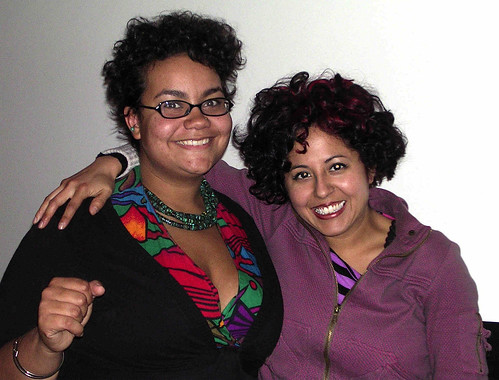 Adrienne Maree Brown, Executive Director of The Ruckus Society (left) and Favianna Rodriguez, co-Founder of the EastSide Arts Alliance, Keynote Speakers at Northwest Progressive Conference in Pullman, Washington. April 20, 2007 |
I drove from Kent to Pullman back in mid-April to attend the Northwest Progressive Conference presented by the Progressive Student Union of Washington State University. This was an ambitious undertaking by a small organizing group with support from nearly twenty sponsors (including two blogs, Washblog and F-words). More than 30 different workshops and presentations were offered during three days ranging over topics as varied as political art, military family issues, clean elections, Christian fundamentalism, climate change, and direct political action tactics. There were two keynote presentations by dynamic speakers of national stature, Adrienne Maree Brown, Executive Director of The Ruckus Society, and Favianna Rodriguez, founding member of Eastside Arts Alliance. Their addresses reflected an underlying theme of the conference: movement building through political communication.
KEYNOTE ADDRESS: ADRIENNE MAREE BROWN
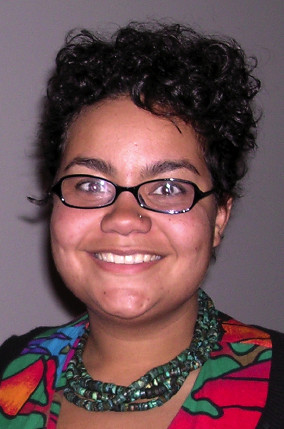
Adrienne Maree Brown is Executive Director of The Ruckus Society. She also serves on the boards of Wiretapmag.org, the Brower Center, the Allied Media Conference, and National Healthcare-NOW. Also known as a co-founder of the League of Young/Pissed Off Voters, Adrienne was co-editor of the youth organizing collection How to Get Stupid White Men Out of Office. As a writer, singer, and organizer, Adrienne has been involved in the growth of many organizations, most recently the New Orleans Network, the Future 5000, and the Arctic Indigenous Alliance.
Localizing Hope
Brown's talk had the flavor of a commencement address -- advice to students for their entrance into the world of movement building. Here is what I saw as her central question:
"Fear underlies hatred. How do we help people go from fear to love?"
She described a facet of her own work as giving people the experience of not feeling fear. As she said this, I had a flash of what it might feel like to be unreservedly at home with others. Maybe, I thought, this would be similar to the victory over fear I imagine that the bannering activists trained by The Ruckus Society achieve. Look closely and you'll see in the photo below that there are two people hanging off the sides of the giant banners -- there so that police will have to negotiate before they cut the banners down.
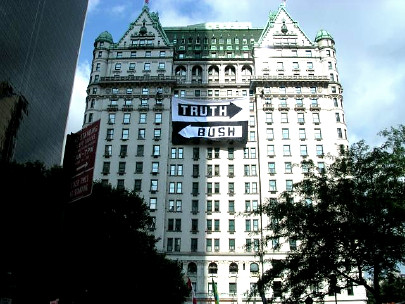 On August 26, 2004 -- two days before the Republican National Convention in New York City, Ruckus Society trainers helped Operation Sybil, a group of students and young professionals, unfurl a 60 foot banner in midtown Manhattan off the front of the historic Plaza Hotel. This image is taken from the site of The Ruckus Society |
A corollary theme in Brown's talk was moving from grandiose hope that shuts down action -- to hope that enables action because it is grounded in community and realism. This was not presented as a matter of thinking small ("We cannot be satisfied with tiny shifts toward the good," she said. "We need quantum leaps.") It was presented, I thought, as a matter of heeding the lessons taught by the natural world and our interactions with others -- connecting with real needs and opportunities.
Grandiose hope makes our tasks seem too big to even start on. If we say: "The world's fucked up and our problems are so big we'll never fix them in our lifetimes" we can't expect more than a few people to join us. If we frame all our issues in terms of what we're fighting against rather than what we're fighting for, we won't attract adequate numbers of people to the cause. It doesn't move us forward when our alternatives are unrealistic. We're not going to eliminate capitalism, for example. Even most activists won't give up consumerism -- technical gadgets, fast food, whatever. But we don't need to ask people to give up what they love. We can ask them to love where they are. We can, for example, focus on engaging with local businesses.
Learning is at the heart of successful movement building. This isn't the same as saying to another person: "Your brain is an emply little bowl and I'm going to pour all my bullshit into it.' It's a matter of deconstructing falsehood and constructing community. We must understand that nothing ever disappears. Look at the natural world. The dinosaurs didn't disappear. New layers formed on top of their bodies. Today's capitalism is a layer that we build on to get to communities that can sustain themselves. We may think that we need to go far or big to effect change. But what is happening in the world now is a result of how people voted in the small, red communities in the United States, like some of those here in Eastern Washington. So start in your house, with your family. And come to the US Social Forum, she said, June 27 to July 1, in Atalanta Georgia. The Ruckus Society will be there.
KEYNOTE ADDRESS FAVIANNA RODRIGUEZ
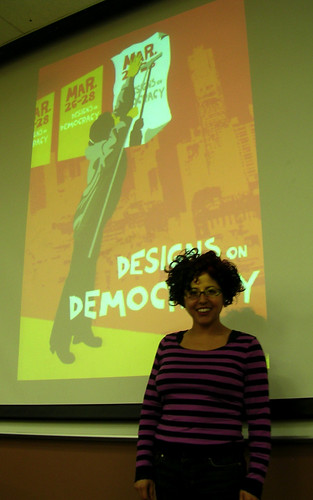 Favianna Rodriguez, co-Founder of the EastSide Arts Alliance (ESAA), stands against the backdrop of her "Designs on Democracy" poster. ESAA is a third world collective of artists and activists working to empower the Oakland, California community through art and culture. Favianna is also the founder of Visual Element, a program that trains young graffiti writers in the traditions of muralism for social change. In 2003, Favianna co-founded the Taller Tupac Amaru, which produces and distributes screenprinted political posters. |
Reproduce and Revolt
Political art has been an integral part of every successful American movement for peace and justice. Art shifts the debate and introduces concepts in ways that words can't touch. It provides tools and inspiration for organizing. Poster art, in particular, is a key tool for media justice and self-determination. It comes from the people, a truly grassroots phenomenon. It defines public spaces and dialogue. It is practical; it moves from store windows to street protests and into all the printed and electronic means of distribution. It is historical, documenting the experiences and accomplishments of the past and always building on previous work.
But political art, used as a tool in the larger social justice movement, is not itself an organized movement. There is no central gathering place for political artists, even on the Internet. Political art is accorded less prestige than mainstream art; it is rare to be able to make a living from it. Young people have inadequate opportunities to be trained as political artists -- and are often discouraged from pursuing this path as Favianna was. People of color, women of color in particular, are underrepresented. And the content of the medium itself is vulnerable. Iconic images are routinely used in ways that are divorced from their history and meaning. Many who proudly wear images of social justice leaders have failed to take the time to learn about them. Some profit commercially from using images without historical context. And the work, as a body, needs to grow in its expression on issues that have emerged in recent decades, such as biotechnology, environmental justice, indigenous rights, sexual rights, and world trade. If there was ever a time to organize the political art movement as a means of offering alternatives to the way we live, that is now, when we find ourselves within an ever-tightening media monopoly.
Favianna is addressing all these movement-building needs in her work with her mix of art, organizing, teaching, and organization-building. While she talked, she showed images: slides of her posters; those of other political artists; work of the high school students she teaches as part of Visual Element, an Urban Graffiti Arts program, and images from an upcoming anthology, Reproduce and Revolt, which will put hundreds of black and white works of contemporary political artists into the public domain for political use. Favianna learned her art through community classes, so now she offers them. She has drawn on the public domain and the heritage of political art for her own work, and so, through Reproduce and Revolt, is expanding public access to both.
One of Favianna's posters depicts a South Korean farmer named Hermano Kyang Hae Lee. In 2002, at the WTO protests in Cancun, farmers and agricultural workers came by the thousands from all over the world, 5,000 or so from Korea alone. Kyang Hae Lee wore, as many of the farmers did, a sign around his neck that read: "WTO Kills Farmers." Farming communities, Favianna noted, are becoming obsolete, pushed aside by corporate agriculture. That day in Cancun Kyang Hae Lee stabbed himself fatally as a protest against the economic policies that were destroying his community and way of life.
The challenge of her work, Favianna said, is to document and humanize without being negative. We have to document our history, she said. The faces looking out from her slides, faces mostly of women (she considers women of color to be her main protagonists), were testimony lending weight to that admonition, reminding us that we can decide to pay attention to their struggles and accomplishments; we can decide to remember them as people and to appreciate their losses and victories. This is an act of self-preservation as well as solidarity. We live in our global economy, where we consume the products grown by dispossessed and displaced farmers like Kyang Hae Lee. We share the same history and challenges.
MILITARY FAMILIES SPEAK OUT
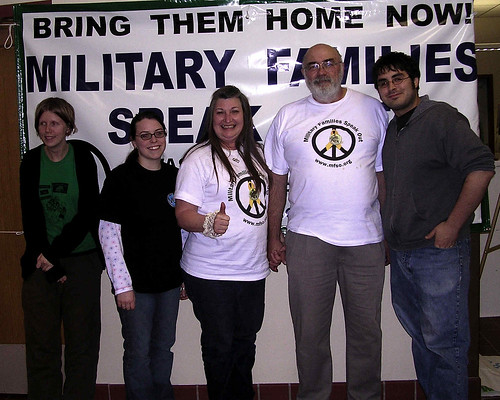 Left to right. Nicki Sabalu (KAOS Community Radio and The Finger Magazine), Abby Cutter of VOX, one of the exhibitors, Lietta Ruger, Arthur Ruger, Ross Mudrick of Campus Progress. |
I've known the Rugers for about two years now through Washblog and they've been instrumental in helping me move into new understandings of military issues in this era of occupation. My lifelong view of military-force-as-predation (with recognized rare exceptions such as WWII), grew more complex as I saw prior to our entry into Iraq how the counsel of top US military advisors would have kept us out. Still, despite its history of backing ill-conceived political aims, there is within the military a profound and resilient drive to keep honor and order. Military conscience and expertise hold potential to help us recover from our current state of permanent militarization.
Lietta began the presentation by differentiating the culture of traditional military families from that of families new to the military experience. Military Families Speak Out (MFSO) has about 3,300 families as members. But many who are opposed to the occupation are not speaking out because they choose the military code of honorable silence. The traditional military culture is proud and idealistic. For many traditionalists, this occupation is profoundly disillusioning, a case of sacred ideals compromised. Even so, they continue to uphold military honor through silence.
Lietta, the coordinator of the Washington branch of MFSO, is from a traditional military background. As a young wife of a soldier fighting in the Vietnam conflict she came to be deeply uneasy about our actions there. But she held to silence even as she was glad that others spoke up. This time around, she feels it is her turn, as a member of the older generation, to speak. "I am extremely disappointed that this is happening again. The people who are old enough to know better should never have let this happen." In 2003 she heeded this call and left her career as a social worker and her pension. She began, first by speaking out during her sermons as an Episcopal lay preacher. In 2004, she appeared on the Newshour with Jim Lehrer. In 2005, before Cindy Sheehan became big news, she joined her in her vigil at Camp Crawford, Texas and travelled for four weeks on the Bring Them Home Now tour. She was one of the organizers for eightmonths of support campaigns leading up to the court martial of Lt. Ehren Watada, the first U.S. Army Officer to refuse orders to deploy to Iraq. She has participated in many media interviews and delegation meetings with U.S. legislators, advocating to bring US soldiers home and to take care of them when they get home.
The Rugers have two returing Iraq veterans in their family, a son-in-law and a nephew. Both are active U.S. Army, have served 15-month extended deployments, and expect to return this this year for new 15-month deployments. Lietta told of her daughter's profound disappointment in 2004 upon learning, on the very last day of her husband's scheduled deployment, that he'd been stop-lossed and would not be coming home to her and their three children for 3 more months. "I worked with her for the whole day," Lietta said, "until she was angry. When she was angry, then I knew she'd be ok."
The presentation moved onto the subject of recruitment in the schools and a member of the audience, asked a question. On the Reservation where she and her children live, she said, some of the teachers double as US military recruiters. Lietta offered to share contact information for groups advocating fair recruitment policies. I was shocked at this poisonous idea of a military recruiter/ teacher.
Then Arthur began. He spoke on the move, walking from one side of the room to the other. Some of my notes defy my attempts to fit them seamlessly in my story here, including something about plans to make a raft of palm trees on the Tigris River to float to Willapa Bay and to change a spark plug by reaching through the tailpipe of a car. And this aphorism: 'To become a neocon and join a think tank, you have to win ten games of Risk.'
Arthur, a social worker with the state of Washington, past president of Local 970 of the Washington Federation of State Employees, current union shop steward, and licensed DSHS translator for Russian and Spanish, is a Vietnam era veteran. He served 6 years in the USAF and 2 in the Army Reserves. Originally trained for priesthood in the Church of Jesus Christ of Latter Day Saints, he is now, like Lietta, a lay preacher at St. Johns Episcopal Parish in South Bend.
The military code says you never leave a person behind, he said. We are doing that now, we are leaving our soldiers behind. We have 33 flags flying on campus here for the Virginia Tech victims. We should have one for every American and every Iraqi who has been killed. What we have in Iraq is a huge, non-Christian genocide. Teddy Roosevelt, a Republican, said that it is traitorous to not dissent. There is a power balance between civilian government, the military, and the people of a nation. When this balance is seriously disturbed, as it is now, we move into dangerous times: "Our nation cannot abide armies of corrupted warriors."
Arthur concluded by reading a letter he wrote to his daughter when she was considering joining the military to fight in Iraq. This letter can be found here on Washblog
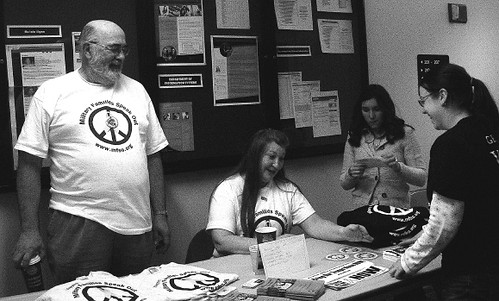
The Rugers talk with conference attendees
IRAQ VETERANS AGAINST THE WAR
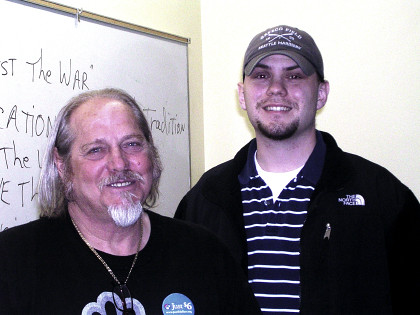 Presenter Dell Hogge on the left. The man on the right, who attended the workshop, is also an Iraq veteran. Unfortunately, I lost his name and contact information. He spoke with Hogge afterwards and agreed with his basic characterization of the on-the-ground reality in Iraq. |
Dell Hogge served in Baghdad, 2003 and is now a student in the VA vocational rehabilitation program at WSU. He began his presentation by leading a group discussion with audience members on reasons that young people join the military. Among those we identified and discussed were patriotism, the desire to defend the country, the desire to carry on family tradition, wanting to see more of the world, wanting to gain skills and education, and the need to earn a living. For some young people, military service is a school that teaches them how to operate in the work world. Hogge depicted soldiers and the US military with pride.
Hogge was born on a reservation and served for 28 years in the National Guard. He was also, he said, "in the war against the Vietnam War", and he left the National Guard during those years to fight against US involvement in Vietnam. But in 1978, with the help of the governor who signed off on the papers, he rejoined and stayed on until going to Iraq in 2003 at the rank of First Sergeant.
Washington's National Guard is one of the best in the country, Hogge said. In 2003 he was in a troop command unit for transportation that had received several awards for its effectiveness. So he knew when we enered Iraq that the unit had a high priority for being called up. All the soldiers in the brigade knew this andwere getting ready to ship out. They were having wills made up, creating family care plans for their children in case they didn't return home. Hogge and some of the other soldiers went to Army-Navy stores beforehand to buy their own protective equipment like vests. They shipped to Iraq on the USS Bob Hope and arrived there the day that "Mission Accomplished" was announced, bringing with them, as required, their their winter uniforms and their winter gear, which made no sense, given Iraq's blistering heat.
Their belief going in was that they were going to a country with WMD's, nuclear weapons, nerve gas. But when they arrived they saw people who had been bombed out, who were living on rats and rice. The Iraqi Army had disappeared. They spent their first night in an ammo dump in southern Iraq, a desolate landscape where desperate people were living in mud huts. There were acres and acres of ammunition. There were no guards and no protection for the soldiers against walking or driving over unexploded ordinance, which was everywhere. Toyata pickup trucks were driving in, filling up with ammo, and driving off. There were no restrooms. Their vehicles were not properly equipped. It was completely disorganized. And hot. And there there was so much dust in the air that sometimes when it rained, red globs of mud fell. There would have been cobras, but the soldiers shot everything that moved. On the second day out, one of the trucks ran over unexploded ammo and the only thing that saved the lives of the men in the vehicle was the fact that they were sitting on MRE (meals ready to eat) packages. Soldiers were undergoing spiritual transitions, hearing voices. One soldier went into convulsions when a smoke cloud drifted his way, thinking that it was a chemical cloud.
Hogge opposed our presence in Iraq as soon as he understood that we weren't there to provide humanitarian aid. Others felt that way, too. Most of these soldiers joined up to be the good guys. They didn't join to invade and occupy another country.
The cameraderie is exquisite. It doesn't matter what your politics or religion are. What matters is that you depend on each other, that you can fix a flat tire under fire. You're family. In this kind of situation you're surviving. You're thinking: 'I'm going to get home.' You might be thinking, "We're going to be heroes." And these soldiers are heroes. One of our Colonels had a plastic leg from the knee down and still was there serving.
Saddam was our guy. We financed his war against Iran. We made sure that he was supplied with chemical weapons. As long as the person who gets the most money gets to be the President, this is what our world will be like. We're fighting this war because we've become a mercenary army in the pay of oil corporations. I worry about these soldiers coming back home and becoming the police chiefs in the local towns, with this mentality of 'kill em all -- and let God sort it out.' This is the culture that created Abu Grahib. The best way to support these troops is to deny the propaganda machine its wars, deny the profit mongers their war profits. We are the people who can change this. We must radicalize ourselves.
Hogge finished up with book recommendations: