Live blogging from the Citizen's Hearing on Iraq
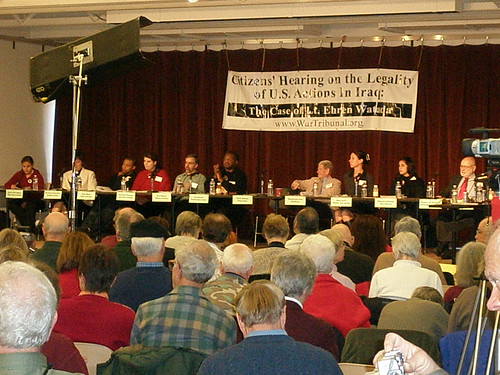
photo by Jason Osgood
'The most difficult thing a person can do inside or outside the military is to think. Lieutenant Watada is causing Americans to think. His stand has forced Americans to think about this war. All Americas have a responsibility to think and to act.' Zoltan Grossman, Evergreen State College faculty member, speaking at the Citizen's Hearing on the Legality of US Actions in Iraq.
Jason Osgood (Zappini) and I just arrived at the Citizen's Hearing at the Tacoma campus of Evergreen State College. 'This an effort for one weekend to set up a parallel citizen's government...' on the legality of the war, says Grossman, as the judge in Lieutenant Watada's case has disallowed the consideration of all substantive issues. U.S. Army 1st Lt. Watada is the first commissioned officer to publicly refuse deployment to Iraq. He is facing a court martial and up to six years in prison.
The panel includes veterans of WWII, Korea, Vietnam war, more recent wars; a Gold Star Family member, a religious leader, a labor leader, a high school student, an academic. Half of the panel members have direct military experience. "At this point in our history, it is particularly important to listen to Americans with military experience," Grossman tells us. Panel members and bios are here.
Lietta Ruger, representing Military Families Speak Out, has just introduced the panel members.
Zappini and I will be tuning in during the proceeedings. I expect (other Washblog writers and editors) Arthur Ruger, Chad Shue, and Pen to be here also, though we haven't seen them yet. It's a big room, filled to capacity, with people in the back and lined along the sides - with limited visibility. My notes, necessarily, will be incomplete. I'm trying for accuracy here -- which can be compared against the complete transcript when it's made available.
Fewer than 1 percent of the people in the nation are carrying 100 percent of the burden of the Iraq war, Grossman says. He quotes Lt. Watada - people coming home from the war feel as if they've entered a society that has no awareness of the war. People are more aware of American Idol. American military members have a unique historic role in bringing wars to an end.
David Krieger, panel chair, is speaking.
 First, this is not a court of law, we are not on trial here. Second, this is not a mock trial of any person. Third, we make no claim of impartiality. But we do make a claim of seeking the truth. Fourth, this is not an official hearing or commission of the US government. No government agency has convened or authorized this hearing. The authority for the hearing stems from the power of governance entrusted in the people. The foundational power of a democracy vests in the people.
Three principal concerns are addressed at this hearing. First, that Lt. Watada will not receive a full and fair trial because he will not be allowed to raise the Nuremberg defense. Second, that the war in Iraq may be illegal, that this deserves close scrutiny, expert testimony, and the full engagement of citizens. Third that it is the right of citizens to oversee the actions of their government, particularly government conduct in matters of war and peace.
This will be conducted in the manner of a hearing held before the Congress. The panel will receive testimony related to the legality of us actions in Iraq. Specifically:
- Does a member of the U.S. Armed Forces have responsibility under Nuremberg, US military law and the Constitution to refuse to take part in an illegal war?
- Is this war illegal?
- Does the ongoing occupation in Iraq constitute a crime against humanity?
- Have the hostilities in Iraq been carried out in such a way as to constitute a pattern of war crimes?
There will be expert witnesses, questions from the audience, deliberations, then the panel will prepare and release its final statement containing its findings which will be sent to every member of the US Congress. (Cheering and applause) We hope they will also be widely distributed by the media throughout the country.
***The hearing has been declared open. Witnesses will be swearing in on the US Constitution.***
Geoffrey Millard is testifying. He has served over 8 years, non-commissioned officer.
He says he's not a legal expert, can't say if the war is legal or not. He thinks of all the training he's gone through, and doesn't remember ever being told he has the right to refuse illegal orders. He has reviewed all the written documentation he has from his career, and finds no right to refuse illegal orders. However, he has been told in training that there is an obligation to do so. 'A right to not follow an illegal order implies implies that we also have the right to follow an illegal order. We were always instructed that if we found an order to be illegal that it was our duty as professional soldiers to refuse it. The first line of our creed states that 'no one is more professional than I.' I personally failed in that duty.' He served for 13 months in Iraq. He did his job, followed orders, filed paperwork, and watched hundreds of thousands of people around him die as he filed that paperwork.'

He says it was not a coincidence that he decided to refuse to serve after Lt. Watada stepped forward. He wishes the US govt. would show the kind of leadership that Lt. Watada has demonstrated.
He was a REMF: Rear echelon mother-fucker, administrative. He wasn't doing the things you see on TV, like soldiers kicking down doors. But working with documentation, including classified information, he saw a much broader picture than soldiers on the ground.
Traffic Control Points (TCP) are set up around the country to control the flow of traffic. Often, people die at these points because you have young, nervous soldiers, heavily armed, in areas with heavy traffic in a country where people drive differently than they do here in the US, where they typically drive fast up to the point they stop. He tells the story of a young soldier who watched a vehicle approach the TCP fast and the soldier had to make a split-second decision. He decided to fire - over 200 rounds into the vehicle-- and killed a civilian family. When the event was debriefed in a room of high-ranking officials, one of them said:
"If these fucking Hajis (people who have completed the pilgrimmage to the Haj) learned to drive, this shit wouldn't happen." That was a big turning point for him in the war. He thought back to his training and interactions throughout his experience in Iraq -- that he had been trained to kill first, that the word, Haji, was a term of respect in Iraq but that the military leadership had turned it into a term of racial dehumanization. The necessity to dehumanize in order to protect ones own -- shoot first to protect oneself and the other soldiers. This attitude goes all the way up the chain of command, it's passed down officially from the division (command/leadership) all through the chain of command. "I would ask that you consider things like this in your deliberation."
(Applause) The audience is given the opportunity to ask questions. Oh, they'll hold questions till after Harvey Tharp, the next testifier.
Harvey Tharp, Former U.S. Navy Lietenant and Judge Adjutant General (JAG) stationed in Iraq. He was the first officer to resign due to the war.
He knew Arabic so was deployed as an area specialist... But he and his cohorts were not Iraq specialists; they knew about Iraq only what they'd read in the paper. There were supposed to be diplomats there, real area specialists, to serve in that role, but there was no security for them and they hadn't arrived yet. So a Navy Dentist was given a high-level diplomatic role, for example, and so was he. He served in that position for 3 months.
During the transfer of the handover of military authority from (French and British to US in a certain geographical area?) there was a rash of human rights abuses. For example, there was one case where an IED went off. It didn't injure anyone in the convoy. But a member of the convoy saw a civilian woman and her children in a bean field, and suspected her. So the soldiers ran after her and she ran away in fear. They shot at her and she was injured, ended up losing a leg. One of her daughters died. He (Tharp) was in the role of investigating this. There was no action taken against the soldiers, as they were determined to be resisting capture under the rules of engagement. The new brigade had not learned yet we were in a primarily peacekeeping role. 'I took that to my commander and asked him to go to the new military personnel that for humanitarian reasons and in order to not create a full-blown insurgency where none had been before.'
When I left, I had 24 Iraqis working for me in the project offices, as I'd had to create from scratch a municipal services -- engineering assessments, bids, evaluate work, make payments. These 24 Iraqis became my psychological support network, my friends. When I left, they threw me a going away party. "I formed deep bonds with this diverse group of Iraqis." A British officer he spoke with at one time observed: the number one problem with the way the US has operated in Iraq is to treat the people there as untermenschen, subhhuman, to devalue the lives of Iraqis. And that's the number one reason we're losing the war. That really stuck with me. That rang true with me in what I saw in the so-called Sunni Triangle. And then the Abuu Grahib pictures came out and I was glad I was back in the states, as I would not have been able to face the Iraqis I'd worked with. It would have been a great shame.
Over the months, I've come to reflect. There was no case for entering Iraq, it had been falsified. We were not benefitting Iraq. Support for our presence there among the people was at 2-5%. Nothing we could do would help the Iraqis; our presence was part of the problem. I was transfered to the national security agency (?) and would have been forced to have taken part as a combatant.
I knew that if I agreed to work in cryptology, I'd be a party to war crimes. So I submitted my resignation. I said the Iraqis were no threat to the US, that we were not benefitting Iraqis. Therefore our presence was immoral and unjust. My resignation was accepted and I was honorably discharged in March of 2005.
Rules of Engagement (ROE) discussion
The rules themselves are classified (can this be true? did I hear right?) so cannot be fully shared.
The first rule is that nothing can take away the inherent right to self defense. They are also trained to start with verbal warnings, then to escalate to a warning shot, only then to shoot to stop, then kill. This is somewhat different from the usual ROE.
Age makes no difference. A child running away from an IED can be considered to be part of the attack and so it would be permissible to shoot that "Haji" child.
Language barrier question: How do you communicate with Iraqis on these matters of life and death?
Response: Even the linguists sent over had a difficult time communicating -- the 'book' language learned was very different from language actually spoken. It causes terror among civilian Iraqis to have their homes broken into in the middle of the night and they can't understand what's being shouted at them. There is a real shortage of translators.
I put my resume on Monster.com and put my proficiency with Iraqi as "limited conversational' and within a day I got an offer of $150,000 to go to Iraq.
Question: why was Harvey Tharp's resignation accepted, but not Watada's?
It's up to the discretion of the unit in charge (I missed this precisely) -- how to treat the resignation. So part of it's discretionary. There was also an element mentioned that Tharp was specifically dealing with issues in the cryptography community and Lt. Watada brought up a broader issue
Panelist asks Harvey Tharp and then Geoffry Millard each in turn two questions: 1.) Do you believe that a pattern of war crimes existed in Iraq that you were personally privy to understanding by your presence there? Would you counsel any individual going to Iraq to do so or not to do so based on your understanding of the war crimes being commmitted there.?
Both answer yes to the war crimes question and say they would counsel people to not join in the Iraq conflict because they would be opening themselves to being involved in committing war crimes.
Millard (I believe [Note on 1/21: Actually, this must have been Tharp, as Millard stated at the beginning that he doesn't want to address this legal question]) added that the war itself is illegal. He cites Article III of Geneva Convention -- the law against overthrowing a legally constituted government. (US government now is not itself a legal one under the Bush administration -- applause from the audience.) The war itself is illegal.
Lt. Watada speaks

Photo courtesty of photographer/thankyoult.org
We're about to break for lunch. Lt. Watada is introduced and makes a brief statement:
Watada says he's here to raise awareness. Government by the people is what must formulate the decisions and destiny of this country. When we join the military, we take an oath to defend this country and its honor. Sometimes that oath comes with a price, and I'm willing to pay that price. It's very unfortunate that the judge has not allowed the arguments you are hearing here today to be heard in my case. Soldiers have a right and duty to refuse unlawful orders. I will not be allowed to present my case that I was acting under this duty. This is a violation of the most sacred premise of due process. It is a travesty of justice. I will fight it. I want the truth to be brought out to the American people. Thank you for being here today. (paraphrase, obviously)
Lunch break.
One of the organizers gets up to explain that there was just a phone conversation with some people in Iraq working with Americans to bring injured Iraqi children to the US for treatment. And the message from the Iraqis was to thank Americans for holding this hearing. One of the children, a 5-year old, was put on the phone and said in Arabic, simply, "I love you."
Daniel Ellsberg is introduced. Standing ovation, clapping, cheering. "Dr. Ellsberg, will you please rise and take the oath on the Constitution?"
 Ellsberg starts out by commenting on Grossman's opening remarks on the critical need for US citizens to think, and the difficulty of thinking, of being aware. And he says this is true, but we're beyond that now. We're looking at new aggression being planned here and new disasters waiting for us (reference I believe to the apparent direction we're heading toward, invasion of Iran and Syria), a double-fold, three-fold escalation. And there is a new challenge here, a challenge to soldiers and citizens that we have never seen before. We are facing not only reckless escalation, as in Vietnam, and not only an illegal criminal action, like the invasion of Grenada or Panama or a single raid against Libya -- but over with soon. But this action is both clearly illegal and protracted. Vietnam was much like this war, but it was not as clearly illegal. Carter and Reagan, after the war, were both able without embarrassment, to call Vietnam an honorable cause.
I think it's fair to say that this has been the most incompetent aggression in the history of Empire. Unlike Vietnam, but like Saddam into Kuwait, like Hitler into Poland, etc., this is a clear-cut aggression. Well described as the pre-eminent of war crimes. What Ehren Watada is focusing on are the constitutional issues really unique to this war. We really have never had such a clear cut challenge in a democracy what to do in the case of an aggression like this. I was watching Fox News and wondered how their coverage differed from the German coverage during WWII. The flag would have been different, but the coverage would have been the same. There were many Germans were very uneasy about that law. They were living under a emergency state. They were no longer under a democracy.
We are not yet a police state, just as Germany was not yet a police state in January 1933, but by June, they were. We may see a major reorganization of what kind of government we have here in the United States.
This is not our first war of aggression. Korea, Gulf War, none of those look like wars of aggression. I don't think many people here know much about the Mexican War. How many people in this room? I see about 20 hands. The personal memoirs of Ulysses S. Grant can be found on the Internet. He's competing for "Worst President of the United States" with George W. Bush. Grant's understanding, when he was a Lieutenant like Lt. Watada, was that he was given orders to deliberately provoke Mexicans so that Polk could falsely claim that Americans had been killed on American territory and then dare Congress to do something about it. Congress was very willing to comply. Except for one Congressman, Abraham Lincoln, who spent every afternoon introducing a spot resolution: "show us the exact location where Americans were killed."
Grant later said of the Mexican War, that it was one of the worst cases of a stronger nation attacking a weaker one. In later years, Grant said he never forgave himself for not having the moral courage to resign.
My life changed when I saw that there were people, like Lt. Watada and like Thoreau, who went to jail over the Mexican war, who were willing to stand up for justice. Thoreau said, when people are committing only small oppressions within the "machinery" of government, it can be tolerated. But when a country is unjustly overruun and conquered by a foreign army, and especially when it is our country committing that act, then it is not too early to rebel.
A majority of Americans are against this war. It takes no courage to oppose it. Like the Democratic Congress of the US with their non-binding resolution. What takes courage is stopping it. Most of the Democratic Congressmembers are ready to let us stay in. But this isn't going to be just more of the same going into the future. These are new kinds of disasters awaiting us, and they're ready to let them take place. And no one is ready to take responsibility for it.
Thoreau said: The thousands opposing slavery and war who hesitate and sometimes protest, but do nothing to stop it, who wait for others to remedy the evil, at most, they give a weak vote. Cast your whole vote, not a strip of paper only. A minority cannot be resisted when it puts its whole weight behind a cause. Lt. Watada has put his whole weight, his career, non-violently and truthfully, his access to information.
I don't discount people who give their partial vote. That is needed too. But it is the people who give their whole vote, their whole weight, who give us hope that we can change the direction of this country and avert these disasters that face us.
Question: What court does have the ability to address the legality of this war?
Congress and the President "fight" over this decision, who decides whether to wage or halt war. But when the question is not just should we have a war, in practical terms, but is it legal, who else should decide that than the courts? If not the courts, then that makes no sense to me. It is not a complex question. Ehren Watada did not have to go to law school to see that this war is illegal. It is new for a court to address this question. But the court can decide to do it. What I would say to the judge in this case: You, like me, should be facing up to what your oath to the Constitution compels you to do.
Zappini has captured some notes on the synergistic effect of investigation and impeachment hearings that Ellsberg has commented on in relation to his experience in the Nixon administration. It's the best argument I've heard in favor of going ahead now with impeachment proceedings against George Bush.
Richard Falk, Professor Emeritus of International Law at Princeton U., etc. Takes the oath on the Constitution
He characterizes this as the most patriotic action he's ever taken part in.
The central question here, does a soldier have a duty and obligation to refuse to commit illegal action? When goverment and international bodies refuse to follow the law, then the people have an obligation to require them to do so.
We must make clear the gap between what is real justice and what appears to be military justice as it is emerging in this case. The rules governing a soldier in time of war have two points of great relevance. First, international law is applicable to the behavior of a soldier in time of war. And second, soldiers have the right and obligation to refuse illegal orders.
Two sections of the Manual of the Laws of Land Warfare: Section 498: Any person.. who commits an act which constitutes a crime under international law' is responsible under the law for having committed that crime -- laws against peace, laws against humanity, war crimes. Section 509: Superior orders are not a valid defense against war crimes. Altho a soldier is normally expected to follow orders, at the same time it must be borne in mind that members of the armed forces are only bound to obey lawful orders.
It seems to me beyond all reasonable doubt that this military officer acting as a judge has put Lt. Watada in a totally untenable position. It is tantamount to an order to serve in the Iraq war. Therefore, he is being ordered to do something he has every reason to believe is implicating him in the gravest crime against peace imaginable. He has no opportunity to raise this issue in the case. This action of the judge is such a blatant offense against justice, it becomes a crime in itself. Even Kafka did not have such a macabre imagination.
If the law were being upheld on an international basis, our President, Vice President, and many others in the US government should be criminally indicted. (applause and cheering)
What Watada's case implies is that all who have the opportunity to stand against this war, have the Nuremberg obligation to do so. This war of aggression, which is daily killing Americans and many Iraqis, is of such urgency, that opposing it is a duty of all citizens; all persons should take what actions they can to stop this aggressive, criminal war.
Professor Benjamin G. Davis, Assoc Professor of Law at U of Toledo, expert on the law of war
He distinguishes domestic and international law. Watada, on grounds of domestic law, should seek again to have his question heard, even before this judge. People have a right to have their defense heard, though a judge can rule a defense inadmissable. This case may go to the Supreme Court. We may have a Watada Supreme Court case, though I'm not sure the Supreme Court will be willing to address questions that have this political element.
In international law, we are addressing crimes against humanity. We have cases of rape, murder, torture in this war. We have to bring forward the evidence of those things. We are also addressing questions of the legality of the war. There are grounds to hear that question too; the evidence must be brought forward. There was some argument for entering Afghanistan as a defense against the actions on 9/11. But we don't see any possible argument that can be made for our actions in Iraq. And there is also the element of proportionality which comes into this in international law. How can our actions in Iraq be said to be proportional to the provocation on 9/11?
There is a key tenet in international law that no state can take advantage of its internal law to break international law. And we see efforts going on in German and Italian courts to look at the legality of the actions of US officials such as Rumsfeld (Germany) and to look at some of the cases of extraordinary rendition (in Italy).
He runs through a number of grounds on which people can be prosecuted --- and shows the ways they can be evaded. He gives a number of historical examples. In this system, don't look to the courts to look for a great deal of help. It comes down to individual citizens to pressure Congress and the executive. The burden, I'm sorry to say, rests with you citizens. But perhaps you can take some courage from Lt. Watada.
Questions
Falk says, in response to a question, that the refusal of the court to hear Lt. Watada's defense is a grave violation of his humanity. But it speaks to perhaps a healthy understanding that the Iraq war is indefensible. Davis adds that there is a pattern in all these challenges to the legality of the Iraq war to avoid judicial review.
Reverend Stanovsky of United Methodist Church, a panelist, says she appreciates the issue of proportionality being brought up. This is a key concept in the Christian Just Law doctrine. Davis discusses a number of historical situations where disproportionate response was clear and then emphasizes that it is not always easy to determine.
Falk says that US military law is largely grounded in the Christian Just Law tradition.
A panelist asks, what is the legality of the war in Afghanistan and Falk says there's much debate on that. But emphasizes the way that Al Qaida and Taliban combatants were put into a legal limbo -- that this put our country in a bad position (administration member, William Taft IV, is an unsung hero who counseled otherwise and was cut out of the deliberations). Falk links this with the Abu Graihb tortures and says that when the photos came out, that could be said to be the point at which we definitely lost the war.
Falk: why was the response to 911 one of war, instead of a response to a crime? If we look back in history, this may turn out to have been our greatest mistake. The characterization of the response as war mobilized the whole country into submission to the President's (dictates) -- enabled the neoconservatives, and it also instituted military action geared toward global military domination by the United States. That weakened our response to terrorism.
Falk: There have been arguments that a war can be illegal, but legitimate, that there's so much acquiescence to it that the acquiescence itself lends legitimacy. That is why citizen opposition is so critical. I talked with someone who fought in the French Resistance and asked why he fought. I expected something complex in response but what he replied was, simply, it was impossible in France -- it was just impossible to allow the Nazis to rule there. That is what is needed from the American people. This cannot be done, we simply cannot allow it.
David Kreiger asks Falk -- does Article 509 of the military manual you cited clearly provide a legal requirement for soldiers to refuse to follow illegal orders? Falk answers, yes, Lt. Watada is doing exactly what he should be doing as a loyal member of the US Armed Forces. Kreiger asks, as a followup, those soldiers who have a similar understanding but continue to participate, are they violating the law? Falk answers, yes. Kreiger asks, is there a legal obligation of citizens to inform each other and the military on the illegality of the war? Falk: yes, it is incumbent as citizens who are politically, legally, and morally responsible for maintaining a constitutional form of government, they have an obligation to fill the institutional void left by Congress.
Davis -- unless we do act now, 50 years from now there will be an apology issued to Lt. Watada. That will be the so-called "American solution" to injustice. It would be much better to do justice now. Kreiger asks is justice for Lt. Watada tantamount to justice for the American people? Davis: yes, I would say he is in the finest tradition of American honor. Krieger: is justice for Watada also justice for the Iraqi people? Davis is less definitive here. Justice in this case is part of the process of unravelling a "horrible, mega FUBAR-type (fucked up beyond repair/recognition) sitution."
Another 5-minute break. At the end of it, an organizer speaks from the front: 'We want you all to go home and write to Patty Murray and Maria Cantwell and your Representatives and tell them that you were here and that they need to act to get us out of Iraq.' This theme comes up again and again -- more civilians need to back up Lt. Watada and other soldiers; they should not bear such a burden to oppose this war.
Retired Army Colonel Ann Wright
 She served for 3 1/2 decades in the US military and there were many times she did not agree with US policy in one way or another during that time. But she always found some thing, some place, within the military where she could serve. But after 2001 as she listened to the debate she knew that invading an oil-rich Arab Muslim country that had nothing to do with 911 would do nothing for US security, in fact would jeopardize US and global security. And she wrote letter after letter. Finally, it was necessary to resign.
At the time of her resignation, she was stationed in Mongolia. Why was she affected there? Well, when the US Governnment tells its diplomats to vote against UN Article 98 (legal basis for war) -- arm twisting, blackmailing, tp vote to exempt Americans from the jurisdiction of the international criminal court, these things really concerned me.
But also, I had taught (US military) classes in the Laws of Land Warfare. And under that law, we have obligations to the people in the countries that we have occupied. As you know after we took over in Iraq, the people there were faced with an ever-accelerating diminuation of all the things that keep people alive -- health care, water, food, sanitation. Was the war legal? No. Was it prosecuted in compliance with international law? No it was not. And to put the people of Iraq in such a dangerous position as far as physical survival and security, that is a multitude of war crimes. Our actions are, in effect, torture.
What was that when we swept up all those civilians and did not follow Geneva conventions? Our own military advised the administration that this put our military forces in danger. We do not have a good standing in the world now. It is as low as is possible -- until the Bush administration cooks up some new outrage. This administration has done everything to undermine the troops.
 But let's get back to torture. Bush, Cheney, Rumsfeld, Powell -- who did not stand up when he should have. They created the environmental conditions that led to torture. And there are individual acts. I don't say this lightly, I am an officer, a retired officer. These people have done criminal acts and they must be held responsible or they will continue and continue and continue. And if we don't hold this administration responsible, the next administration will do the same.
Finally, in 2004, with the Abu Graihb photos, the US public found out what we were doing. 95% of the people in Guantanamo now, we paid for. The US pays $5,000 for the capture of a suspected Al Quaida, for example. These people are in slavery. Thhere were (500 something) people in Guantanamo (that have been released?). Only one was charged with a crime. These people were taken off the streets. Now there are 383 people in Guantanamo. We're told that 80-90, tops, will be even tried. There are thousands of Iraqis in jail in Iraq. We don't know about them. It is critical we find out: who is being tortured right now in Iraq? Who is being tortured in the forgotten war in Afghhanistan? I don't think the President of the United States is being honest with us. I think there are many more people in captivity.
Guantanamo is the "show place". Worse things are happening in Baghram. And it's still going on in Abu Graihb.
She comments on the revocation of habeus corpus in the United States (I could never have imagined I'd ever write those words.) She says we must put pressure on this Congress to repeal the military commissions act.
We must have oversight hearings on the legality of this war in Congress. But what happens to all those prisoners in Iraq? Is there any system to move them through? How is this dilemma resolved, that anyone who shoots at us as a foreign invader is thrown into the clinker? It's a dilemma we must solve first by getting out of Iraq. It's a dilemma we solve by people like Lt. Watada standing up. Lt. Watada tried to resign twice and was prohibited. He had to face a court martial. For me, when I resigned, I simply lost a job. Lt. Watada is in real danger of going to jail. This should not fall on the shoulders of the military to stop an illegal war. It's the responsibility of all Americans. We must ensure that members of the US military are not put in the position of being ordered to carry out crimes against humanity and illegal war.
Staughhton Lynd -- question
He notes that he is not, as noted in the program, an academic: "that was a casualty of the Vietnam War." He differentiates between pacifists opposing war and soldiers opposing it. In Lt. Watada's case, there is likely to remain this pressure to suppress his speech, because of his position. What do you characterize as Lt. Watada's responsibility vis a vis "conduct becoming an officer?"
Colonel Wright responds. This is the heart of this matter. Conduct becoming an officer: take care of your troops, keep themm out of harm's way, there is the obligation to explore with your chain of command and understand what's going on. We see here a failure of Lt. Watada's chain of command all up the line. We did have one four-star general who spoke out, General Shinseky. He did not speak out against the war, per se, but against how it is being prosecuted. The military is not one monolithic group. There is great debate going on within the military. However, it is not right that it is a lieutenant who is taking the heat for this. We should have had officers at higher levels standing up like this. We've had retired generals speaking up. That's a bit late.
A question from a member from Military Families Speak Out about the treatment of Iraqi civilians. Colonel Wright answers that it is necessary, beyond reasons of ethics and human rights, to treat civilians well. That is a step toward prevailing in military actions on the ground. We have not even begun to do what we should for the people of Iraq.
Panelist Zeek Green of ILWU notes he represents himself, not his union, asks about the lethargy and apathy of the American people. Colonel Wright notes what a small percentage of the population is carrying this burden. Most American lives are not affected. Every church should be ringing its bells at noon. Every union could be organizing a daily walkout (for part of the day, didn't hear, an hour?) All Americans can do their part.
Panelist Lyle Quasim asks, we are addressing 4 matters in this tribunal. The fourth has to do with crimes against humanity.
There is a degradation to the air, the water, the land. I want to include that in the indictment. In your pedagogy, do you reference those kinds of things?
Colonel Wright answers, in regard to how the degradation of the air, land, and water affect human beings, that does relate to military law. It is part of Lt. Watada's considerations. And it is a current, critical issue in Afghanistan.
Panel Chair Kreiger asks, is the Military Manual of Land War a legally binding document on military personnel? Colonel Wright answers, yes. Krieger asks, there is a pattern of this administration acting to exculpate itself, hiding behind its own military and soldiers. Do you see that. Colonel Wright answers yes.
At this point my laptop battery died. Added later:
Denis Halliday, Former UN Assistant Secretary General, coordinated Iraq humanitarian aid
 My own energy had about given out by now, just like the battery for my laptop. Halliday spoke of how the UN has also failed the people of Iraq and the United States - both during the long era of economic sanctions against Iraq and in the lead up to and during the Iraq war. It was a moving presentation, and I could absorb only so much, after the emotional impact of the rest of the day. He noted that the five permanent voting members of the UN Security Council are countries that, in aggregate, produce 85% of the world's weapons. I don'ty remember if he said this, or if it was my interpretation: structurally, in the governance of this world, we are set up to make war, not peace.
| < Gregoire Pushes for Rainy Day Fund | We Were There: Thoughts on getting away with talking mean about the government > |


PNW TOPIC HOTLIST


Recommended Diaries
- Eye Candy from 08 Pride Parade
A girl has to have SOME fun. Above, 34th District Obama delegates Dinazina (moi) and Jody Rogers. This year I
By dinazina (7 comments) - It's election day somewhere.
The sun is hot and the calendar pages are flipping slow And so am I Election season passes like molasses in
By chadlupkes (3 comments) - Democrats MUST quit using Republican framing
I have been tearing my hair out reading all the nitpicky squabbling in cyberspace about minor differences in the platforms and
By eridani (7 comments) - On How The State Gave Me MRSA (Part II), Or, What, Me Worry?
We began a story this week that describes how poor clinical practice in a State-operated healthcare facility holds the potential to
By fake consultant (14 comments) - Dina Johnson for Obama Delegate!
I want to go the National Convention as an Obama delegate, and I understand the competition to be elected state delegate
By dinazina (49 comments) - Winter Soldier Hearings and More
OP-ED sent to Walla Walla Union Bulletin
By buddy georgia (9 comments)
Recent Diaries
By moirao (3 comments)
By Pen (0 comments)
By dlaw (1 comments)
By m3047 (2 comments)
By fake consultant (2 comments)
By fake consultant (1 comments)
By fake consultant (1 comments)
By Damn It Jim (0 comments)
By fake consultant (1 comments)
By Brian (2 comments)
By fake consultant (3 comments)
By eridani (0 comments)
By m3047 (7 comments)
Related Links
+ Daily Kos+ Citizen's Hearing on the Legality of US Actions in Iraq
+ here
+ Lietta Ruger
+ Military Families Speak Out
+ Washblog
+ the Nuremberg defense
+ photograph er/thankyoult.org
+ Manual of the Laws of Land Warfare
+ five permanent voting members
+ More on Military
+ Also by noemie maxwell
Washblog RSS Feeds
Political Contacts
Local Media
 Coastal/Grays Harbor
Aberdeen Daily World
Chinook Observer
Montesano Vidette
Pacific County Press
Willapa Harbor Herald
KXRO 1320 AM
Olympic Peninsula
Peninsula Daily News
Bremerton Sun
Bremerton Chronicle
Gig Harbor Gateway
Port Orchard Independent
Port Townsend Leader
North Kitsap Herald
Squim Gazette
Central Kitsap Reporter
Business Examiner
KONP 1450 AM
Sound and Islands
Anacortes American
Bainbridge Review
Voice Of Bainbridge
San Juan Journal
The Islands' Sounder
Whidbey NewsTimes
South Whidbey Record
Stanwood/Camano News
Vashon Beachcomber
Voice Of Vashon
KLKI 1340 AM
North Puget Sound
Bellingham Herald
The Northern Light
Everett Herald
Skagit Valley Herald
Lynden Tribune
The Enterprise
Snohomish County Tribune
Snohomish County Business Journal
The Monroe Monitor
The Edmonds Beacon
KGMI 790 AM
KELA 1470 AM
KRKO 1380 AM
Central Puget Sound
King County Journal
Issaquah Press
Mukilteo Beacon
Voice of the Valley
Federal Way Mirror
Bothell/Kenmore Reporter
Kirkland courier
Mercer Island Reporter
Woodinville Weekly
Greater Seattle
Seattle PI
Seattle Times
KOMO TV 4
KIRO TV 7
KING 5 TV
KTBW TV 22
KCTS 9
UW Daily
The Stranger
Seattle Weekly
Capitol Hill Times
Madison Park Times
Seattle Journal of Commerce
NW Asian Weekly
West Seattle Herald
North Seattle Herald-Outlook
South Seattle Star
Magnolia News
Beacon Hill News
KIRO 710 AM
KOMO AM 1000
KEXP 90.3 FM
KUOW 94.9 FM
KVI 570 AM
South Puget Sound
The Columbian
Longview Daily News
Nisqually Valley News
Lewis County News
The Reflector
Eatonville Dispatch
Tacoma News Tribune
Tacoma Weekly
Puyallup Herald
Enumclaw Courier-Herald
The Olympian
KAOS 89.3 FM
KCPQ 13
KOWA FM 106.5
UPN 11
Cascade/Okanogan
Ellensburg Daily Record
Levenworth Echo
Cle Elum Tribune
Snoqualmie Valley Record
Methow Valley News
Lake Chelan Mirror
Omak chronicle
The Newport Miner
Spokane/Palouse
The Spokesman-Review
KREM 2 TV Spokane
KXLY News 4 Spokane
KHQ 6 Spokane
KSPS Spokane
Statesman-Examiner
Othello Outlook
Cheney Free Press
Camas PostRecord
The South County sun
White Salmon Enterprise
Palouse Boomerang
Columbia Basin Herald
Grand Coulee Star
Walla Walla Union-Bulletin
Yakima Herald-Republic
KIMA 29 Yakima
KAPP TV 35 Yakima
KYVE Yakima
Wenatchee World
Tri-City Herald
TVEW TV 42 Tri-cities
KTNW Richland
KEPR 19 Pasco
Daily Sun News
Prosser Record-Bulletin
KTCR 1340 AM
KWSU Pullman
Moscow-Pullman Daily News

