How KC Does Mail Ballot Processing
The following is a fair approximation of how mail ballot processing occurs in King County Washington in 2007. (Your county's mileage may vary, but not by much.) This information lays the groundwork for understanding how use of Election Trust's (nee VoteHere's) Mail-in Ballot Tracker threatens the integrity of our elections.
This description will be expanded, updated, and corrected as able.
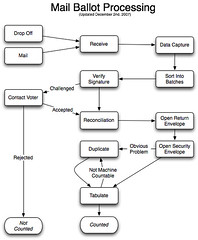
Voters add a stamp to their return envelope and drop their ballot packet into the mail.
Drop Off
Voters drop their packet off at a poll site or at the county court house.
Receive
Mail ballots are held at the post office and picked up by REALS. The privacy flap, covering the voter's signature, is manually removed. [verify]
Currently, loads of ballots are taken offsite to a contractor (PSI Group) for scanning, sorting, and batching. In the near future, these tasks will be done in-house at the new election center in Renton.
Processing time: pickup daily
Data Capture
Return envelopes contain barcodes identifying the voter, their precinct, and the current election. This data is captured, tracking which ballot is which batch, to be used later during signature verification and reconciliation.
Sort Into Batches
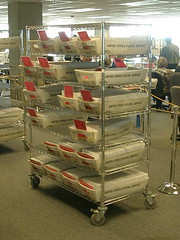
As they are received, ballots are sorted by legislative district. Ballots are then partitioned into batches. Batches are given a unique identifying number.
Batch size (count) is limited to the number of ballots that can fit into a standard postal service mail tray. For general elections, that's 200-250 ballots per batch.
Processing time: 1 day
Verify Signature
The voter's signature on the return envelope must be compared to the signature on file. This task is semi-automated.
A human verifier holds a batch (tray) of mail ballots. Signatures are displayed on a computer screen. The verifier visually compares the signature on the return envelope with the signature on the screen. If the signature does not match, the ballot is "challenged", the envelope is removed from the batch and forwarded to Contact Voter.
The signatures shown on screen come from voter registration cards. Using the previously captured data, signatures appear in the same order as the ballots in a batch.
Processing time: ~20 minutes per batch
Contact Voter
When a ballot has been challenged, REALS attempts to contact the voter. The voter then has an opportunity to verify or correct their signature. Voters have until the certification of the election, 21 days after election day, to respond.
Accepted ballots are rebatched and then processed further.
Rejected ballots are not counted and get archived.
Reconciliation
Once a voter's signature has been accepted, the voter is credited with voting. This is called "reconciliation"
Being credited with voting does not guarantee the votes were counted.
Processing time: automatic
Open Return & Security Envelopes
In an attempt to preserve voter privacy, the return and security envelopes are opened in separate steps by different workers.
The security envelope is removed from the outer return envelope and placed back into the tray. The return envelopes are archived.
The ballot is removed from the security envelope and placed back into the tray.
Washington State is a "voter intent" state, meaning that a voter does not lose their right to vote if a mistake is made. Therefore, each ballot is inspected, to ensure can be machine counted. Ballots which cannot be read by the tabulator are removed from the batch and sent to Duplication.
Possible reasons a ballot requires duplication include stray marks, the voter made changes, damaged ballots, etc.
Processing time: ~40 minutes per batch
Duplication
A ballot is manually duplicated, the valid votes copied from the original ballot to a new ballot, by a team of two humans. First, human A reads the votes while human B completes the new ballot. Next, they swap ballots. Human B then reads the original ballot while human A verifies the choices on the new ballot.
A control number is added to both the original and the new ballots. This allows referring back to the original ballot, if needed. The original ballot is archived and the new ballot is rebatched and sent to Tabulate.
Voter intent is determined per the Secretary of State's published guidelines [VI]. If there are any questions, ballots are forwarded to the Canvass Board for resolution.
Processing time: ~40 minutes per batch
Tabulate
For the central count, King County uses Diebold's AccuVote OS mark sense ballot tabulators with the Diebold AccuFeed add-on unit. Currently, up to 40 units are used during an election. Each unit is networked to Diebold's GEMS software.
There are two humans per unit. The ballots are taken from the batch's tray and placed into the unit. Counting continues until a ballot cannot be machine read. Counting then stops to try to resolve the problem with the unreadable ballot (e.g. try all four possible orientations). Unreadable ballots get removed from the batch and forwarded to Duplicate. Counting then resumes. [Verify this.]
Processing time: ~20 minutes per batch
Batch Handling
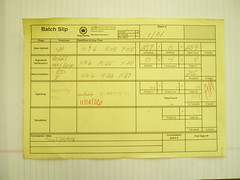
Batches are held in secure storage ("the cage") between processing steps. At every processing step, a batch's ballots are counted and the number recorded on a batch processing slip.
Open Questions
Are ballots scanned then sorted, or sorted and then scanned?
When are envelopes with late postmarks rejected?
What are all the circumstances when a voter will get credited with voting, but their votes not counted? Returning the wrong ballot, using the wrong envelope, missing security envelope, voters sign wrong envelope (wife and husband swap envelopes)
How does reconciliation prevent voters from voting more than once? What is the precedence? Mail ballot trumps provisional? Reissued ballot trumps original ballot?
When are write-in candidates canvassed? During duplication?
TODO Items
Glossary
Add citations to RCWs, WACs
References
[VI] Voter Intent: Statewide Standards On What Is A Vote (Revised 2007)
Acknowledgement
| < Resolution on election integrity endorsed by over 200 organizations | Flooding devastation and help needed: Lewis County, WA > |