Reckless Plan to Buy Diebold's New Ballot Counters [Updated]
I'm told that yesterday's hearing will air on KCTV today at 3:30pm.
http://www.metrokc.gov/kctv/
Be sure to watch the first testimony given. "Raincity Calling" was on fire, her message was spot on. The debate was over right then and there. Everything after her was gravy.
This hearing was a huge success for democracy. Thirty people, including Senator Eric Oemig, showed up to oppose King County Election's plan to buy Diebold's new ballot counters.
Feedback ranged from deep reservations to impassionated outrage that our county was going to buy more Diebold equipment. All of our major talking points were covered (too risky in a Presidential year, fallacy of early results, etc). No one spoke in favor of the business plan.
Also present were 10 representatives from King County Elections, members from the Citizens Election Oversight Committee, and some staff.
- New tabulators will not yield faster election results. Because you cannot count ballots you have not yet received.
- Multiple changes to our elections over a short time period, just before a Presidential election, stresses the system and is too risky.
The press release is below the fold.
Details about today's public hearing are posted online.
The hearing begins at 6:30pm in the King County Council's chambers. Enter the building on 3rd Ave. Show up early (6:00pm) to sign up and testify.
Support for our major talking points are below. We'll provide detailed talking points at the hearing. (Which will be posted here afterwards.) Each activists is encouraged to testify about the facets (issues) they believe most important.
News Release/Media Advisory
Washington Citizens for Fair Elections objects to Diebold purchase
Citizens Election Oversight Committee public hearing
For Immediate Release: May 13, 2007
Contact:
Jason Osgood
206-784-9416
zappini@gmail.com
Washington Citizens for Fair Elections says King County Elections' plan to purchase new Diebold ballot counting system is reckless.
As reported in the Seattle Times, April 24, 2007, King County Elections plans to purchase brand new, untested and as yet, not federally certified, Diebold "high speed" ballot scanners to "support next year's planned move to all-mail voting." According to the Times, Sherril Huff, the King County Elections Director, states that the new Diebold systems are "the solution with the least amount of risk."
Citizen activist group, Washington Citizens for Fair Elections disagrees. We believe converting to this brand new, untested technology, is reckless in the run up to the 2008 presidential election. Furthermore, the technology will not fulfill KCE's stated purpose for the purchase which is to allow it to "report a high percentage of results on election night."
KCE hopes to move to all-vote by mail in time for the 2008 presidential election. If it follows through on this plan, it will require significant changes to the current election procedures and processes over a compressed time period. These changes include a move to a new facility, a new elections director managing her first presidential election in King County, brand new technology (most of which is not yet certified), voting centers using only Diebold touch screen voting machines, electronic poll books rather than standard paper poll books, provisional ballot voters voting on touch screen voting machines instead of paper provisional ballots, and new ballot processing procedures. These changes also require developing new policies, procedures, and providing new training to all employees. Making so many significant changes in a presidential election year adds stress to an already stressful situation and is fraught with risk. This is like a person getting married, moving to a new city, taking on a new job, having a baby, and losing a parent all in one year. It will cause significant stress and a much greater likelihood of mistakes and problems. The 2008 presidential election year should not be the year to take on this level of change and stress in addition to making King County the test county for new technology.
KCE asserts that new high speed tabulators are necessary in order to "report a high percentage of results election night." According to Jason Osgood, a spokesperson for Washington Citizens for Fair Elections, "what KCE doesn't mention is that ballots that have not yet been received cannot be counted. Since approximately two-thirds of mail-in ballots are not yet received or processed as of election night, high speed tabulators will not lead to a high percentage of results election night. Instead, like in all years past, the vast majority of mail in ballots cannot be counted until days after election night."
KCE does not have to add undue risk to our 2008 presidential election. It should delay purchasing any new equipment and software, but especially untested, uncertified equipment and software in this crucial election year. There is no good reason why KCE can't operate with its current 600+ optical scan ballot counters.
Washington Citizens for Fair Elections intends to address its concerns at the May 14, 2007 Public Hearing before the King County Citizens Election Oversight Committee
http://www.metrokc.gov/mkcc/committees/elections/hearing.htm
Fallacy of Early Results
Most mail ballots are received on or near election day. That means they aren't available to count on election day. This graph posted on the Secretary of State's website shows the daily mail ballot returns in Spokane and Pierce Counties for the general election November 7, 2006.
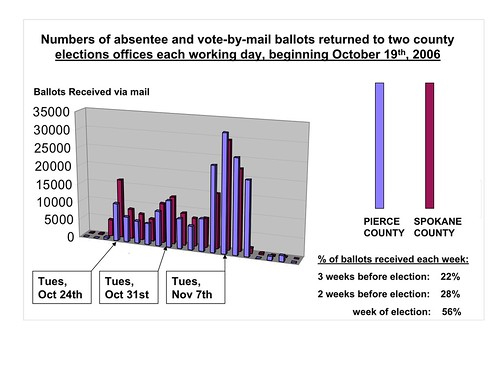
(Original pdf here.)
Here's the graph for King County's daily mail ballot return, also for the general election Nov 7, 2006.
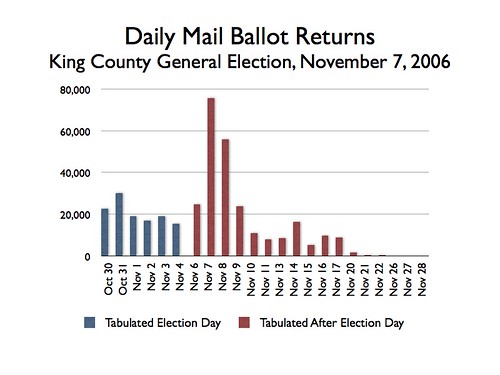
The bluish numbers represent ballots that are ready to be tabulated on election day (Nov 7). The reddish numbers represent ballots that are counted after election day.
When mail ballots are received, they must be sorted into batches (offsite by PSI Group), have the voter's signatures verified, reconciled (voters credited with voting), be opened (to remove the ballot), squished flat, and then finally tabulated. During crunch time, in King County, start-to-finish, these steps take three days.
Notice that ballots received Nov 6th are not ready to be tabulated until Nov 9th. Maybe it'd be clearer if I overlayed a graph of when ballots are tabulated. I've been trying to figure out how to represent (graph) how batches progress through the system. (If someone is a graph ninja, I'd appreciate the help.)
We've been analyzing data taken from the King County's batch accountability records. The lifecycle of each batch of ballots is tracked, showing when each processing step is done and how long it took.
The Real Bottlenecks
People in the know have confirmed that tabulation is not the bottleneck. AJ Culver, member of CEOC and former chair, called that thinking "a red herring" during one of their meetings.
The first bottleneck to election results is the mail. You can't count ballots you haven't received.
The next biggest bottleneck, surprisingly, is envelope opening. A typical batch contains 250 ballots. Opening takes 2 full hours per batch. I don't fully understand the batch accountability spreadsheets, but it looks like there were roughly originally 1,500 batches for Nov 7, 2006. (More batches are created when ballots are pulled for duplication.)
Comparatively, all the other processing steps are much faster. Signature verification takes about 30 minutes. Actually tabulating a batch takes about 20 minutes.
Nothing in King County Elections Vote By Mail Transition Plan or Highspeed Tabulator Business Case addresses the actual bottlenecks. Rather, they intend to spend roughly $5m optimizing processing steps which are already pretty fast.
Very interesting.
[Updated: The SOS's graph shows Spokane County, not Snohomish County. My bad.]
| < Jackie Minchew for Everett City Council | Adam Smith questioned by seajane > |