Leadership Transition at Justice Works!: A Conversation with Kathya Alexander and Lea Zengage
Kathya Alexander, Justice Works! new Executive Director served as Resident Manager and later Vice President of the Board of A Woman's Place in Champaign Illinois, one of the first domestic violence shelters ever opened in the country, if not the first. She worked directly with women as a counselor at the Eastside Domestic Violence Program in Bellevue. She was Director of Student Life of Parkland College in Illinois, which had over 10,000 students. She served as Employment Director at The Urban League of Metropolitan Seattle. She was most recently Manager of Rainier Valley Cultural Center. | ||
L: Lea Zengage, Founder and Executive Director of Justice Works! R: Kathya Alexander, Justice Works! new Executive Director | I met with Kathya Alexander and Lea Zengage at Justice Works! (JW!) headquarters and Gift and Thrift shop on Rainier Avenue in Seattle. Kathya had just accepted the position of Executive Director of this grassroots criminal justice reform organization. Lea, after nearly a decade as Executive Director, is stepping down. The two women will work together for several months for a smooth transition. Lea will stay with Justice Works! as an organizer.
It's a milestone for the organization. Lea has served without pay since JW! was founded in 2001 under the name, Justice Passage. Kathya, a founding member of JW!, will be paid. The shift to new leadership - and the paid staff position are signs of the organization's growth. | |
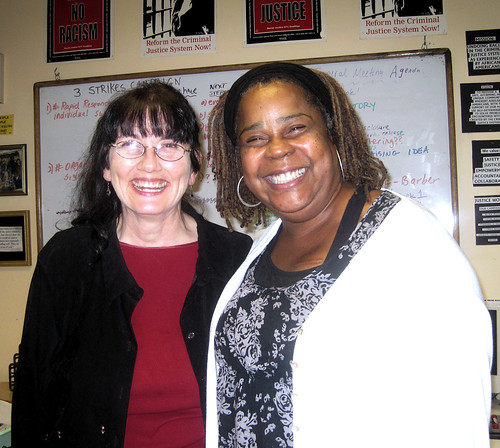
"When we started," Lea said, "there were people who were very clear with me about all the reasons this couldn't work. I was told many times that you can't run an organization on 100% volunteers. But, yes you can!" Kathya, sitting across the cafe style glass table, laughs and repeats the phrase from the Obama campaign: "Yes we can!" And the two women laugh together.
Justice Works! defies conventional wisdom in other ways. Grants provided much of the organization's funding in earlier years, but in recent years, no grants have been sought. Funding comes from sales at the Gift and Thrift shop and the many small donations that Justice Works! receives from its base of supporters.
The shop, a program of JW! Business Sendoff Project (BSP), was set up in collaboration with a previously incarcerated person, providing her the opportunity to learn the steps needed to establish and run a business. It now provides - in addition to funding for the organization - a hub for JW! organizing work and a resource center for the community. A barbershop now in the early planning stages will provide income for the previously incarcerated person who is participating as JW! BSP student - while also providing additional donations to support the work of the organization.
Kathya takes the helm of an organization that now is rooted more firmly in community, thanks in part to her work on the first JW! board. Outside-In, a monthly newsletter that was started in 2004, now goes to approximately 700 people incarcerated in all of Washington's prisons. A letters to the editor campaign headed by Shirley White, the mother of a 3-Striker, has resulted in nearly 600 letters published in newspapers throughout Washington State since late 2004. Observers working through JW! Court Watch program have been present at dozens of court proceedings of defendants who requested their presence. Over 400 incarcerated people have worked with outside partners to complete ROOTS correspondence courses in subjects ranging from African American literature to balancing a checkbook and other life skills needed for successful transitioning from prison to the community. (About a third of the ROOTS classes were created by incarcerated people). Organizing work through events, doorbelling, phone calls, and email has resulted in thousands of contacts made to legislators and other public officials. With others, JW! organizers worked to support legislation that successfully restored voting rights to thousands of previously incarcerated people in Washington. Since passage of that law, JW! organizers have done outreach resulting in approximately 1,000 newly eligible people registering to vote. Nearly 2,000 individuals, from every legislative district in the state, have joined the organization's 3-Strikes Rapid Response system - which mobilizes during the session to support reform legislation.
INTERVIEW
Noemie Maxwell (NM)
Lea Zengae (LZ)
NM
Kathya Alexander (KA)
It was another transition time for the organization. The original mission and vision of the organization had never been written down. We got together to put it down in writing to protect it. I remember standing in front of a blackboard, writing it down.
LZ
KA
LZ
NM
KA
LZ
NM
KA
NM
KA
I am so excited and so thrilled to be part of this oganization.
NM
LZ
I also plan to do a lot of writing. I have a unique set of experiences as a woman born into one part of the culture - and then, through JW!, being honored to be taught about other life experiences. I think this enables me to be a bridge in the way that I understand certain issues and problems. There are not many people fortunate enough to know both of these worlds so intimately.
KA
Really, Lea should take a well-needed rest. But I'm glad that she's not going to. I don't know if I would have taken the job if she were not going to be actively engaged in the transition. I know that I need her. At the same time, I know how hard and dogged and dedicated she has been in this work. I'm looking forward to helping her take a break when the time comes.
|
| < I-1098 & Federal Income Tax Deduction? | You've got the "We Got Nothing Party" and the "We've Got No Spine Party" > |
PNW TOPIC HOTLIST

Recommended Diaries
- Free Speech for People moves forward in Washington State
At my urging, Senator Jacobsen has introduced a Senate Joint Memorial asking for Congress to submit to the states a Federal
By chadlupkes (365 comments) - State Budget Craters By $2 Billion More. The Good News Is....
... Now Progressives are going to have to stop talking about tax hikes and start talking about the value of government.
By dlaw (1435 comments) - Why Aren't We Fighting for a State Income Tax?
I am getting really tired here: I've been asked to sign petitions and send emails by almost any advocacy group that
By ktkeller (595 comments) - We Want to Take You and We Will Nyah Nyah
Last week I'm watching a podcast of Monday's House Local Government and Housing Committee because I'm interested in the Executive Session
By ktkeller (1286 comments) - Online Voting Rights for Overseas Military Personal
Having been deployed during an election I have some very passionate views on this issue. I have seen my friends simple
By dorsolplants (765 comments) - A Modest Proposal: How to Cut Education Funding
As cited in a recent Seattle P-I article, Sen. Rosemary McAuliffe, chairwoman of the state Senate education committee, warned that budget
By OrneryDemocrat (545 comments)
Recent Diaries
By waygradethon1985 (0 comments)
By naylinsdelhoe1973 (0 comments)
By distditornews1971 (0 comments)
By tubidiy (0 comments)
By pingmama01 (0 comments)
By waygradethon1985 (0 comments)
By sagasan (0 comments)
By naylinsdelhoe1973 (0 comments)
By Merlin (0 comments)
By forgenius (0 comments)
By diyiyuwi (0 comments)
By lebachemi1978 (0 comments)
By arrenabina (0 comments)
Washblog RSS Feeds
Political Contacts
Local Media
 Coastal/Grays Harbor
Aberdeen Daily World
Chinook Observer
Montesano Vidette
Pacific County Press
Willapa Harbor Herald
KXRO 1320 AM
Olympic Peninsula
Peninsula Daily News
Bremerton Sun
Bremerton Chronicle
Gig Harbor Gateway
Port Orchard Independent
Port Townsend Leader
North Kitsap Herald
Squim Gazette
Central Kitsap Reporter
Business Examiner
KONP 1450 AM
Sound and Islands
Anacortes American
Bainbridge Review
Voice Of Bainbridge
San Juan Journal
The Islands' Sounder
Whidbey NewsTimes
South Whidbey Record
Stanwood/Camano News
Vashon Beachcomber
Voice Of Vashon
KLKI 1340 AM
North Puget Sound
Bellingham Herald
The Northern Light
Everett Herald
Skagit Valley Herald
Lynden Tribune
The Enterprise
Snohomish County Tribune
Snohomish County Business Journal
The Monroe Monitor
The Edmonds Beacon
KGMI 790 AM
KELA 1470 AM
KRKO 1380 AM
Central Puget Sound
King County Journal
Issaquah Press
Mukilteo Beacon
Voice of the Valley
Federal Way Mirror
Bothell/Kenmore Reporter
Kirkland courier
Mercer Island Reporter
Woodinville Weekly
Greater Seattle
Seattle PI
Seattle Times
KOMO TV 4
KIRO TV 7
KING 5 TV
KTBW TV 22
KCTS 9
UW Daily
The Stranger
Seattle Weekly
Capitol Hill Times
Madison Park Times
Seattle Journal of Commerce
NW Asian Weekly
West Seattle Herald
North Seattle Herald-Outlook
South Seattle Star
Magnolia News
Beacon Hill News
KIRO 710 AM
KOMO AM 1000
KEXP 90.3 FM
KUOW 94.9 FM
KVI 570 AM
South Puget Sound
The Columbian
Longview Daily News
Nisqually Valley News
Lewis County News
The Reflector
Eatonville Dispatch
Tacoma News Tribune
Tacoma Weekly
Puyallup Herald
Enumclaw Courier-Herald
The Olympian
KAOS 89.3 FM
KCPQ 13
KOWA FM 106.5
UPN 11
Cascade/Okanogan
Ellensburg Daily Record
Levenworth Echo
Cle Elum Tribune
Snoqualmie Valley Record
Methow Valley News
Lake Chelan Mirror
Omak chronicle
The Newport Miner
Spokane/Palouse
The Spokesman-Review
KREM 2 TV Spokane
KXLY News 4 Spokane
KHQ 6 Spokane
KSPS Spokane
Statesman-Examiner
Othello Outlook
Cheney Free Press
Camas PostRecord
The South County sun
White Salmon Enterprise
Palouse Boomerang
Columbia Basin Herald
Grand Coulee Star
Walla Walla Union-Bulletin
Yakima Herald-Republic
KIMA 29 Yakima
KAPP TV 35 Yakima
KYVE Yakima
Wenatchee World
Tri-City Herald
TVEW TV 42 Tri-cities
KTNW Richland
KEPR 19 Pasco
Daily Sun News
Prosser Record-Bulletin
KTCR 1340 AM
KWSU Pullman
Moscow-Pullman Daily News

