Two scholars agree that mass incarceration is "Massively Not OK", differ on role of race
The New Jim Crow: Mass Incarceration in the Age of Colorblindness, Michelle Alexander, The New Press, 2010
When Brute Force Fails: How to Have Less Crime and Less Punishment, Mark A.R. Kleiman, Princeton U. Press, 2009
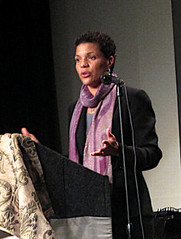 |  | |
| Michelle Alexander at Rainier Valley Cultural Center, Seattle Washington, April 14, 2010 | Mark A.R. Kleiman at Seattle Town Hall, April 22, 2010 |
Moritz College of Law professor Michelle Alexander and UCLA professor of public policy Mark A.R. Kleiman, recently made the rounds in Seattle.
Alexander, formerly Director of the Northern California ACLU Racial Justice Program, spoke with an audience of students, lawyers, civil rights leaders, and professors at the UW School of Law William H. Gates Public Interest Law Program. The following day, she did an interview with Dave Ross on KIRO radio, spoke with correctional officers and inmates in the prison at Monroe and then, in a benefit for 3-Strikes reform, addressed a community audience at Rainier Valley Cultural Center. Senator Adam Kline, King County Councilmember Larry Gossett, and former 3-Strikers Stevan Dozier and Vance Bartley also spoke that evening. I was one of the event organizers with the primary sponsoring organization, Justice Works!
Kleiman's visit was hosted by Seattle City Councilmember Tim Burgess, a former Seattle Police Department officer and detective. Kleiman met with criminal justice and elected officials to discuss research on crime and incarceration reduction and then gave a talk at Seattle Town Hall followed by a panel discussion. Panelists included Secretary of Washington State Department of Corrections Eldon Vail, King County Superior Court Judge Wesley Saint Clair, King County Deputy Prosecutor Mark Larson, and Washington ACLU Drug Policy Director Alison Holcomb.
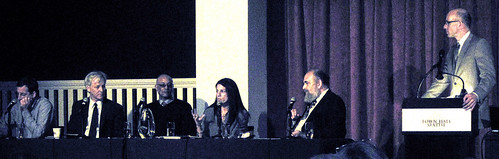
L-R: King County Deputy Prosecutor Mark Larson, Secretary of Washington State Department of Corrections Eldon Vail, King County Superior Court Judge Wesley Saint Clair, ACLU Drug Policy Director Alison Holcomb, Mark A.R. Kleiman, Seattle City Councilmember Tim Burgess
"MASSIVELY NOT OK"
Both authors begin with the premise that mass incarceration is not an ineffective crime-reduction strategy and that its results -- 2.3 million Americans behind bars at any one time; many more under correctional control in the community; a broad cross-section of Americans on lock-out from many housing, education, and job opportunities because of prior felonies -- and all of this falling much more heavily on black people and communities -- are, to borrow Kleiman's turn-of-phrase, "massively not ok."
Kleiman was one of the people recommending longer sentences in the 1970s, he said during his talk. Now he feels like the sorcerer's apprentice searching for the "off switch." He calls for cutting the correctional population in half within 10 years.
Alexander observes that, in order to return to the incarceration levels of the 1970s, which many people thought were too high at the time, we would need to release four out of every five people who are now behind bars - resulting in a loss of over a million jobs. Piecemeal fixes to our justice system won't be enough to turn this around. We need fundamental social change.
Alexander puts historical and current racial tensions at the center of the causes and solutions for mass incarceration. Kleiman cautions against identifying racial bias as a key driver of either mass incarceration or the tragedy of racial disparity in the criminal justice system.
HOW DID WE GET HERE? HOW DO WE GET OUT?
 |  | |
| ||
Kleiman: Crime surge, brute-force response, and a crime-punishment-poverty cycle
"The first step in getting away from brute force is to want to get away from brute force: to care more about reducing crime than about punishing criminals, and to be willing to choose safety over vengeance when the two are in tension." Mark A.R. Kleiman: When Brute Force Fails
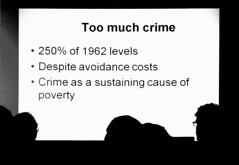
Kleiman portrays excess crime and excess punishment as comparably devastating expressions of the same underlying forces. The challenge is not so much to reduce one or the other alone - but to break through the crime-poverty-punishment cycle and reduce both. Ideological insistence on tough-on-crime policies hinder this. In fact, Kleiman points out, vengeful laws and political demands for quick and easy fixes can eerily echo aspects of the criminal behavior they target. On the other side of the political equation, the tendency of liberals to downplay the catastrophic impact of crime on people and communities makes it more difficult to address the problems we face. As does the tendency of some observers to employ "melodrama" in critiques that attribute racial disparity to systemic bias rather than to the historical accidents that Kleiman identifies as its underlying causes. (p. 24)
Kleiman traces the origin of today's tough-on-crime policies to the crime-wave that began in the 1960s, prompting a national response of brute force.
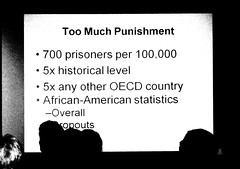
Four decades later our incarceration rate has quintupled - but our crime rate, while lower, is still more than twice as high as it was before the surge. Tough-on-crime policies can't be credited for the bulk of the reduction in crime over the last two decades, as fluctuations in crime rates during this time don't track with differences in policies - and other factors provide better explanations. Kleiman cites research showing, for example, that reduced blood lead levels in children after lead was banned in paint and gasoline "could easily explain a very large proportion - certainly more than half - of the crime decrease of the 1994-2004 period."
|

Image above: "US Violent Crime vs Gasoline Lead" from: Research Links Childhood Lead Exposure to Changes in Violent Crime Rates Throughout the 20th Century, Rick Nevin. Nevin Lead Exposure Study. Click to enlarge. The complete text of the Nevin Study is available at icfconsulting.com
Brute force, in other words, has not served us well. Excess punishment wastes resources, for example with three strikes laws which keep people in prison for many years after they have aged out of committing crimes. It unnecessarily removes large numbers of people from their families, communities, and jobs. And it contributes to poverty and more crime by excluding an ever-increasing percentage of the population - primarily poor people who are already living on the margins -- from many housing, employment, and educational opportunities because of prior felonies.
A good portion of Kleiman's book is devoted to case studies on successful local programs that reduce both crime and punishment. He discusses these programs within a game theory context, showing how dynamic concentration of resources (adapting how resources are used as the needs change); programs that reach people at the point where they decide whether to commit or refrain from crime; and the application of the minimum dose of punishment needed to deter or incapacitate unwanted behavior, can be dramatically successful.
Alexander: Political profiteering and a failure to care enough across race and class
"Drug crime in this country is understood to be black and brown and it is because drug crime is racially defined in the public consciousness that the electorate has not cared much what happens to drug criminals - at least not the way we would have cared if the criminals were understood to be white. It is this failure to care, really care across color lines, that lies at the core of this system of control..."
Alexander identifies the leveraging of racial tensions for political gain as the origin of tough-on-crime politics -- and the "first cause" of mass incarceration.
Republicans lost the black vote in the South following their opposition to the civil rights victories of the 1950s and 1960s. By the 1970s, however, strategists had discovered they could offset those losses by wooing poor whites who were struggling with the same job losses that black people were - but were also aggrieved by forced busing and affirmative action. Get-tough rhetoric on crime and welfare - which played heavily on racial stereotypes - resonated well among these voters. This "Southern Strategy" was wildly successful. Before long, Democrats jumped into the politically lucrative game, as well.
While this new get-tough punishment regime fails to effectively combat crime, it is exceptionally effective as a system of racial control. Today, nearly half of America's young black men are either under correctional control -- or "branded" for the rest of their lives as felons. This permanently bars them from many housing, employment, and education opportunities. In some urban areas, Alexander writes, a majority of black men are behind bars or have felony records.
The single biggest contributor to the rise in incarceration and the racial disparity, Alexander writes, is the war on drugs. While there are hundreds of different crimes on the books - drug crimes account for 20% of the people now in prison, including 55% of the people in federal prisons. The majority of those serving for drug crimes have no history of violence or high-level drug selling activity. (1)
"Vast numbers of people are swept into the criminal justice system by the police, who conduct drug operations primarily in poor communities of color. They are rewarded in cash -- through drug foreiture laws and federal grant programs -- for rounding up as many people as possible, and they operate unconstrained by constitutional rules of procedure that once were considered inviolate...
"Once arrested, defendants are generally denied meaningful legal representation and pressured to plead guilty whether they are or not.... Once convicted, due to the drug war's harsh sentencing laws, drug offenders in the United States spend more time ... in jail or in prison, on probation or parole -- than drug offenders anywhere else in the world...."
Finally, individuals with prior felonies... "are denied employment, housing, education, and public benefits. Unable to surmount these obstacles, most will eventually return to prison and then be released again, caught in a closed circuit of perpetual marginality."
Mass incarceration, then, which can be seen as a backlash against the gains of the civil rights movement, has resulted in a de facto reversal of many of those gains. We now have a permanent undercaste of poor people of color who lack access to mainstream employment, education, and housing opportunities. Nationally, about 1 in 7 black men cannot vote due to felony convictions.
Jim Crow has not ended, Alexander says, it has merely been redesigned. Unlike the historical Jim Crow, this one is nearly invisible in the public discourse. The stigma and shame associated with crime stands in the way of people who are most directly affected joining together to work for change. In society at large, there is a failure to care enough across class and color lines to notice -- and act to address -- this profound reshaping of our social landscape.
Achieving significant and lasting change will require us to meaningfully address the racial tensions that gave rise to the system of mass incarceration and to foster in its place an enduring ethic of caring and compassion across lines of color and class. Without this fundamental social change, we are vulnerable to new destructive policies that can arise to take the place of whatever old ones we manage to dismantle.
RACIAL BIAS: HISTORICAL RELIC, OR KEY DRIVER OF HIGH CRIME AND PUNISHMENT RATES?
While Alexander identifies racial tension as the foundation and sustaining cause of mass incarceration, Kleiman advises we avoid the "melodrama" of asserting that racial bias drives disparity in the criminal justice system. (p. 24) He doesn't dispute that race played a role in creating mass incarceration, but does dispute that it sustains it now. Today's higher punishment rates are attributable, he writes, to higher rates of crime among black people - and lower rates of punishment relative to those crimes.
Black people and communities, he argues, are caught in a "positive-feedback loop from high criminal activity to low punishment-per-crime back to high criminal activity." Representing less than 15% of the population, they suffer more than 50% of the murders - almost all committed by other blacks. More crime should draw more arrests and prosecutions. But black neighborhoods, he writes, don't receive law enforcement attention commensurate with that need. If they did, racial disproportionality in both crime and punishment would diminish -- because crime victimization is a major sustaining cause of both crime and poverty. Remove excess victimization from the equation -- and neighborhoods and people are better able to rebound from the historical legacy of poverty, crime, and punishment.
Do the numbers support Kleiman's contention that black people commit more crimes and are punished less?
Kleiman's statistics on black homicide rates, cited above, come from a US Bureau of Justice report Black Victims of Violent Crime, by Erika Harrell. He reports Harrell's finding that, while black Americans comprised 13 percent of the U.S. population in 2005, they were the victims of almost half of all homicides, approximately 8,000 homicides of black people. But he omits her finding that they were the victims of only 15 percent of all nonfatal violent crime that year -- approximately 805,000 black victimizations. (2)
This larger data set is, at least categorically, more relevant to Kleiman's argument than the numbers he presents -- and reflects a small level of overall disproportionality -- rather than the severe disproportionality he describes. I sent a draft of this story to Professor Kleiman, questioning his choice of data and he responded in part:
"Homicide rates are reliable: they're body counts. Other crimes are based on self-report on surveys or on calls to the police. I trust the body counts, and have no confidence that blacks are as likely as whites to call the police if they're mugged. I'd like to hear a theory about how it came to be that black-on-black assaults are three times as lethal as white-on-white assaults. I doubt such a theory could be defended."
If we accept for the sake of argument Professor Kleiman's critique of survey-based crime statistics - we are still confronted with data that show that, once arrested for homicide, black people are more severely punished than white. FBI data indicate rough parity between murder victimization rates for blacks -- and arrest rates for those crimes with the Uniform Crime Report for 2008 showing that 47.9% of the people arrested for murder in 2008 were white, and 50.1 were black. But the US Bureau of Justice Statistics reports that there were 61,400 blacks in state prisons for murder in 2005 - compared with 34,700 whites - showing that nearly twice the number of black people are in prison after being arrested for approximately the same number of murders.
We see more severe punishment for black people for other crimes, as well. African Americans comprise approximately 13% of the general population and federal survey statistics have, for years, indicated very similar rates of drug use among black and white people. (3) So we would expect to find that about 13% of the people arrested for drug crimes are black. But recent statistics show that 37% of drug arrests are of African Americans. Once again, if we accept Professor Kleiman's critique of survey-based data and look only at non-disputed data on punishment, we are still confronted with disparity. As compared with the 37% of people arrested for drug crimes who are black, 56% of persons serving in state prisons for drug crimes are black. (4)
There is also strong non-survey based evidence of racially disproportionate drug arrest rates. A 2003 Seattle study, for example, identified several ways in which law enforcement choices on the ground resulted in much higher arrest rates of African Americans for the same drug activities that their white counterparts engaged in.
"Seattle residents were far more likely to report suspected narcotics activities in residences - not outdoors - but police devoted their resources to open-air drug markets and to the one precinct that was least likely to be identified as the site of suspected drug activity in citizen complaints. In fact, although hundreds of outdoor drug transactions were recorded in predominantly white areas of Seattle, police concentrated their drug enforcement efforts in one downtown drug market where the frequency of drug transactions was much lower. In racially mixed open-air drug markets, black dealers were far more likely to be arrested than whites, even though white dealers were present and visible." (5)
Observations on disparity may be less contradictory than they seem
Kleiman's and Alexander's contentions - that crimes committed by or against black people are under-reported and that they are punished more often and more severely - may be less contradictory than they seem. A crime victim might, understandably, be less likely to report a crime if he or she believed that the community member who committed it faced much more severe punishment on account of race. It's also widely recognized that serious crimes against poor people often don't get the same law enforcement attention as those committed against higher income people. These two factors alone might account for more crimes going unpunished in poor and black communities - and a concomitant rise in crime and poverty in those communities -- the vicious cycle Kleiman invokes. At the same time, Kleiman's contention that violent crime rates by black people are much higher than standard statistics indicate has not been established. But it has been established, as Alexander contends, that black drug crimes receive more law enforcement attention than white drug crimes - and that, once arrested, black people are more likely to be punished -- and to be punished with greater severity - than white people.
ALL OF US OR NONE
There's no essential conflict between Kleiman's admonishment to avoid counterproductive race rhetoric and Alexander's call for racial tensions to be meaningfully addressed. As Alexander points out, it's not racial hostility or bad intent that causes disparity as much as it is indifference - a failure to notice and to care enough. Citing the name of an organization that fights discrimination against people with felonies, All of Us or None, Alexander argues that the welfare of people in one racial or economic group cannot meaningfully be improved if the welfare of people all groups is not meaningfully improved. Poor white people won't experience significant improvements in their welfare unless poor black and brown people do too -- and vice versa. Alexander's call for a focus on race is not divisive but, instead, positive and unifying:
"We should hope not for a colorblind society, but instead for a world in which we can see each other fully, learn from each other, and do what we can to respond to each other with love." Michelle Alexander, The New Jim Crow: Mass Incarceration in the Age of Colorblindness.
NOTES
- Mark Mauer and Ryan S. King. A 25-Year Quagmire: The "War on Drugs" and its Impact on American Society. The Sentencing Project. 9/2007 p. 13
- Other survey data on relative crime rates between whites and blacks also indicate racial disparity. The annual US Bureau of Justice Statistics survey measuring non-drug crimes like burglary and assault found that, in 2005, there were "no measurable differences in the percentages of white and black households sustaining one or more crimes".
- US Office of Applied Statistics, 2005 Drug Survey on Drug Use and Health
- African Americans comprise approximately 37% of those arrested for drug offenses - but 56% of persons in state prison for drug offenses.
Supra note 1 at 1. Sources cited:- Arrest data from FBI File UCR 91.300, March 2002
- Prison data from Ryan S. King and Marc Mauer, Distorted Priorities: Drug Offenders in State Prison, The Sentencing Project, 9/2002. p. 11.
- The New Jim Crow, 124. Citing Katherine Beckett, Kris Nyrop, Lori Pfingst, and Melissa Bowern. "Drug Use, Drug Possession Arrests, and the Question of Race: Lessons from Seattle." Social Problems. 52 (3): (2005) 419-41 and Katherine Beckett, Kris Nyrop, and Lori Pfingst, "Race, Drugs, and Policing: Understanding Disparities in Drug Delivery Arrests." Criminology 4491): 2006, P. 105.
| < Seattle becomes first city to affirm the Charter for Compassion | Sen. Ken Jacobsen, All the Best > |
PNW TOPIC HOTLIST

Recommended Diaries
- Free Speech for People moves forward in Washington State
At my urging, Senator Jacobsen has introduced a Senate Joint Memorial asking for Congress to submit to the states a Federal
By chadlupkes (371 comments) - State Budget Craters By $2 Billion More. The Good News Is....
... Now Progressives are going to have to stop talking about tax hikes and start talking about the value of government.
By dlaw (1473 comments) - Why Aren't We Fighting for a State Income Tax?
I am getting really tired here: I've been asked to sign petitions and send emails by almost any advocacy group that
By ktkeller (607 comments) - We Want to Take You and We Will Nyah Nyah
Last week I'm watching a podcast of Monday's House Local Government and Housing Committee because I'm interested in the Executive Session
By ktkeller (1311 comments) - Online Voting Rights for Overseas Military Personal
Having been deployed during an election I have some very passionate views on this issue. I have seen my friends simple
By dorsolplants (770 comments) - A Modest Proposal: How to Cut Education Funding
As cited in a recent Seattle P-I article, Sen. Rosemary McAuliffe, chairwoman of the state Senate education committee, warned that budget
By OrneryDemocrat (547 comments)
Recent Diaries
By distditornews1971 (0 comments)
By lebachemi1978 (0 comments)
By ditab1 (0 comments)
By ditab1 (0 comments)
By naylinsdelhoe1973 (0 comments)
By jaynal (0 comments)
By ditab1 (0 comments)
By naylinsdelhoe1973 (0 comments)
By Rezaul77 (0 comments)
By hasinaroy (0 comments)
Related Links
++ [2]
+ [3]
+ [4]
+ [5]
+ [6]
+ icfconsult ing.com
+ Black Victims of Violent Crime
+ Uniform Crime Report for 2008
+ reports
+ survey
+ 2005 Drug Survey on Drug Use and Health
+ More on Criminal Justice
+ Also by noemie maxwell
Washblog RSS Feeds
Political Contacts
Local Media
 Coastal/Grays Harbor
Aberdeen Daily World
Chinook Observer
Montesano Vidette
Pacific County Press
Willapa Harbor Herald
KXRO 1320 AM
Olympic Peninsula
Peninsula Daily News
Bremerton Sun
Bremerton Chronicle
Gig Harbor Gateway
Port Orchard Independent
Port Townsend Leader
North Kitsap Herald
Squim Gazette
Central Kitsap Reporter
Business Examiner
KONP 1450 AM
Sound and Islands
Anacortes American
Bainbridge Review
Voice Of Bainbridge
San Juan Journal
The Islands' Sounder
Whidbey NewsTimes
South Whidbey Record
Stanwood/Camano News
Vashon Beachcomber
Voice Of Vashon
KLKI 1340 AM
North Puget Sound
Bellingham Herald
The Northern Light
Everett Herald
Skagit Valley Herald
Lynden Tribune
The Enterprise
Snohomish County Tribune
Snohomish County Business Journal
The Monroe Monitor
The Edmonds Beacon
KGMI 790 AM
KELA 1470 AM
KRKO 1380 AM
Central Puget Sound
King County Journal
Issaquah Press
Mukilteo Beacon
Voice of the Valley
Federal Way Mirror
Bothell/Kenmore Reporter
Kirkland courier
Mercer Island Reporter
Woodinville Weekly
Greater Seattle
Seattle PI
Seattle Times
KOMO TV 4
KIRO TV 7
KING 5 TV
KTBW TV 22
KCTS 9
UW Daily
The Stranger
Seattle Weekly
Capitol Hill Times
Madison Park Times
Seattle Journal of Commerce
NW Asian Weekly
West Seattle Herald
North Seattle Herald-Outlook
South Seattle Star
Magnolia News
Beacon Hill News
KIRO 710 AM
KOMO AM 1000
KEXP 90.3 FM
KUOW 94.9 FM
KVI 570 AM
South Puget Sound
The Columbian
Longview Daily News
Nisqually Valley News
Lewis County News
The Reflector
Eatonville Dispatch
Tacoma News Tribune
Tacoma Weekly
Puyallup Herald
Enumclaw Courier-Herald
The Olympian
KAOS 89.3 FM
KCPQ 13
KOWA FM 106.5
UPN 11
Cascade/Okanogan
Ellensburg Daily Record
Levenworth Echo
Cle Elum Tribune
Snoqualmie Valley Record
Methow Valley News
Lake Chelan Mirror
Omak chronicle
The Newport Miner
Spokane/Palouse
The Spokesman-Review
KREM 2 TV Spokane
KXLY News 4 Spokane
KHQ 6 Spokane
KSPS Spokane
Statesman-Examiner
Othello Outlook
Cheney Free Press
Camas PostRecord
The South County sun
White Salmon Enterprise
Palouse Boomerang
Columbia Basin Herald
Grand Coulee Star
Walla Walla Union-Bulletin
Yakima Herald-Republic
KIMA 29 Yakima
KAPP TV 35 Yakima
KYVE Yakima
Wenatchee World
Tri-City Herald
TVEW TV 42 Tri-cities
KTNW Richland
KEPR 19 Pasco
Daily Sun News
Prosser Record-Bulletin
KTCR 1340 AM
KWSU Pullman
Moscow-Pullman Daily News

