Joseph Schuler's King Co. Farm: Laws are Not Enough to Protect it
Grateful thanks to Mr. Schuler for his generosity
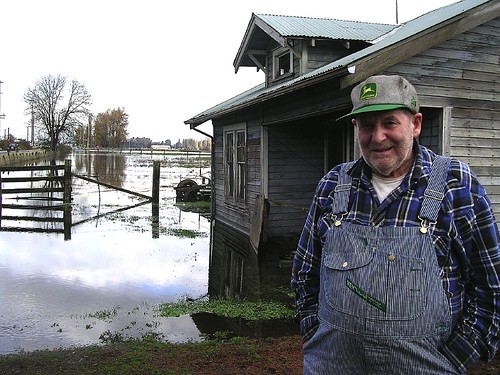
Joseph Schuler, the farmer shown standing next to his flooded home, above, has lived and worked on his farm in the Lower Green River Valley since 1937. Recently, intensive development and increasingly heavy rainfall, have led to severe flooding on his property, affecting his home and livelihood. Both the rainfall and development pressures are expected to intensify.
I drove to Mr. Schuler's farm on November 9, 2006, after several days of heavy rainfall. A friend had introduced us several weeks earlier and I was concerned when I noticed the flooding in his neighborhood. The pictures I took that day only hint at the dramatic effect of the flooding in this community when seen in person. Both sides of Highway 167 leading to his home appeared to be under deep water extending out a quarter mile or more in each direction -- along perhaps a mile of the highway. As I stood in front of Mr. Schuler's house and talked with him, I was close to tears. The situation seemed so wasteful and unjust to me.
CONTENTS
--ECONOMIC AND REGULATORY DISCONNECTS
--IRREPLACEABLE FARMLAND -- OR LAKEFRONT GAS STATION?
--THE LAY OF THE LAND
--A VALLEY LAKE AND AN ISLAND FARM
--JOSEPH SCHULER
--AGRICULTURAL DITCHES
--COW ISLANDS, HIGHWAY UPGRADE, AND A NEW CORPORATE PARK
--MEREDITH BUSINESS PARK: SALMON BLOCKED AND $2 MILLION PAID
--MEREDITH HEIGHTS: 202 NEW HOMES: SAME WATERWAY SAME STORMWATER PATH
--A WHOLE SYSTEMS APPROACH
Note: All the photographs in this story were taken by the author on November 9, 2006, except for two, as labeled, by Mara Heiman. This article was written after several months of working with the Back to the Roots program of Institute for Washington's Future to better understand and to spark public discussion on the critical need for improving the economic viability of sustainable uses of the land -- particularly in relation to agriculture and emerging renewable fuels and energy industries. A good faith effort was made for accuracy in this complex story. Corrections are welcomed.
Farming is valuable to society. Economically, it is a valuable as any other land use that crowds it out. But, as much as we are willing to invest public funds to preserve farms like Mr. Schuler's, there is a disconnect between our investment -- and our effectiveness in making that investment pay for either the farmer or for society. Despite all our investments in Mr. Schuler's farm, for example, he can no longer make a living on this land -- and we are on the verge of losing this farm forever. This situation is not uncommon for smaller and mid-sized farms. We have not, as a society, looked at our investments in a whole-systems way that would allow us to make sustainable agriculture economically viable for the people who depend on it for a living. We can do this; we have the resources and ability. As we see in this story, this oversight has profound implications not just for farms, but also for wildlife habitat, urban livability, food (and energy) security, and many other aspects of daily life. There is also a substantial disconnect between the public policy objectives of many land use laws and regulations and their real world impact. Numerous programs, laws, and governmental agencies, often innovative and effective in relation to specific problems, and often administered by caring professionals, are not enough to protect farmland. Some of them even present barriers to small and mid-sized businesses as they open up loopholes for sophisticated developers. Policies and programs that are now under development, such as King County's 10-year flood plan, affect how well we can address these interlocking environmental and economic issues. But where do policies and plans like this fit into the larger picture, and how can we consider them in the light of all the other critical factors at work? I also spoke with Aaron Litowitz on November 15th. Mr. Litowitz, his family members, and businesses that he and his family are associated with, hold several parcels of land within this APD, totaling by my calculations, about 185 acres. One of these properties is across the street from Mr. Schuler's farm. On the day I visited, it was the only high-and-dry looking property on the intersection of West Valley Highway and S. 277th Street. The land on this site had a filled-in appearance to me and a large area was covered with construction vehicles, cars, piles of gravel, and trailers. Icon Construction is currently permitted there to temporarily stockpile 500 cubic yards of fill for Highway 167. There is also an enforcement measure being pursued by King County on this property for unpermitted clearing or grading in a critical area. Both actions, along with others, can be viewed here, on King County's Online Permit Applications Report for that property. I told Mr. Litowitz that I was writing a story for Washblog on the flooding of the Schuler Farm, focusing on developments within and near the APD that could be contributing to this flooding. I said I'd visited the site and that his farmland looked filled in to me. I asked if illegal filling was going on there. He replied that the site had been filled in 1982, and that he'd had a permit to do it at the time. He said that he does not live on that property, has not committed any illegal acts, and, if any have been committed there, it's up to the police to take care of it. "The police know what's going on there," he said. And then he added that "this is lakefront property now," referring to the flooding. He noted that several years ago he'd looked into putting an Arco gas station on the property. "But the zoning isn't proper yet." Are you still trying to get this land rezoned, I asked? There probably will be a gas station there eventually, he said. Well, it is sad to me, I said, to see farmland converted to commercial use. Then you should ask to have these operations transferred to your back yard, he answered. They're improving the highway and they have to put the gravel somewhere.
Mike Carpinito, owner of Carpinito Brothers Farm, which owns land in active agricultural use in the community, is quoted in a January, 2006 King County Journal article as wondering whether excess water entering some properties in the valley are being diverted from other properties. He could not have been referring to this particular use of the Allito land, as the article was written prior to this activity. Nevertheless, it is reasonable to wonder why a government agency would issue a permit for non-agricultural use of land within an APD with so many sensitive water absorption and flow issues impacting neighborhood agricultural operations like Carpinito's and Schuler's.
ECONOMIC AND REGULATORY DISCONNECTS
Wet valley farmland is nothing new. The lower Green River Valley has always flooded periodically, enriching land that, in turn, provides drainage and filtering for the surrounding community. This is one of many farmland benefits that Washingtonians have invested substantial resources to preserve. Mr. Schuler's farm is within an Agricultural Production District (APD), one of numerous programs that represent this investment.
IRREPLACEABLE FARMLAND -- OR LAKEFRONT GAS STATION?
Judy Herring, property rights specialist with the King County Farmland Preservation Office noted in our phone conversation of November 15 that the soil in this particular APD is among the most productive in the world. She spoke of it as an irreplaceable resource. The Green River Valley floor was once covered by farmland, she said. Now only 1,300 acres remain. Yes, there are economic and development pressures. But when you think about how this soil and the heritage here can never be recovered once you build over it, your perspective changes. King County has never wavered in its determination to preserve this farmland, she said.
 Land on the Allito property appears high and dry with significant fill. |  Construction trailers between the Allito property and West Valley Highway block any causual view of the operations | |
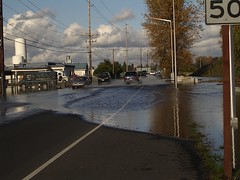 West Valley Highway flooded just north of S. 277th. |  Carpinito property on the northeast corner of West Valley Highway and S. 277th |
THE LAY OF THE LAND
Agricultural Production Districts are designated under King County's Comprehensive Plan. A high level of legal protection is assumed for these lands. In the two maps below, we see the Lower Green River Agricultural Production District (LGRAPD) to the left, outlined in purple, and the southwest portion the district, where the Schuler Farm and, across the street, the Allito property, are located. Click on the thumbnails for a bigger view.
 |  |
Several tributaries, labeled 0045 through 0053, run through this area. These are part of a complex system, in place since at least the 1930s, that was maintained over generations by farmers who straightened existing waterways and dug new ones. Mill Creek Tributary, or Tributary 0053, runs through the site of Meredith Heights, a 202-home development planned upstream from the Schuler Farm, through the Meredith Business Park site, where it has been altered and diverted, and then further downstream along the front of the Schuler Farm. The hills to the south of the Schuler Farm, where Meredith Heights is planned (labeled Harbor Homes on the map) have been extensively developed in recent years.
A VALLEY LAKE AND AN ISLAND FARM
Mr. Schuler's land has steadily been getting wetter in recent years. His situation dramatically worsened during the past two years. Last year, approximately half his 55 acres were intermittently covered with standing water from October through May. When I visited him on November 9, 2006, he estimated that approximately 70% of his land was covered.
 Looking north west on Highway 167 S. approaching the 277th Street exit |  Driving south on West Valley Highway. The barns of the Schuler Farm are on the left |
 Schuler farm from the north |  Schuler farm from the south |
JOSEPH SCHULER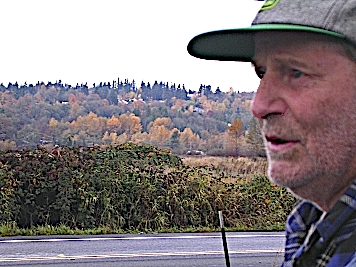 Mr. Schuler seems to know every family, property, waterway and natural feature of the area -- and a fair amount about other communities in Washington state. The Green River, he said in our first conversation, is being squeezed hard by development. People think they can get away without long-range planning, he said. They are mistaken. He spoke of both I-933 and Measure 37 in Oregon, as initiatives desgined to benefit attorneys more than property owners. He spoke of our current tendency to build without adequately planning ahead -- and the failure of today's society to properly value land, work and farming, as leading our country down a path of defeat.
Twice in our conversation he mentioned children from other families in the community whom he "raised up" when their parents died or were ill. Right after speaking with him, I stopped to chat with someone in the neighborhood, and when I mentioned Joe Schuler, he volunteered with a smile, "Oh yes, Joe pretty much raised me up."
Mr. Schuler moved here with his parents and family when he was seven from a nearby farm. He remembers sitting at the kitchen table with his family shortly after they moved in, promising each other to work together as a team. Even at that young age, Joseph had already been milking cows and doing other farm work. The second barn was built on the property when he was about 10 years old, and he helped to lay the concrete foundation.
During his childhood, many of the farmers in this community were Japanese. He gave me a copy of a book entitled, "A Pictoral Album of the History of the Japanese of the White River Valley" (Japanese American Citizen's League, 1986). As we leafed through it together he pointed out a number of people he went to school with as a child or that he knew as neighbors. Mr. Shoichiro Katsuno, who was 100 years old in 1984, owned a farm across the street from the Schuler family. After Pearl Harbor, he was put in an internment camp and his farm was taken from him.
 |  |
Because harmful impacts to salmon and other fish habitat occur when these waterways are altered, they are strictly regulated and permits are required to clear or dredge them. The ditch in front of Mr. Schuler's house has not been cleaned for many years, he said. Sediment has been collecting here all the while, slowing the drainage. Upstream, the same waterway has been significantly altered, apparently illegally, at the site of Meredith Business Park.
I contacted King County's Agricultural Drainage Assistance Program with concern for Mr. Schuler and feeling that it was very unjust for an upstream developer to alter this waterway, seemingly at will, while Mr. Schuler struggled on his flooded land. I was referred to Kathy Creahan, King County's Agriculture Program Coordinator, who notified me that there is a plan under development for this area. She referred me on to other contacts, including a followup interview currently scheduled with Curt Crawford, Stormwater Services Section Manager for King County's Water and Land Resources Division.
King County's Rural Economic Strategies Report, 2006, indicates that it has recently become easier for property owners to maintain these ditches: "Agricultural ditch maintenance no longer requires a separate county clearing and grading permit if conducted pursuant to a Farm Management Plan developed in consultation with the King Conservation District."
Mason Bowles, Senior Ecologist with King County Department of Natural Resources (KCDNR), also noted that King County Water and Land Resources plans two capital improvement projects -- one on Tributary 0053 and another on a nearby stream, Tributary 0045. These projects are being designed to reduce downstream flooding by improving conveyance and floodplain storage and will also be required to provide salmon habitat.
COW ISLANDS, HIGHWAY UPGRADE, AND A NEW CORPORATE PARK
 On the Schuler Farm Cow Island to the north |  On the Schuler Farm Cow Island to the south |
Your cows look intelligent, I observed. Are they? "Well, I just feed them and they make their deposits." These cows are one of the well-appreciated features of the landscape. Earlier that morning Mr. Schuler helped a young child, whose parents stopped as they were driving by, touch one through the roadway fence. These days, the herd, which was once much larger, tops out at about 100 cows. He still sells the calves for beef. But his operation no longer makes a profit, he said. In fact, he is subsidizing it. Feed for the cows, corn and hay, is particularly expensive Corn costs have risen because of the ethanol market. Flooding has reduced the grazing area for his cows, and weeds from nearby developments have crowded out much of the red top grass and clover he planted here years ago. There is, simply, less for his cows to eat here.
 This land, on the north east corner of the farm, did not flood until last fall and winter. Mill Creek runs through here, roughly north to south. |  Corporate Express. Built on a waterway on the east side of Highway 167 |
Several years ago, approximately 18 acres of Mr. Schuler's property was purchased for use on Highway 167 construction. Other neighbors, he told me, received $6,000 to $10,000 per acre. He received between $2 and $3,000 per acre. Since this construction, a huge building was erected for Corporate Express on top of what Mr. Schuler indicated was a stream bed, on the side of Highway 167 across from his property.
MEREDITH BUSINESS PARK: SALMON BLOCKED AND $2 MILLION PAID
Meredith Business Park (MBP) is under construction about a quarter mile upstream from the Schuler Farm. The map below shows the 4-plat site of the business park, with a natural looking waterway, which I understand to be Tributary 0053, meandering across the center. I did not see any sign of this waterway in my observations on November 9. A map of the Tributary 0053 area that Mason Bowles, Senior Ecologist with King County Department of Natural Resources (KCDNR), mailed to me, dated 1/25/06 and created by Jeanie Pride, shows a waterway running in a straight north-to-south line along Meredith Business Park's western property boundaries -- but nothing running across the property.

Site of Meredith Business Park, from King County GIS site, accessed 11/12/06 at http://www.metrokc.gov/gis/mapportal/iMAP_main.htm#
This site comprises four parcels with the following recorded wetland composition:
- 0221049073: 79% wetland
- 0221049074: 59% wetland
- 0221049075: 75% wetland
- 0221049085: 84% wetland
All four of these parcels were sold by their separate owners for $0 to the Meredith Corner LLC within a few days of each other in August 2003 -- and all four were sold again in August, 2006. The three southernmost parcels were repurchased for $0 by the 2003 owners or, in the case of one, by an apparent associated company. The northernmost parcel, was purchased on 8/15/06, by WVBP, LLC for over two million dollars. KING COUNTY ALERTS AUBURN, THE U.S. ARMY CORPS OF ENGINEEERS, AND WA DEPT. OF FISH AND WILDLIFE MBP was required under state law to obtain a Hydraulic Permit before undertaking any changes to wetlands and waterways. But it did not. Mr. Bowles noted that the owners obtained this permit only after he had alerted Washington Fish and Wildlife to what was occurring on the property. By that time, the wetlands had already been filled and the stream, now impassible to salmon, had been relocated.
MARA HEIMAN ALERTS THE CITY OF AUBURN Ms. Heiman said that she was first aware of a waterway diversion and grading on that site in 1996 or 1997 -- several years after an Army Corps of Engineers inspector surveyed the site, determined that it contained significant wetlands and habitat, and was told by the owners' representative that they had no intention to apply for any permits to alter the habitat. The work began at night, Ms. Heiman said, and she complained at the time to the City of Auburn. Auburn issued two separate stop work orders. But the work continued and enforcement was not undertaken in time to meet the statute of limitations. Further diversion and filling occurred, she said, during the preparation of the Meredith Business Park site after it was sold to the current owner and without the required Hydraulic Permit. AUBURN'S MAYOR LEWIS, VICE CHAIR OF THE GREEN RIVER FLOOD CONTROL DISTRICT: ALL PERMITS WERE PROPERLY OBTAINED He told me that it was absolutely not the case that work had been done on Meredith Business Park during his tenure as Mayor without the legally required Hydraulic Permit having been issued when legally required. People may be saying that, he said. But I am sure that once you look at the documentation, you will see that is not true. I informed Mayor Lewis that I'd placed a public records request for that documentation with the City of Auburn in early November (I haven't heard back yet.) He shared with me that these had been "low quality" wetlands, a contention that I think is refuted by the 1993 Army Corps of Engineers report, linked above. Mayor Lewis applauded me for my interest and told me: "We are always delighted to work with all the parties. Our biggest concern is that we make sure we're meeting all the regulatory requirements." THE HYDRAULIC PERMIT WAS NOT FILED
FEBRUARY, 2006 DEPARTMENT OF ECOLOGY REPORT ON VIOLATIONS AT MEREDITH BUSINESS PARK
TOO LATE ALREADY? MBP's drainage has not been functioning adequately. Larry Fisher, the Area Habitat Biologist with Washington State Department of Fish and Wildlife who responded to my letter of concern about the apparently illegal grading and diversion at MBP, wrote to me in a 11/20/06 email: "WDFW is currently working with the City of Auburn on issues related to this development site (meaning MBP). The City agrees with WDFW that the drainage plan for the project is not working and needs to be corrected." Based on the past history of this site, I have no confidence that the water flowing down from Meredith Heights homes through Meredith Business Park and onto Mr. Schuler's farm will not intensify his flooding problems. My sense of the management at MBP is one of scrambling to repair past mistakes and illegalities. Mara Heiman relayed to me that one evening in the week after my November 9 visit to Mr. Schuler, an employee of the contractor at MBP was paid to "babysit" the water flow on the site all night, presumably to keep debris from clogging the flow. Here are two pictures that she took that week: In the photograhs below, which I took on November 9, you can see a concrete drainage conveyance in construction along the edge of West Valley Highway at the front of MBP (MBP #2 and #3) and views of the front and side of the park (MBP #1 - #5) that seem to indicate a high and dry site with large areas covered with impermeable surfaces. The last photograph, taken from the back of the site on S. 287th Street shows that this land is naturally low and wet.
The story told here speaks to the need for a whole-systems public policy approach to economic and environmental issues, particularly in relation to land and resource use. Can we do a better job of realistically valuing agriculture's input into the economy -- and the input of all land use, including wildlife habitat -- so that potential short-term gains do not blind us to our true interests? Can we simplify and strengthen environmental regulations so that they can be more easily enforced? What can we do to further move public understanding in Washington beyond the all-too-common belief that environmental protection is an infringement on private rights or that it interferes with economic prosperity? King County's new 10-year flood plan is a critical piece of public policy now under development. What groups are tracking policies such as this in Washington State? The loss of productive farmland on the lower Green River Valley is not a small matter. The regional economy and environment -- and our quality of life -- are impacted when we cannot find ways to sustain urban edge farms.
Two quotes make a fitting close to this story. The first is from The Cascade Agenda a multi-group coalition creating a 100-year vision and strategy for livability in Washington. Their focus is on the four-county area of King, Kittitas, Pierce and Snohomish Counties. This group "advocates a cooperative, market-based, non-regulatory approach .... (and) recognizes conservation and economic growth are two sides of the same coin. We can't have one without the other and still retain the special quality of life that we all prize so highly." The second quote is from King County's Rural Economic Strategies Report, and gives a quick overview of the role and state of farmland in King County:
In a recent Census of Agriculture by the State of Washington, King County ranked 14th out of the 39 Washington counties based on value of production. Only three western Washington counties Snohomish, Skagit, and Whatcom Counties ranked higher. A critical mass of agricultural land is needed to support a diverse agriculture economy and necessary infrastructure, such as feed stores and large animal veterinarians, and is another reason to retain the remaining agriculture lands. Today, there are about 40 thousand acres in the county that have been zoned for Agriculture and much of that land lies within the Agricultural Production Districts (APDs). Some of the agriculturally zoned lands are either idle or underused, and the reasons the property owners are allowing this to happen should be explored. Additionally, the county is still losing agricultural land outside of the APDs. The county should continue to explore the reasons behind the loss of agricultural use on these lands to see what options might be available to ensure that more farmlands stay in production.
Mason Bowles has travelled to the Agricultural Production District several times, bringing maps and other information to Mr. Schuler and, I assume, also to the MBP site a few blocks away. He told me that, during the construction of MBP, which began two years ago, wetlands were filled and portions of Tributary 0053 were diverted, blocking the passage of salmonids and affecting drainage. KCDNR notified the City of Auburn, he said, which had issued the construction permit. It also notified the U.S. Army Corps of Engineers, which issued the permit to fill the wetlands, and Washington's Department of Fish and Wildlife, which issued the hydraulic project approval.
Mara Heiman, owns property right outside the APD that has repeatedly flooded over the past ten years from nearby developments, many of them not conforming to legal requirements. Her account of events on the Meredith Business Park (MBP) property is consistent with that of Mr. Bowles.
I called Pete Lewis, Auburn's Mayor, on November 15, 2006, and said that it appeared to me as that Auburn might be enforcing land use laws in a relaxed way, possibly resulting in harm to fish habitat and a downstream farm. Would he like to respond for the article I was writing? Mr. Lewis is Vice Chair of the Green River Flood Control Zone District, in addition to seven other major committee appointments on city, state, and regional councils that oversee economic development, and human services. He was traveling in a car when I called, but he knew about the MBP properties.
In addition to the observations offered by Mason Bowles and Mara Heiman, examination of two documents establish definitively that waterway diversion and wetland work began on the MBP site in 2005 or 2006 without the legally required Hydraulic Permit having been granted. A 2/13/06 stormwater compliance report that I received via a public document request from Washington Department of Ecology notes that the site had been "completely cleared" -- and listed numerous violations indicating newly graded land and diverted waterways. Mara Heiman provided me with a copy of the site's Hydraulic Permit, which was finally issued on 4/14/06. This permit, issued two months later, noted the following:This project came to the attention of WDFW (Washington Department of Fish and Wildlife) due to stream flows going through the detention facility as a result of sediment deposition in the alluvial fan of the stream causing the channel to avulse. This HPA is issued to correct that problem and install the wetland mitigation for the development of the property.
The 2/13/2006 Stormwater Compliance Inspection Report I received from Ecology was explicit about the violations there. Here are most of them, with several violations and much of the detail omitted:January 27, 2006
January 30, 2006
In other words, this site was a mess, one which almost two dozen photographs document. The notice mentions possible jail time for non-compliance. But enforcement is a complex matter. Any given governmental agency enforces only what is within its purview and deals with separate standards and statutes of limitations. Larry Fisher, the Habitat Biologist with Washington State Department of Fish and Wildlife responsible for this area of the state, responded to an email I sent him, asking if he would consider rescinding existing permits on this site so that an investigation could better take place. His answer indicated that he believes the statute of limitations may have expired:"It is unfortunate that these apparent violations, which occurred mostly in the late 1990s, came to the attention of WDFW only recently, since WDFW operates with a two year statute of limitations to prosecute violations of its code."
MEREDITH HEIGHTS: 202 NEW HOMES, SAME WATERWAY, SAME STORMWATER PATH
Harbour Homes, a Federal Way business, plans an uphill development of 202 homes on 57 acres on the canyon above Meredith Park in unincorporated King County. Tributary 0053, which runs through the Meredith Business Park site and downstream through the Schuler Farm, also runs right through the center of the proposed Meredith Heights. This development has received a preliminary Determination of Mitigated Non-Significance under the State Environmental Protection Act (SEPA). Its flow will be directed into the now failed MBP site. From the SEPA document: "This determination is based on .... the newly constructed downstream drainage improvements for the Meredith Business Park within the City of Auburn."
The back (west side) of Meredith Business Park on November 12, 2006
Photograph by Mara Heiman 
The Back of MBP, November 12, 2006
Photograph by Mara Heiman
(MBP #1) A waterway running east and west
along the south edge of MBP
A new diversion of Tributary 0053? 
(MBP #2) The front of MBP on West Valley Highway.
(MBP #3) The front of MBP on West Valley Highway
with drainage tile under construction. Compare this
to the inundation in front of Mr. Schuler's house. 
(MBP #4)South edge of MBP.
(MBP #5)The south edge of MBP. This land looks raised up. 
(MBP #6)The property behind (west of) MBP.
Taken on S. 287th. This land is low and wet.
A WHOLE-SYSTEMS APROACH TO LAND USEFrom the agricultural chapter of the Cascade Agenda Report
As long as farms remain viable as a cohesive working landscape, they will continue to provide a multitude of public benefits in addition to contributing to our local food supply. These benefits include:From King County's Rural Economic Strategies Report
The fertile valley soils and temperate marine climate has enabled agriculture to flourish in King County. The urbanizing of the Puget Sound region and fluctuating agricultural markets nation-wide has impacted farming in the county. Today, the shift is from larger farms with few products, to smaller farms often growing a diversity of crops to meet current market demands. The numbers seem to indicate that agriculture is making a comeback in the county with sales increasing from $99 million in 1997 to $120 million in 2002, but the challenges facing this economic cluster are still significant.
| < Blogging the reorganization (a digest) | Election legislative agenda digest > |
|

 |


Recommended Diaries
- No Tears From Me for Lonesome Brian Baird
For those of you who have not seen this from the Seattle Times, I have taken Mr. Westneat to task just
By The Left Shue (4 comments) - Bernie Sanders to the richest: via Youtube
What Bernie says -- in 2005 the top 1% of earners made more than the bottom 50% in the United States.
By chadlupkes (2 comments) - Terry Bergeson Has To Go - Do The Math
At the Thursday July 10th 36th Disctrict Democrat endorsement meeting, some people spoke in favor of Terry Bergeson. I thought they
By rmdSeaBos (21 comments) - Eye Candy from 08 Pride Parade
A girl has to have SOME fun. Above, 34th District Obama delegates Dinazina (moi) and Jody Rogers. This year I
By dinazina (7 comments) - It's election day somewhere.
The sun is hot and the calendar pages are flipping slow And so am I Election season passes like molasses in
By chadlupkes (3 comments) - Democrats MUST quit using Republican framing
I have been tearing my hair out reading all the nitpicky squabbling in cyberspace about minor differences in the platforms and
By eridani (7 comments)
Recent Diaries
By dlaw (2 comments)
By Daniel K (0 comments)
By Arthur Ruger (0 comments)
By Washington CAN (0 comments)
By dlaw (0 comments)
By fake consultant (13 comments)
By dlaw (0 comments)
By Arthur Ruger (0 comments)
By Fred (4 comments)
By dlaw (3 comments)
By Daniel K (1 comments)
By WA Spirit Matters (2 comments)
Related Links
++ increasing ly heavy rainfall
+ ECONOMIC AND REGULATORY DISCONNECTS
+ IRREPLACEA BLE FARMLAND -- OR LAKEFRONT GAS STATION?
+ THE LAY OF THE LAND
+ A VALLEY LAKE AND AN ISLAND FARM
+ JOSEPH SCHULER
+ AGRICULTUR AL DITCHES
+ COW ISLANDS, HIGHWAY UPGRADE, AND A NEW CORPORATE PARK
+ MEREDITH BUSINESS PARK: SALMON BLOCKED AND $2 MILLION PAID
+ MEREDITH HEIGHTS: 202 NEW HOMES: SAME WATERWAY SAME STORMWATER PATH
+ A WHOLE SYSTEMS APPROACH
+ Institute for Washington's Future
+ 10-year flood plan
+ King County Farmland Preservation Office
+ Online Permit Applications Report
+ King County Journal article
+ [2]
+ Comprehens ive Plan
+ [3]
+ [4]
+ Agricultur al Drainage Assistance Program
+ Rural Economic Strategies Report
+ http://www .metrokc.gov/gis/mapportal/iMAP_main.htm#
+ 0221049073
+ 0221049074
+ 0221049075
+ 0221049085
+ Hydraulic Permit
+ Army Corps of Engineers inspector surveyed the site
+ Hydraulic Permit [2]
+ the site's Hydraulic Permit
+ Determinat ion of Mitigated Non-Significance
+ Cascade Agenda Report
+ More on Land use/zoning issues
+ Also by noemie maxwell
Washblog RSS Feeds
Political Contacts
Local Media
 Coastal/Grays Harbor
Aberdeen Daily World
Chinook Observer
Montesano Vidette
Pacific County Press
Willapa Harbor Herald
KXRO 1320 AM
Olympic Peninsula
Peninsula Daily News
Bremerton Sun
Bremerton Chronicle
Gig Harbor Gateway
Port Orchard Independent
Port Townsend Leader
North Kitsap Herald
Squim Gazette
Central Kitsap Reporter
Business Examiner
KONP 1450 AM
Sound and Islands
Anacortes American
Bainbridge Review
Voice Of Bainbridge
San Juan Journal
The Islands' Sounder
Whidbey NewsTimes
South Whidbey Record
Stanwood/Camano News
Vashon Beachcomber
Voice Of Vashon
KLKI 1340 AM
North Puget Sound
Bellingham Herald
The Northern Light
Everett Herald
Skagit Valley Herald
Lynden Tribune
The Enterprise
Snohomish County Tribune
Snohomish County Business Journal
The Monroe Monitor
The Edmonds Beacon
KGMI 790 AM
KELA 1470 AM
KRKO 1380 AM
Central Puget Sound
King County Journal
Issaquah Press
Mukilteo Beacon
Voice of the Valley
Federal Way Mirror
Bothell/Kenmore Reporter
Kirkland courier
Mercer Island Reporter
Woodinville Weekly
Greater Seattle
Seattle PI
Seattle Times
KOMO TV 4
KIRO TV 7
KING 5 TV
KTBW TV 22
KCTS 9
UW Daily
The Stranger
Seattle Weekly
Capitol Hill Times
Madison Park Times
Seattle Journal of Commerce
NW Asian Weekly
West Seattle Herald
North Seattle Herald-Outlook
South Seattle Star
Magnolia News
Beacon Hill News
KIRO 710 AM
KOMO AM 1000
KEXP 90.3 FM
KUOW 94.9 FM
KVI 570 AM
South Puget Sound
The Columbian
Longview Daily News
Nisqually Valley News
Lewis County News
The Reflector
Eatonville Dispatch
Tacoma News Tribune
Tacoma Weekly
Puyallup Herald
Enumclaw Courier-Herald
The Olympian
KAOS 89.3 FM
KCPQ 13
KOWA FM 106.5
UPN 11
Cascade/Okanogan
Ellensburg Daily Record
Levenworth Echo
Cle Elum Tribune
Snoqualmie Valley Record
Methow Valley News
Lake Chelan Mirror
Omak chronicle
The Newport Miner
Spokane/Palouse
The Spokesman-Review
KREM 2 TV Spokane
KXLY News 4 Spokane
KHQ 6 Spokane
KSPS Spokane
Statesman-Examiner
Othello Outlook
Cheney Free Press
Camas PostRecord
The South County sun
White Salmon Enterprise
Palouse Boomerang
Columbia Basin Herald
Grand Coulee Star
Walla Walla Union-Bulletin
Yakima Herald-Republic
KIMA 29 Yakima
KAPP TV 35 Yakima
KYVE Yakima
Wenatchee World
Tri-City Herald
TVEW TV 42 Tri-cities
KTNW Richland
KEPR 19 Pasco
Daily Sun News
Prosser Record-Bulletin
KTCR 1340 AM
KWSU Pullman
Moscow-Pullman Daily News

