Life Without Parole for Low-Violence Crimes: Can Washington Find Redemption?
Many thanks to Justice Works! for advisement and other significant help on this story. Notes and a printable copy of this story with all comments can be found here
In his 12 years in prison, Mr. Bartley had lived infraction-free within that system, pursuing his own education and helping others with GED tutoring and legal research. He had also continued to research legal issues related to his own case and had, against all expectations, identified a way to correct an error in one of his convictions that his attorneys had missed. As a result, that conviction no longer counted as strike offense and Bartley would soon be released. This hearing was held to determine whether he would be free within a few weeks or would wait as long as another 42 months. As I sat with Court Watch volunteers from JusticeWorks!, a grassroots criminal justice reform organization, I felt privileged to witness an occasion which marked not only Bartley's personal transformation but also, in a sense, the hopes and striving of the larger community for transformation within Washington's criminal justice system.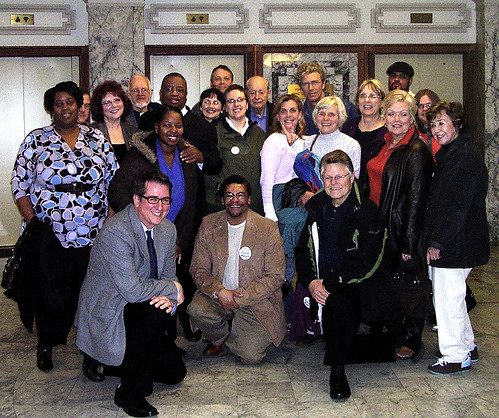
The courtroom benches in Judge Spector's King County Superior Court were filled with supporters and observers for Vance Bartley's re-sentencing hearing on the morning of November 15. Bartley had been serving life without possibility of parole under Washington's Persistent Offenders Accountability Act, or "Three Strikes" law since August 22, 1997. There had been little hope that he'd ever leave prison. In the words of Judge Spector, the system had 'thrown him away'.
Above: Some of the supporters and observers for Vance Bartley's re-sentencing hearing gather after its conclusion. The group includes Jeff Ellis, Bartley's attorney; King County Councilmember Larry Gossett; JusticeWorks! founder Lea Zengage; Carol Estes, from Yes! Magazine who testified at the hearing; and volunteers and employees with community organizations. Click on photo for a larger version and more information.
 Nearly 30 supporters and observers were in the courtroom that morning, including one of Mr. Bartley's daughters and her mother, former Department of Corrections staff, volunteers from numerous community organizations, and an attorney from The Defender Association. King County Councilmember Larry Gossett arrived toward the end of the morning.
There was a strong sense of occasion related to the presence of so many community members who were offering support for Bartley's life transition, even as the harm he had caused to his victims was formally detailed and acknowledged as part of the proceedings. The injustice of the 3-strikes law under which Bartley had been sentenced was not mentioned in the hearing.
Nearly 30 supporters and observers were in the courtroom that morning, including one of Mr. Bartley's daughters and her mother, former Department of Corrections staff, volunteers from numerous community organizations, and an attorney from The Defender Association. King County Councilmember Larry Gossett arrived toward the end of the morning.
There was a strong sense of occasion related to the presence of so many community members who were offering support for Bartley's life transition, even as the harm he had caused to his victims was formally detailed and acknowledged as part of the proceedings. The injustice of the 3-strikes law under which Bartley had been sentenced was not mentioned in the hearing.Above: Vance Bartley. Image from: From the other side of the bars< , Carol Estes and Catherine Bailey. Yes! Magazine, Spring, 2007.
THIS MAN'S HEART HAS CHANGED Defense attorney Jeff Ellis spoke of reading the descriptions of these crimes in the Department of Correction's 1997 pre-sentencing report and feeling shock. 'I wondered: is this the same man I have come to know over the past year? Poetry is not my job as a lawyer. But I can say that although this is the same body and the same brain, there is a transformation. This man's heart has changed.' Ari Kohn, president of the Post Prison Education Fund and Carol Estes of Yes! Magazine attested to Mr. Bartley's rare, genuine and "driven" desire to learn and to help others. "I've taught college courses and ESL courses to hundreds of students," Ms. Estes said. "Vance stands out. He’s a man who belongs in college and a profession, not in a red jump suit and handcuffs." There was a job waiting for Mr. Bartley on the outside, they testified, as well as a place in college and a scholarship. Bartley offered his "humble, most sincere apologies to my victims and to society." He thanked the judge and his supporters. He said that his failure to face his substance abuse had led him to commit "deplorable, cowardly acts unacceptable in society." The people I harmed, he said, "did not deserve to be victimized. I hope they have been able to recover." He described long years of his incarceration during which he had to face the reality that he could not undo the harm he had caused to other people and that he might die in prison. "Still, I wanted my time to count for something," he said. And so he worked to atone for his crimes by pursuing his own education and reaching out to others to offer GED tutoring and help with legal matters. "Education is a gift," he said. It is what he focused on, in the process, trying to set an example for the younger prisoners. My plea, he said, is that my accomplishments count for something. I remain infraction free for a decade. I do want to respect law and order, I do want to follow the rules. I have undergone a spiritual transformation. After reviewing an earlier draft of this story, Mr. Bartley wrote to Lea Zengage of JusticeWorks! that he would like to emphasize that it was the support of community and the grace of God that allowed him to keep hope and to improve his situation in prison. The Department of Corrections not only did not provide adequate opportunity for rehabilitation, but it put up barriers that closed off or limited rehabilitation opportunities offered by the community. I was told several times that Judge Spector is known for being tough. But when she spoke, I thought she sounded pleased and perhaps even moved. 'It is rare,' she said, 'to see someone make such vast improvement. You have exercised self-help rarely seen on the outside. I'm going to go to the bottom of the range."
VIOLENCE IN THE HEART OF WASHINGTON'S CRIMINAL JUSTICE SYSTEM An occasion involving this law brings to mind the people it was advertised to protect: potential victims of brutal crimes like murder and rape. It also demands recognition of those who, like Mr. Bartley, are sentenced to life in prison for committing crimes that involve low or nonexistent levels of physical violence, small amounts of money, and legal errors committed because there is insufficient time for defense attorneys to devote to their cases. The Revised Code of Washington at RCW 9.94A.010 requires that punishment be proportionate to the seriousness of the crime and commensurate with that given to others for similar crimes. In 2001, Washington's Sentencing Guidelines Commission noted in its annual Sentencing Reform Act Review that the range of behaviors associated with Robbery 2 pose "little risk of physical injury" and recommended that the state legislature remove Robbery 2 from the 3-strikes list. It also noted that all behaviors associated with Assault 2 are "probably not commensurate" with strike status and recommended that the legislature evaluate the inclusion of Assault 2. Each year, Senator Adam Kline has introduced legislation to attempt to accomplish this. Each year, the legislation has failed. This year, SB 5349, sponsored by Senators Kline, Franklin, Kohl-Welles, and Weinstein, which would remove Robbery 2 only from the list of offenses, did not make it to a floor vote. (1)
[Update 12/15: SB 5964, is also a bill currently in Washington's legislature. It started out as proposing to exclude from the list of 3-strike offenders people who had committed only Assault 2 and/or Robbery 2 offenses (about 27 people with primarily non-violent offenses). It was then changed to merely require study of 3-strikes. The bill was opposed by Washington Coalition of Crime Victim Advocates, which characterizes it, inaccurately, as " dropping Assault 2 and Robbery 2 from the list of three strikes offenses".] Three strikes is administered with severe racial disparity. 3.5% of all Washingtonians -- but 45% of Washingtonians incarcerated under this law -- are African American . (2, 3, 4) It violates the state law that governs how all felony sentences are structured. And it rests on a foundation of fear and even vengeance, rather than on evidence of what works for public safety or considerations of justice. In effect, Washington's 3-strikes law constitutes a societal hate crime. Very few people within the system that upholds and administers this law are guilty of personal racism or vindictiveness. The collective impact of the law, however, is both racist and vindictive. The weight of that impact comes down directly on a few individuals, their families, and their communities. I believe it impacts the whole society and diminishes public safety.
A MOVEMENT BORN IN VIOLENCE AND PAIN After the failure of the first 2 attempts to gain enough signatures to put a 3-strikes initiative on the ballot (5), the grassroots movement strayed from its community beginnings to merge with special interests. Initiative 593 was passed in 1994 with the help of conservative talk show host John Carlson as well as $250,000 in donations, nearly half of it from the gun lobby according to JusticeWorks! (6), including 91,146 from the National Rifle Association (NRA). At the time, the NRA was engaged in a "guns don't hurt people -- people hurt people" campaign. Three strikes fit right in. The pain of crime victims had been successfully leveraged to serve the political goals of special interests. Each time Senator Adam Kline introduces the legislation to remove Robbery 2 and non-violent Assault 2 from the list of Strikes offenses, as recommended in the 2001 Sentencing Reform Act Review,incarcerated people and their loved ones have experienced an "emotional rollercoaster" as Steven Dozier, who is incarcerated under three strikes, explained it to journalist Silja J.A. Talvi in a recent Real Change article. (7) And each time, there is a conservative outcry led by interests that closely monitor this legislation, ready to mobilize opposition if it gets traction. The argument is that it would release many dangerous criminals.
DISPELLING UNNECESSARY FEAR, SAVING MONEY AND WASHINGTON STATE'S HONOR If Robbery 2 were removed from the 3 strikes list, as proposed under SB 5349, 128 people would qualify for re-sentencing reviews and 87 of those, according to the fiscal note attached to the legislation, would be likely to proceed beyond that initial review to a hearing. In my examination of the SGC list of individual conviction histories, I see seventy-eight people who have at least one Robbery 2 conviction, and who do not appear to have committed any "worst of the worst" crimes (such as rape, murder, kidnapping, or child molestation). I see thirteen people who have been convicted only of Robbery 2 -- the crime characterized by Washington's Sentencing Guidelines Commission as involving "little risk of physical injury" and known in the criminal justice community as shoplifts gone bad. I have talked with family members of these nonviolent offenders serving life sentences. SB 5349 would not cause any person to be released from serving his or her full sentence. The only change would be the lifting of the mandatory life sentence imposed above and beyond those existing sentences. In other words, the state would not be required to warehouse people into their 70s, 80s, or 90s. Clearly, there would be no mass release of dangerous criminals. Compared with the nearly 3,000 people now incarcerated for murder or rape in Washington state who will be released during their lifetimes, the potential for 10 or 20 people who have been convicted of "most serious" crimes being released after having served their full sentences for those crimes, (8) does not merit the alarm that opponents of the legislation have raised. On the other hand, a number of non-violent offenders, as well as their families, would be released from extreme and disproportionate punishment. And the state would save millions of dollars -- and some of its honor. The rule of law would be stronger in Washington state if we were not routinely breaking it under 3-strikes. SB 5349 is a start to making the 3-strikes law reflect what voters for Initiative 593 intended: life sentences for people who have committed the most violent crimes. We should be going even beyond 5349 to comply with the recommendation of the SGC and to consider the appropriateness of each life sentence imposed on those convicted of Assault 2, as well. I count 208 people serving under 3-Strikes who have at least one Robbery 2 or Assault 2 conviction. Of these people, 130 have no convictions for crimes considered to be "most serious". The money saved by releasing people who have committed low-violence offenses would much more effectively protect potential victims if it were spent on addiction treatment, education, housing, or even increased funding for community policing.
RESTITUTION AND PRACTICAL SOLUTIONS -- OR VIOLENCE AND BLAME? Through his actions in prison over 11 years and his statements in court, Bartley demonstrated an approach opposite to this kind of vengeance and blame shifting. He focused on what he was able to do with his limited resources to improve his situation and to work toward restitution. This a path that leads away from individual and institutional violence. It requires us to focus on solutions rather than blame. It demonstrates faith in people and society. It is the antithesis of the 3-strike mentality. Barack Obama wrote in Dreams from my Father (11) that the imperfect laws and justice of the United States are part of a larger expression of 'a nation arguing with its own conscience.' This view, without denying the harm that systemic injustice causes, understands the legal system as a process that we can improve over time, just as an individual can improve. Successful rehabilitation for Washington's criminal justice system might follow a path similar to Mr. Bartley's individual rehabilitation in prison: we can recognize our mistakes; do our best to make restitution for the harm we have caused although we cannot undo that harm; and educate ourselves to reduce our potential for causing more harm in the future. The legal community and policymakers continually work to improve Washington's criminal justice system, and improvements are regularly made. Removing nonviolent and low-violence offenses from the list of crimes causing people to be sentenced to life imprisonment without hope of parole is perhaps the most critically needed step in this improvement. This continuing violation of law -- upheld only by fear and indifference -- is a clear affront to the rule of law and the honor of the state.
JOIN: 3-Strikes Rapid Response
JUSTICEWORKS! I asked Lea Zengage what her response would be to the reality that there are dangerous people. They might be causing violence on the street or from a high-paid corporate position. But as long as they have the freedom to harm others, they will. Isn't this a legitimate fear behind the 3-strikes law? There is a percentage of people on the inside who have a mean disposition, Zengage said. This is true also on the outside. But it is a small number. There are very few people who have lost hope to the degree that prevents them from even dreaming about having a positive life. The judge was saying that it is unique to find someone like Vance who not only does the work, but has the temperament to succeed. We have lost a lot of people who leave the prison system full of promise and passion but who are “Set up to Fail” because we don’t have the resources to support them. People come out of prison having studied and worked for a positive direction. But they are set up to fail. They start out with hope and they end up lying on the ground, defeated. It is the biggest dream of the older people who have been in the criminal justice system to convince younger people to not do what they did, to convince them to not use drugs, to pursue education, to not commit crimes, Zengage said. The person who has been incarcerated knows what he needs to succeed. He is the expert. But the challenges faced after leaving prison are overwhelming. You are set up to fail. Your passion is great. But you’ve also got someone’s boot on your neck. People are released from prison with a $40 check and no ID and a cardboard box with a few personal belongings. They have no home to go to, no services, no help. This causes desperation and defiance.
The prosecuting attorney, who spoke first, described Mr. Bartley's crimes at length, robberies in which Mr. Bartley would show a real or fake weapon, demand that the victim comply with his demands or be cut or shot, and sometimes lead the victim into a back room to be bound with duct tape. "This is a fairly significant violent set of facts," the attorney said, "that has had impact on a large number of victims. One of them has said that her experience: 'forever altered her life.'
It occurred to me after the hearing that if community support -- and even a kind of blessing -- had been offered to Bartley for his life transition, it had also been offered for a needed societal transformation -- an easing of the structural violence in Washington's criminal justice system that is expressed perhaps in its most concentrated form in the 3-strikes law.
Washington was the first state in the nation to pass a three-strikes-and-you're out law. One might say that it was part of a movement born in the anguish of crime victims, illustrating the truth that violence begets violence. A key figure early on in the movement was Ida Ballasiotes, later a state Representative, who took action after her daughter, Diane, was raped and murdered by a man on work-release who had already served time for two previous sexual assaults. Ballasiotes and others won changes in Washington's sexual predator laws. Then they moved on to advocate for a three-strikes law, which was sold as a measure that would protect society from the "worst of the worst".
I've looked at the fiscal note for SB 5349 and at each of the three crimes listed by the Sentencing Guidelines Commission (SGC) for each of the 285 people who are incarcerated under three strikes.
There is a deep irony particular to Vance Bartley's case that illustrates the wastefulness of treating drug addiction with incarceration. It illustrates, as well, the tragic consequences of being so tough on crime that we fail to implement known solutions that protect people from becoming victims of crimes, from committing crimes, and from having parents and other family members who commit crimes and go to jail. The legal error that caused Bartley to be incarcerated under 3-strikes occurred because he pled guilty to a more serious crime than what he had committed. He chose to make this more serious plea because he believed it would qualify him for treatment for drug addiction. (9) That treatment did not materialize. He left prison still an addict and lapsed back into substance abuse and robberies to pay for drugs. He and his victims and his family could have been spared tremendous suffering if treatment for drug addiction had been provided to him. It would have been a fiscally prudent move for the state, as well. Treatment for drug addiction costs $3,500 per year, compared with a annual per-prisoner cost estimated between $22,000 and nearly $32,000. (10)
After the hearing, I took a city bus with Lea Zengage, Timothy Bacani, and Jason Clark to JusticeWorks! headquarters. We sat in a living room overlooking Martin Luther King Way in the Central District of Seattle. JusticeWorks! was inspired by the men in the Black Prisoners Caucus, Zengage explained. People who have been incarcerated are able to say, 'We know what works. We know what prevents crime. We know what we need.' The programs are designed around the premise that previously incarcerated people can put their own solutions into action, but they can't do it without support. So in this organization we all put our gifts on the table. None of us can do it all. But this is the dream, that we do it together. “A unique, safe, affirming community.”
Notes and a printable copy of this story with all comments can be found here
| < Report from Lietta Ruger: Storm Causes Complete Infrastructure Collapse in Pacific Co. | Links to Info on Farm Flooding/Devastation in SW Washington > |
PNW TOPIC HOTLIST

Recommended Diaries
- Free Speech for People moves forward in Washington State
At my urging, Senator Jacobsen has introduced a Senate Joint Memorial asking for Congress to submit to the states a Federal
By chadlupkes (4 comments) - State Budget Craters By $2 Billion More. The Good News Is....
... Now Progressives are going to have to stop talking about tax hikes and start talking about the value of government.
By dlaw (20 comments) - Why Aren't We Fighting for a State Income Tax?
I am getting really tired here: I've been asked to sign petitions and send emails by almost any advocacy group that
By ktkeller (25 comments) - We Want to Take You and We Will Nyah Nyah
Last week I'm watching a podcast of Monday's House Local Government and Housing Committee because I'm interested in the Executive Session
By ktkeller (6 comments) - Online Voting Rights for Overseas Military Personal
Having been deployed during an election I have some very passionate views on this issue. I have seen my friends simple
By dorsolplants (20 comments) - A Modest Proposal: How to Cut Education Funding
As cited in a recent Seattle P-I article, Sen. Rosemary McAuliffe, chairwoman of the state Senate education committee, warned that budget
By OrneryDemocrat (15 comments)
Recent Diaries
By DemandProgress (0 comments)
By TheLDI (0 comments)
By m3047 (1 comments)
By m3047 (1 comments)
By Lurleen (1 comments)
By Dumer (1 comments)
By eridani (0 comments)
By eridani (2 comments)
By Lurleen (0 comments)
By Lurleen (0 comments)
By ThinkerFeeler (0 comments)
Related Links
+ JOIN: 3-Strikes Rapid Response+ Justice Works!
+ here
+
+ JusticeWor ks!
+ The Defender Association
+ From the other side of the bars<
+ Post Prison Education Fund
+ Yes! Magazine
+ RCW 9.94A.010
+ Sentencing Reform Act Review
+ SB 5349
+ SB 5964
+ Washington Coalition of Crime Victim Advocates
+ the state law that governs how all felony sentences are structured
+ to journalist Silja J.A. Talvi
+ fiscal note
+ by the Sentencing Guidelines Commission
+ SB 5349 [2]
+ shoplifts gone bad
+ JusticeWor ks! [2]
+ More on Social Justice
+ Also by noemie maxwell
Washblog RSS Feeds
Political Contacts
Local Media
 Coastal/Grays Harbor
Aberdeen Daily World
Chinook Observer
Montesano Vidette
Pacific County Press
Willapa Harbor Herald
KXRO 1320 AM
Olympic Peninsula
Peninsula Daily News
Bremerton Sun
Bremerton Chronicle
Gig Harbor Gateway
Port Orchard Independent
Port Townsend Leader
North Kitsap Herald
Squim Gazette
Central Kitsap Reporter
Business Examiner
KONP 1450 AM
Sound and Islands
Anacortes American
Bainbridge Review
Voice Of Bainbridge
San Juan Journal
The Islands' Sounder
Whidbey NewsTimes
South Whidbey Record
Stanwood/Camano News
Vashon Beachcomber
Voice Of Vashon
KLKI 1340 AM
North Puget Sound
Bellingham Herald
The Northern Light
Everett Herald
Skagit Valley Herald
Lynden Tribune
The Enterprise
Snohomish County Tribune
Snohomish County Business Journal
The Monroe Monitor
The Edmonds Beacon
KGMI 790 AM
KELA 1470 AM
KRKO 1380 AM
Central Puget Sound
King County Journal
Issaquah Press
Mukilteo Beacon
Voice of the Valley
Federal Way Mirror
Bothell/Kenmore Reporter
Kirkland courier
Mercer Island Reporter
Woodinville Weekly
Greater Seattle
Seattle PI
Seattle Times
KOMO TV 4
KIRO TV 7
KING 5 TV
KTBW TV 22
KCTS 9
UW Daily
The Stranger
Seattle Weekly
Capitol Hill Times
Madison Park Times
Seattle Journal of Commerce
NW Asian Weekly
West Seattle Herald
North Seattle Herald-Outlook
South Seattle Star
Magnolia News
Beacon Hill News
KIRO 710 AM
KOMO AM 1000
KEXP 90.3 FM
KUOW 94.9 FM
KVI 570 AM
South Puget Sound
The Columbian
Longview Daily News
Nisqually Valley News
Lewis County News
The Reflector
Eatonville Dispatch
Tacoma News Tribune
Tacoma Weekly
Puyallup Herald
Enumclaw Courier-Herald
The Olympian
KAOS 89.3 FM
KCPQ 13
KOWA FM 106.5
UPN 11
Cascade/Okanogan
Ellensburg Daily Record
Levenworth Echo
Cle Elum Tribune
Snoqualmie Valley Record
Methow Valley News
Lake Chelan Mirror
Omak chronicle
The Newport Miner
Spokane/Palouse
The Spokesman-Review
KREM 2 TV Spokane
KXLY News 4 Spokane
KHQ 6 Spokane
KSPS Spokane
Statesman-Examiner
Othello Outlook
Cheney Free Press
Camas PostRecord
The South County sun
White Salmon Enterprise
Palouse Boomerang
Columbia Basin Herald
Grand Coulee Star
Walla Walla Union-Bulletin
Yakima Herald-Republic
KIMA 29 Yakima
KAPP TV 35 Yakima
KYVE Yakima
Wenatchee World
Tri-City Herald
TVEW TV 42 Tri-cities
KTNW Richland
KEPR 19 Pasco
Daily Sun News
Prosser Record-Bulletin
KTCR 1340 AM
KWSU Pullman
Moscow-Pullman Daily News

