Martin Luther King Day: An answer to denial
My grandmother used to tell me that her grandmother told her... that "the road to hell is paved with good intentions."
When I lived in Brooklyn, New York, I'd often see a man who wore a cape over mismatched clothes, walking in circles on a certain street corner. One day our eyes met and I smiled at him. He broke from his circling and walked over to me. "Miss," he said, "You are so lovely. If only I weren't caught in this magnetic trap." And then the moment and the connection ended and he went back to his circle.
I feel kinship with this person and his stuck condition. The beauty of this world is beyond what I can do justice to with my understanding or actions. I want to express love in ways that exceed my capabilities. I long to move beyond habitual ways of seeing and knowing to the kind of clarity of perception appropriately responsive to the realities of this world and its inhabitants.
I have felt this way about race issues. There is a childlike part of me that, on the most basic level, feels pride and delight in the achievements of people like Martin Luther King -- as if he expresses wiith the greatest fidelity what is best about my essential self and all the people I love. And, in a childlike way, as well -- I feel overwhelmed by sorrow over the grave injustices along color lines that surround us. As my understanding of racial injustice - of unnecessary suffering and the waste of time and talent and lives of so many people in this world - has unfolded over the years, I have not known how to properly respond. I have not been equal to the task. On some level, it feels as if I am continually walking out of darkness into flames and then retreating back into darkness again.
People still deny that racism is real. I see this even on the progressive listservs. And I hesitate on some level to answer back that racism is a profound, persisting problem that creates foundational distortions in our culture and harms all its children. Asserting this seems to be inappropriate, somehow. First, it is a sad truth -- too sad to properly pay respects when it is expressed. Second, it seems to characterize a large percentage of the people in this world as victims and to ignore the kind of complexities that characterize all our lives. Third, it seems to divide rather than to unify people to call out such disparities. And, for me personally, there has also been a long struggle with a feeling of inadequacy. As a white person, I have felt that maybe these issues are none of my business, maybe I am driven by subconscious motives that are not laudable. Maybe I have not sufficiently paid my dues -- and, categorically, never can. And yet, despite any barriers that any of us can interpose between the truth and our perception of it, doesn't the truth persist and call out for recognition?
Infant Mortality
The report, Racial Disparities in Infant Mortality: An Update King County, 1980-2002, shows that, while the 2002 infant mortality rate in King County dropped to 4.5 deaths per 1,000 live births, a reduction of 56% since its peak 20 years ago, progress in infant death prevention has not been shared equally by all groups. African American and American Indian/Alaska Native infants are more than twice as likely to die in the first year of life than white infants.
King County Datawatch
Stolen Farms
African Americans represent less than 1 percent of all farmers, a steep drop from the 1920s, when 925,000 blacks owned about 14 percent, or nearly 50 million acres, of the nation's agricultural landscape. Census data show that there now are about 18,000 black farmers.
Seattle Times. Sam Fulwood III. BLACK FARMERS -- ANGER OVER BIAS PERSISTS, 7/16/1998Dispossession is an especially acute problem for African-American farmers. The failure of Reconstruction to create the conditions for a sustainable yeoman agriculture after the Civil War left African-American farmers largely trapped in a sharecropping economy that resembled slavery. Still, many blacks managed to acquire land; by the 1920s more than 200,000 African-American farmers owned land, and in total nearly one million black families farmed. However, during a single generation, from 1954 to 1987, farms with African-American operators declined by 95%, and between 1950 and 1974 the number of African-American owners dropped 80%. As a USDA demographer observes, this has been "one of the most remarkable social and economic transformations in the history of our country." The decline of black farming continues today. The nation stands at the verge of losing, perhaps permanently, significant farmland ownership by African-Americans.
Poverty, Racial Discrimination and the Family Farm Carpenter, Stephen. Poverty & Race. Washington: Feb 28, 1997.Vol.6, Iss. 1; pg. 2
High School graduation rates
- Only 67% of all Washington State public school students from the class of 2001 graduated from high school;
- This is significantly lower than the 82% graduation rate suggested by official Washington State statisitcs;
- Graduation rates are significantly lower for African-American students (53%), Latinos (47%) and Native Americans (47%). Graduation rates are higher for white (70%) and Asian-American (77%) students;
Civic Report No. 27 August 2002: High School Graduation Rates in Washington State. Jay P. Greene, Ph.D., Senior Fellow, Manhattan Institute for Policy Research
Disenfranchisement
A 1998 Sentencing Project report estimated that more than 151,500 Washingtonians are denied the right to vote because of a felony on their record. That's 3.7% of the voting population of Washington State, more than double the national average. Disenfranchisement is a major problem in Washington that especially affects low-income people and African Americans. In fact, nearly 25% of African American men in Washington have permanently lost their right to vote, seriously limiting the voice of the African American community on public policy issues.
Western Prison Project.
Incarceration
A massive racial disparity has resulted from sentencing laws. In 2003, African Americans, who comprise only 12 percent of the U.S. population, represented about 44 percent of all prisoners nationwide. That same year, 12 percent of all American black males in their twenties were in prison.
State ActionIn Washington State, 23 percent of prisoners are African-American, although Blacks only represent three percent of the total state population. Of all of the state's inmates, 65 percent are doing time for non-violent offenses, and fully 50.6 percent of those incarcerated on drug charges are African-American. By comparison, the national average is 37.8 percent.
Washington Free Press.
Left out of the New Deal
Between 1945 and 1955, the federal government transferred more than $100 billion to support retirement programs and fashion opportunities for job skills, education, homeownership and small- business formation. Together, these domestic programs dramatically reshaped the country's social structure by creating a modern, well- schooled, homeowning middle class.But most blacks were left out of all this. Southern members of Congress used occupational exclusions and took advantage of American federalism to ensure that national policies would not disturb their region's racial order. Farmworkers and maids, the jobs held by most blacks in the South, were denied Social Security pensions and access to labor unions. Benefits for veterans were administered locally. The GI Bill adapted to "the southern way of life" by accommodating itself to segregation in higher education, to the job ceilings that local officials imposed on returning black soldiers and to a general unwillingness to offer loans to blacks even when such loans were insured by the federal government. Of the 3,229 GI Bill-guaranteed loans for homes, businesses and farms made in 1947 in Mississippi, for example, only two were offered to black veterans.
New Deal, Raw Deal; How Aid Became Affirmative Action for Whites; [FINAL Edition] Ira Katznelson. The Washington Post. Washington, D.C.: Sep 27, 2005. pg. A.23
Recently, I read a post on a listserv that criticized people like me for being well-meaning "white liberals." Although I've heard this kind of formulation many times before, this time the use of this phrase took me somewhere new, somewhere I hadn't been before. I saw an interesting connection.
All my adult life I have been pinned to the wall by the angry use of the term, "liberal." I have internalized the disdain of conservatives for the kind of `bleeding-heart' sensibility that has been attributed to people like me. My understanding has been that the caring I feel shows that I am weak and self-serving. My anger over the Bush administration jumpstarted me past this. I saw clearly that I was needed in the action and couldn't afford any longer to be shamed out of it.
This recent post parked a similar rebellious response in me. I saw a connection between how I had internalized conservative disdain - and how I had internalized suspicion of my own motives and capabilities because I am a white person who cares about race. And I saw how both responses impede clarity of perception.
There are so many ways to go wrong with ones' good intentions. There is the danger of seeing other people as victims, of focusing on a single dimension of the complex existence of another. There is the danger of stepping into a position of "reaching out" to others -- and forgetting that we are all in the same boat. There is a danger of seeing the people around us as "other" in ways that we are really kin. There is the danger of focusing on what is tragic and small and forgetting what is beautiful and expansive.
And yet, despite the indignities and pitfalls, it is necessary to go on trying. It has become clear to me that, to the extent we consider the healing of racism to be the job only of those who are its direct victims, we all will continue to suffer from it.
My favorite folktale involves a poor village in which only one person is rich. A delegation of Rabbis visits him one day to ask for money and, being your archetypal folktale miser, the rich man refuses. "Leave it up to me," says one of the Rabbis. Then he goes back to the miser and asks for a single ruble. The miser throws it at the Rabbi in contempt -- and the Rabbi thanks him with sincerity.
This goes on for days, the Rabbi returning and accepting each scornfully tossed ruble with gratitude and sincere respect. Until one day, the miser seeks out the Rabbi and gives him all the money that was asked for.
"Never in my life," says the miser, "has anyone been able to accept the little bit that I have been able to give. And so, I have never been able to give anything. Now I understand what it is to give. And I thank you."
The lesson that I have taken from this tale is to accept the little bit that I have been able to give, to abandon my disdain of my own small gifts, for a sincere respect. After all, regardless of the enormity of the suffering around me -- and my knowledge that others can do so much more -- even my own small gifts are worthy of respect. It is better, I think, to share, rather than to withhold them.
| < Is Josh Feit right? | Party Chair - Candidate Forum - Pasco Washington > |
|
 *** FUND DRIVE IN PROGRESS ***


|

|

.gif)
|

Challenging the Corporate Media Blockade 
|
|

 WA PEACE LINKS |
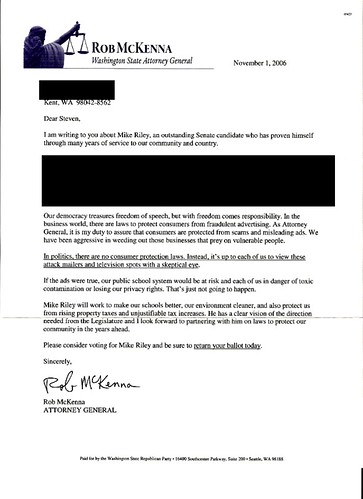
 ABUSE OF POWER Inspired by Rob McKenna's Fake Attorney General Letterhead GIF of Letter |


PNW TOPIC HOTLIST


Recommended Diaries
- Douglas County is the only county in Washington State that does not have a weed board.
The county commissioners and other "Private Property Rights "activists have been fighting the state and county residents for years on this
By Dixie (4 comments) - Political Graphics 101: 34th LD lit deconstructed
As part of my highly opinionated, ruthlessly honest series on political graphics, I zero in on campaign lit from the 34th.
By dinazina (6 comments) - Gulliver's Travels
Jeb Bush came to town today and stopped by to speak with the Microsoft Political Action Committee. Most memorable metaphor on
By BryceM (8 comments) - WA Insurance Commissioner Says: Don't Believe the Hype (Yes on R -67)
Today I received the email copied below from Mike Kreidler, Washington State's Insurance Commissioner. It contrasts interestingly with the letter full
By noemie maxwell (2 comments) - Here in Douglas County who you are still seems to carry a lot of clout.
Commissioner Dane Keane has done it again! This time he has damaged a county vehicle while apparently under the influence. Although
By Dixie (3 comments) - John Edwards In Seattle - Why You Should Be There
Hello everyone. My name is Michael, I live in Puyallup, and this is my first time posting here. I wanted to
By Michael 4 Edwards (14 comments)
Recent Diaries
By gibney (2 comments)
By bltfsk (3 comments)
By IvyTodd (0 comments)
By gibney (3 comments)
By Dixie (0 comments)
By BryceM (0 comments)
By dlaw (8 comments)
By bltfsk (0 comments)
By Dixie (1 comments)
By The Left Shue (4 comments)
Related Links
+ King County Datawatch+ Civic Report No. 27 August 2002: High School Graduation Rates in Washington State
+ Western Prison Project
+ State Action
+ Washington Free Press
+ More on Building the base
+ Also by noemie maxwell
Washblog RSS Feeds
Political Contacts
Local Media
 Coastal/Grays Harbor
Aberdeen Daily World
Chinook Observer
Montesano Vidette
Pacific County Press
Willapa Harbor Herald
KXRO 1320 AM
Olympic Peninsula
Peninsula Daily News
Bremerton Sun
Bremerton Chronicle
Gig Harbor Gateway
Port Orchard Independent
Port Townsend Leader
North Kitsap Herald
Squim Gazette
Central Kitsap Reporter
Business Examiner
KONP 1450 AM
Sound and Islands
Anacortes American
Bainbridge Review
Voice Of Bainbridge
San Juan Journal
The Islands' Sounder
Whidbey NewsTimes
South Whidbey Record
Stanwood/Camano News
Vashon Beachcomber
Voice Of Vashon
KLKI 1340 AM
North Puget Sound
Bellingham Herald
The Northern Light
Everett Herald
Skagit Valley Herald
Lynden Tribune
The Enterprise
Snohomish County Tribune
Snohomish County Business Journal
The Monroe Monitor
The Edmonds Beacon
KGMI 790 AM
KELA 1470 AM
KRKO 1380 AM
Central Puget Sound
King County Journal
Issaquah Press
Mukilteo Beacon
Voice of the Valley
Federal Way Mirror
Bothell/Kenmore Reporter
Kirkland courier
Mercer Island Reporter
Woodinville Weekly
Greater Seattle
Seattle PI
Seattle Times
KOMO TV 4
KIRO TV 7
KING 5 TV
KTBW TV 22
KCTS 9
UW Daily
The Stranger
Seattle Weekly
Capitol Hill Times
Madison Park Times
Seattle Journal of Commerce
NW Asian Weekly
West Seattle Herald
North Seattle Herald-Outlook
South Seattle Star
Magnolia News
Beacon Hill News
KIRO 710 AM
KOMO AM 1000
KEXP 90.3 FM
KUOW 94.9 FM
KVI 570 AM
South Puget Sound
The Columbian
Longview Daily News
Nisqually Valley News
Lewis County News
The Reflector
Eatonville Dispatch
Tacoma News Tribune
Tacoma Weekly
Puyallup Herald
Enumclaw Courier-Herald
The Olympian
KAOS 89.3 FM
KCPQ 13
KOWA FM 106.5
UPN 11
Cascade/Okanogan
Ellensburg Daily Record
Levenworth Echo
Cle Elum Tribune
Snoqualmie Valley Record
Methow Valley News
Lake Chelan Mirror
Omak chronicle
The Newport Miner
Spokane/Palouse
The Spokesman-Review
KREM 2 TV Spokane
KXLY News 4 Spokane
KHQ 6 Spokane
KSPS Spokane
Statesman-Examiner
Othello Outlook
Cheney Free Press
Camas PostRecord
The South County sun
White Salmon Enterprise
Palouse Boomerang
Columbia Basin Herald
Grand Coulee Star
Walla Walla Union-Bulletin
Yakima Herald-Republic
KIMA 29 Yakima
KAPP TV 35 Yakima
KYVE Yakima
Wenatchee World
Tri-City Herald
TVEW TV 42 Tri-cities
KTNW Richland
KEPR 19 Pasco
Daily Sun News
Prosser Record-Bulletin
KTCR 1340 AM
KWSU Pullman
Moscow-Pullman Daily News
|
|