The Time is Now to End the War on Drugs
Other reports on this event: Former Police Chief Denounces War on Drugs, The Skanner; South End forum takes aim at failures and racism of the War on Drugs, Beacon Hill News; Time to End the Drug War?, Real Change; Getting the Message Out, Blog Reload.
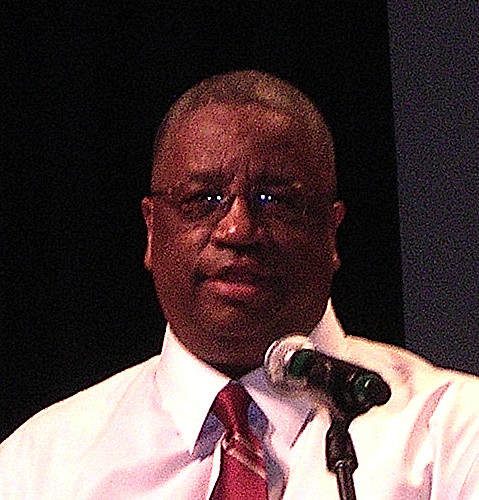 King County Councilmember Larry Gossett was the first to speak at a recent community meeting in Seattle that called for an end to the failed $40 billion-per-year War on Drugs. We hope that you'll be inspired by the information we share with you tonight to take action, Gossett said. We need a progressive, multiracial people's movement to put a definitive end to the war on drugs. We must recognize that class and race matter. Of the 2,500 people in King County jails, one third are there for drug offenses. Forty percent of these are African Americans, most of whom had less than $50 worth of drugs on them when they were arrested. "This is dastardly." Three percent of Washington's population is black people. But statewide, 25 - 30% of the people in prison are black. Folks, we've got to organize and change this. This takes the creativity of all of us. It's the kind of change that has been brought about by grassroots groups that started off like this, with a community meeting. I've seen it happen. But it doesn't happen without organizing.
Over 500 people were gathered at the event at Rainier Valley Cultural Center on May 17. In addition to Gossett, former Seattle Chief of Police Norm Stamper, John Page of Village of Hope, and University of Washington sociologist Katherine Beckett also spoke, outlining the costs paid in human suffering and public resources for drug prohibition. Organizers from American Friends Service Committee and the Defender Association's Racial Disparity Project suggested `next steps' toward building a coalition. Central themes included the economic and political implications of an ever-growing prison-industrial complex that feeds off the war and perpetuates it -- and the severely disproportionate impact of the war on people of color.
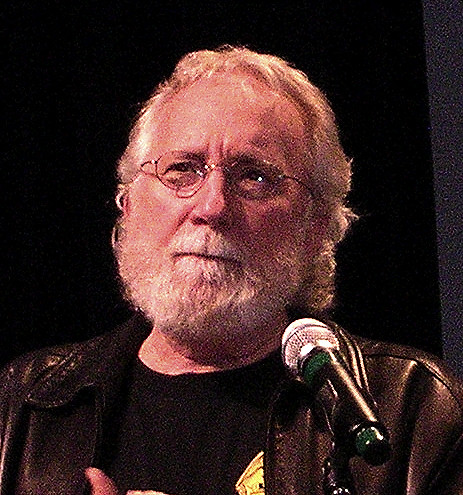 Norm Stamper, former Chief of Police for the City of Seattle, spoke of his 34 years in policing. My overriding passion, he said, was creating an equitable and authentic relationship between the community and the police. This is something we cannot achieve while our police officers are the foot soldiers in an unwinnable and immoral war that is not waged against drugs, but against people - young people, poor people, and people of color. Since Nixon declared the war in 1969, Stamper said, we've spent at least a trillion dollars on it. We squander $69 billion every year. Over two million people claim as their residence a prison cell. We ought to be ashamed. We need to move to a regulatory model and a public health approach of treatment and compassion.
Norm Stamper was Seattle Police Chief from 1994 to 2000. He's a member of Law Enforcement Against Prohibition, and author of Breaking Rank: A Top Cop's Expose of the Dark Side of American Policing
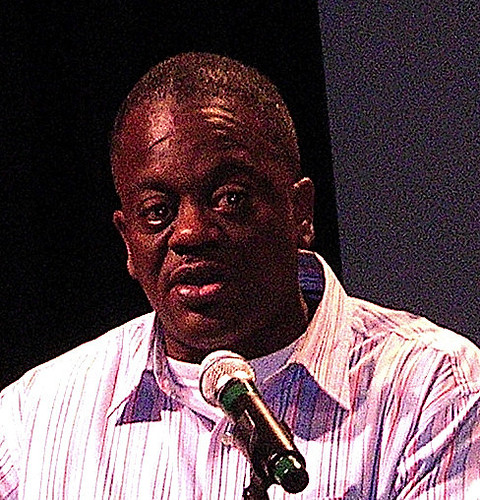 This is the "City of Hope", right here, said John Page, pointing to all of us in the audience at the Cultural Center. Page spoke of the need to humanize the effects of the War on Drugs, to make it personal. I know people, decent people, he said, doing life without parole on drug charges. We need an honest national dialogue on addiction and alcohol. Here in the United States, we seem to forget people who are right front of us, who are standing on Third and Pike. It takes effort to get past our fear, to see beyond the addiction to the person. I am not immune to that fear myself, he said. He contrasted our cultural ability to 'see past' people who are among us to stories from his recent visit to Kenya, where people still remember those who disappeared in the slave trade centuries ago. I've been out of prison a year tomorrow, he said. I wouldn't be sober today if it weren't for the people around me. Healing happens after people leave prison. It is the whole family that needs healing. And it does take a village. As thehim notes in his piece on the gathering at Blog Reload, Page really did bring down the house.
John Page. Represents the Village of Hope and is the Organizing Coordinator for People's Institute Northwest in Seattle, a local office of People's Institute for Survival and Beyond.
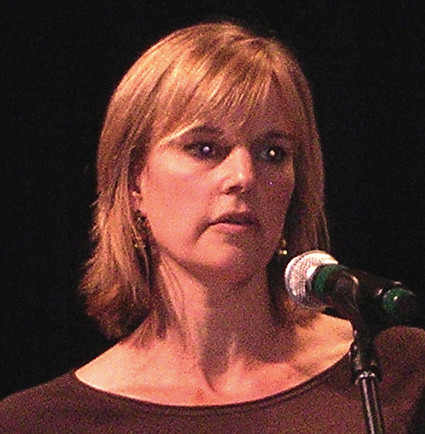
Katherine Bennett, a University of Washington sociologist, showed a graph of color disparities in drug arrests for major US cities relative to population and drug use. In Detroit, the US city with the smallest color gap, 1.2 black people are arrested on drug charges for every 1 white person. In San Francisco, where there is high disparity, this ratio is 7 to1. Seattle beats this with the highest ratio of all - a 10.7 higher arrest rate for blacks than for whites.
In 2005, we know from surveys that 20 million people had used illegal drugs in the past month, she said. Drug use is about the same among white people and black people. But drug arrests don't reflect this. We have, nationwide, an incarceration rate that is six times higher for blacks. Drug arrests don't reflect who is breaking the law - they reflect, among other factors, where the police find it easier to make arrests.
One of the arguments in favor of the war on drugs is that it helps people avoid addiction. But, while we have no evidence that a criminal justice approach reduces drug use, we do know that treatment and harm reduction work. When the member of a middle-class white family is arrested on drug charges, does the rest of the family say, oh good, it was time for him to get help? No, they hire a lawyer to keep him out of jail and then they arrange for treatment. Poor people don't have the same options.
Katherine Beckett, Associate Professor in the Department of Sociology at the University of Washington, is author of Making Crime Pay: Law and Order in Contemporary American Politics. Also see Drug Use, Drug Possession Arrests, and the Question of Race: Lessons from Seattle, Katherine Beckett, Kris Nyrop, Lori Pfingst, Melissa Bowen. Social Problems, Vol. 52, Issue 3, pp. 419-441
NEXT STEPS
Several organizers and community members introduced speakers, moderated questions, and spoke about "next steps". KL Shannon and Dustin Washington encouraged attenders to contact elected officials. A flyer provided with the program listed national and state legislators, Seattle's Mayor, and King County Councilmembers. Another suggestion was for attendees to host "Drug War Listening sessions" in their neighborhoods. Contact information was given for KL Shannon (klorganizer [at] yahoo) and Dustin Washington (dwashington [at] afsc [dot] org).
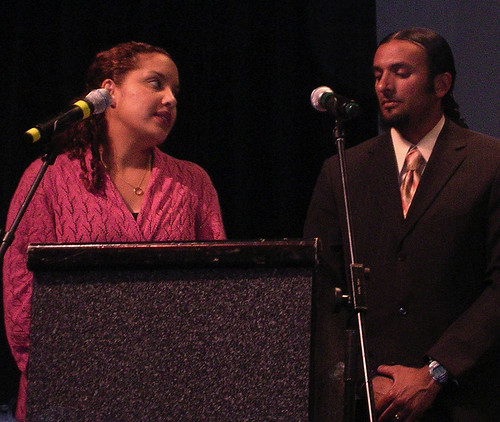 Alexes Harris. Assistant Professor at the Department of Sociology, University of Washington, and Sunil Abraham, staff attorney for The Defender Association. | 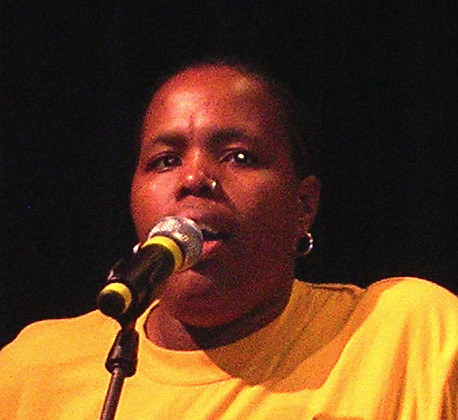 K.L. Shannon. Community organizer working on public safety and police accountability through the King County Bar Association's Racial Disparity Project. |
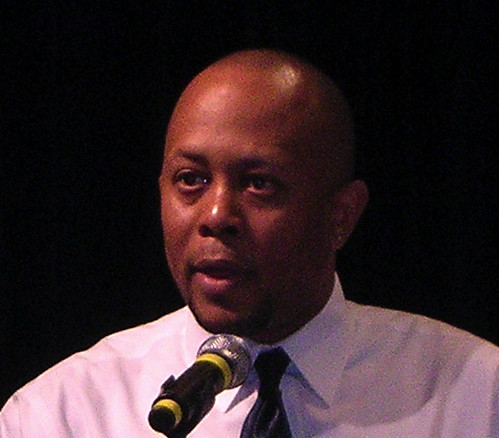 Dustin Washington. Youth community organizer for the American Friends Service Committee. | 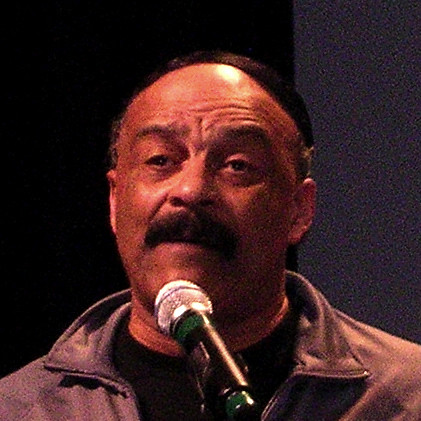 Eddie Rye Jr. Business leader and community activist who prompted King County to change its logo from the crown to the image of Martin Luther King Jr. |
POLITICAL POWER AND RACIAL DISPARITY IN THE WAR ON DRUGS
During the question and answer session, an audience member asked Katherine Bennett to explain why liberal Seattle might have the most pronounced color gap in drug arrests of all larger American cities. One theory, Bennett answered, is that Seattle has a relatively small percentage of black people in the population. This translates to less political clout. Clearly, this is an indication of the need, as Gossett pointed out, for multiracial coalitions to demand an end to the war on drugs -- and to address the divisions between people along color lines that diminish our collective political power. This is urgent in a state where the War on Drugs has helped lead to a 25% disenfranchisement rate for black men -- and a 17% overall disenfranchisement rate for black people.
National Disparities
Black people make up 12-13% of the US population. They comprise 40% of the US prison population. This is the largest prison population in the world, more than 2 million people of all races (Prisoners in 2005, US Dept. Justice).
- White people and black people use illegal drugs at about the same rate (US Department of Health and Human Services).
- Approximately 12% of the U.S. population is black.
- Therefore, we should expect slightly more than 12% of the drug arrests in the United States to be of black people.
- But the FBI's Uniform Crime Report for 2005 shows that 33.9% of the drug arrests in 2005 were of African Americans.
- This nearly a three-fold disparity widens between arrest and incarceration because arrest is only the first step in a process in which being African American is a disadvantage at every step.
- Once arrested, black people are 20% more likely to be convicted than whites. Black people also receive longer prison terms. In 2002, the average prison term of 105 months for blacks was 69% longer than the average of 62 months for whites. (The Sentencing Project).
- The collective result of these disparities and others brings us to a place where, today, more than 8% of African American men between the ages of 19 and 25 are in jail.
State Disparities
Washington's disparity is even more serious than the national average. For every 100,000 whites in Washington state, 393 were in state or local jails in 2005 -- compared with 2,522 black people, a 1 to 6.41 ratio (compared to a 1 to 5.55 ratio nationally (Table 14, Prison and Jail Inmates at Midyear, 2005, US Department of Justice.)
Our felon disenfranchisement laws compound the problem. According to a December, 2006 Amici Curiae (friend of the court) briefing in the case of Farrakhan v Gregoire, one-quarter of otherwise qualified black male voters, and almost 17% of the entire adult black population of Washington state are prohibited from voting because of prior felonies. It is difficult to contemplate that any of us can stand for such a situation for even a moment longer. And yet, as Gossett said, it is grassroots organizing -- a long-term process -- that is needed to build on what has already been accomplished and finally put an end to this.
EVENT ENDORSERS
African Youth United, ACLU, American Friends Service Committee, Casa Latina, Central Area Motivation Program, Central House, Coalition to Undo Racism Everywhere, Communities Against Rape and Abuse, Community Coalition for Environmental Justice, The Defender Association Racial Disparity Project, El Centro de la Raza, Fellowship of Reconcilation, Freedom Church, Greater Mount Baker Church, Intra Afrikan Konnection, Japanese-American Citizen's League, Justice Works, King County Bar Association, Latina/o Bar Association, Law Enforcement Against Prohibition, , Minority Executive Directors Coalition, NAACP, People of Color Against Aids Network, People's Coalition for Justice, People's Institute Northwest (local office of People's Institute for Survival and Beyond), Post Prison Education Program, Racial Justice Commission of the Chhurch Council, Rainier Beach Community Empowerment Coalition, Real Change, Seattle Young People's Project, Physicians for Social Responsibility-- University of Washington students' group, Village of Hope, The Zella Company, LLC
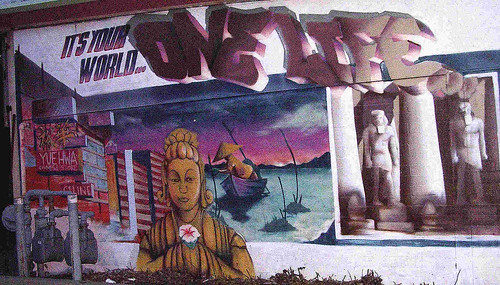
"It's Your World: One Life". Portion of a mural near the Rainier Valley Cultural Center.
| < Citizen juries and the initiative process | Mark Sidran for King County prosecuting attorney? > |
|

 |


Recommended Diaries
- No Tears From Me for Lonesome Brian Baird
For those of you who have not seen this from the Seattle Times, I have taken Mr. Westneat to task just
By The Left Shue (4 comments) - Bernie Sanders to the richest: via Youtube
What Bernie says -- in 2005 the top 1% of earners made more than the bottom 50% in the United States.
By chadlupkes (2 comments) - Terry Bergeson Has To Go - Do The Math
At the Thursday July 10th 36th Disctrict Democrat endorsement meeting, some people spoke in favor of Terry Bergeson. I thought they
By rmdSeaBos (21 comments) - Eye Candy from 08 Pride Parade
A girl has to have SOME fun. Above, 34th District Obama delegates Dinazina (moi) and Jody Rogers. This year I
By dinazina (7 comments) - It's election day somewhere.
The sun is hot and the calendar pages are flipping slow And so am I Election season passes like molasses in
By chadlupkes (3 comments) - Democrats MUST quit using Republican framing
I have been tearing my hair out reading all the nitpicky squabbling in cyberspace about minor differences in the platforms and
By eridani (7 comments)
Recent Diaries
By dlaw (2 comments)
By Daniel K (0 comments)
By Arthur Ruger (0 comments)
By Washington CAN (0 comments)
By dlaw (0 comments)
By fake consultant (13 comments)
By dlaw (0 comments)
By Arthur Ruger (0 comments)
By Fred (4 comments)
By dlaw (3 comments)
By Daniel K (1 comments)
By WA Spirit Matters (2 comments)
Related Links
+ Former Police Chief Denounces War on Drugs+ South End forum takes aim at failures and racism of the War on Drugs
+ Time to End the Drug War?
+ Getting the Message Out
+
+ $40 billion-per-year
+ Village of Hope
+ American Friends Service Committee
+ Racial Disparity Project
+ [2]
+ Law Enforcement Against Prohibition
+ Breaking Rank: A Top Cop's Expose of the Dark Side of American Policing
+ [3]
+ thehim
+ People's Institute for Survival and Beyond
+ [4]
+ Making Crime Pay: Law and Order in Contemporary American Politics
+ [5]
+ The Defender Association
+ [6]
+ [7]
+ [8]
+ Prisoners in 2005
+ US Department of Health and Human Services
+ Approximat ely 12% of the U.S. population
+ Uniform Crime Report for 2005
+ The Sentencing Project
+ Prison and Jail Inmates at Midyear, 2005
+ Amici Curiae
+ African Youth United
+ ACLU
+ American Friends Service Committee [2]
+ Casa Latina
+ Central Area Motivation Program
+ Communitie s Against Rape and Abuse
+ Community Coalition for Environmental Justice
+ The Defender Association Racial Disparity Project
+ El Centro de la Raza
+ Fellowship of Reconcilation
+ Greater Mount Baker Church
+ Intra Afrikan Konnection
+ Japanese-A merican Citizen's League
+ Justice Works
+ King County Bar Association
+ Latina/o Bar Association
+ Minority Executive Directors Coalition
+ NAACP
+ People of Color Against Aids Network
+ People's Coalition for Justice
+ Post Prison Education Program
+ Real Change
+ Seattle Young People's Project
+ More on Social Justice
+ Also by noemie maxwell
Washblog RSS Feeds
Political Contacts
Local Media
 Coastal/Grays Harbor
Aberdeen Daily World
Chinook Observer
Montesano Vidette
Pacific County Press
Willapa Harbor Herald
KXRO 1320 AM
Olympic Peninsula
Peninsula Daily News
Bremerton Sun
Bremerton Chronicle
Gig Harbor Gateway
Port Orchard Independent
Port Townsend Leader
North Kitsap Herald
Squim Gazette
Central Kitsap Reporter
Business Examiner
KONP 1450 AM
Sound and Islands
Anacortes American
Bainbridge Review
Voice Of Bainbridge
San Juan Journal
The Islands' Sounder
Whidbey NewsTimes
South Whidbey Record
Stanwood/Camano News
Vashon Beachcomber
Voice Of Vashon
KLKI 1340 AM
North Puget Sound
Bellingham Herald
The Northern Light
Everett Herald
Skagit Valley Herald
Lynden Tribune
The Enterprise
Snohomish County Tribune
Snohomish County Business Journal
The Monroe Monitor
The Edmonds Beacon
KGMI 790 AM
KELA 1470 AM
KRKO 1380 AM
Central Puget Sound
King County Journal
Issaquah Press
Mukilteo Beacon
Voice of the Valley
Federal Way Mirror
Bothell/Kenmore Reporter
Kirkland courier
Mercer Island Reporter
Woodinville Weekly
Greater Seattle
Seattle PI
Seattle Times
KOMO TV 4
KIRO TV 7
KING 5 TV
KTBW TV 22
KCTS 9
UW Daily
The Stranger
Seattle Weekly
Capitol Hill Times
Madison Park Times
Seattle Journal of Commerce
NW Asian Weekly
West Seattle Herald
North Seattle Herald-Outlook
South Seattle Star
Magnolia News
Beacon Hill News
KIRO 710 AM
KOMO AM 1000
KEXP 90.3 FM
KUOW 94.9 FM
KVI 570 AM
South Puget Sound
The Columbian
Longview Daily News
Nisqually Valley News
Lewis County News
The Reflector
Eatonville Dispatch
Tacoma News Tribune
Tacoma Weekly
Puyallup Herald
Enumclaw Courier-Herald
The Olympian
KAOS 89.3 FM
KCPQ 13
KOWA FM 106.5
UPN 11
Cascade/Okanogan
Ellensburg Daily Record
Levenworth Echo
Cle Elum Tribune
Snoqualmie Valley Record
Methow Valley News
Lake Chelan Mirror
Omak chronicle
The Newport Miner
Spokane/Palouse
The Spokesman-Review
KREM 2 TV Spokane
KXLY News 4 Spokane
KHQ 6 Spokane
KSPS Spokane
Statesman-Examiner
Othello Outlook
Cheney Free Press
Camas PostRecord
The South County sun
White Salmon Enterprise
Palouse Boomerang
Columbia Basin Herald
Grand Coulee Star
Walla Walla Union-Bulletin
Yakima Herald-Republic
KIMA 29 Yakima
KAPP TV 35 Yakima
KYVE Yakima
Wenatchee World
Tri-City Herald
TVEW TV 42 Tri-cities
KTNW Richland
KEPR 19 Pasco
Daily Sun News
Prosser Record-Bulletin
KTCR 1340 AM
KWSU Pullman
Moscow-Pullman Daily News

