Hearing on 3-Strikes Bill: Testimony and Progress
 "Michael ... is our adopted son who is in the Monroe State Reformatory under the 3-Strikes law. He's 36. I delivered him to heroin addict parents who didn't pick him up or show him any love because of their addiction. At 7 months, he refused to eat, was limp, almost starved to death, and was thought to be handicapped. We were able to take him in for foster care. In 3 months, we were able to restore him and he checked out normal. Later, we adopted him."
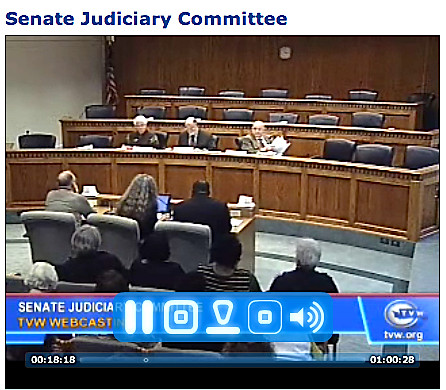
Dr. Larry Hoover, Retired obstetrician, 2/4/09, testifying in support of Senate Bill 5292. He is pictured seated at the table for public testimony on the left.
Bills to reform Washington's Three Strikes law have been introduced in the legislature each year for over a decade. Here's a list. Last Wednesday, a hearing was held for the most recent 3-Strikes reform bill, SB 5292, sponsored by Senator Adam Kline. I can't get the video to embed, but here's that link. My transcription of the testimony given at the hearing, including a question and answer session between Senator Kline and Tom McBride of Washington Association of Prosecuting Attorneys, (WAPA) is below the fold.
SB 5292 would remove Robbery 2 from the list of 3-Strikes offenses, one of two recommendations made in 2001 by Washington's Sentencing Guidelines Commission (SGC). (1)
Given the complexity of the problems that 3-Strikes proposes to address and the highly-politicized nature of criminal justice policymaking in recent years, it's not surprising that the decade-long effort to implement the 2001 SGC recommendations has so far resulted in no change to the law. There has been progress.
Senate Bill 5292 is endorsed by Washington State Commission on African American Affairs. It's supported by 23 organizations calling for reform or repeal of the law at Fix 3-Strikes. Washington's statewide Catholic, Lutheran, Quaker, and Unitarian Universalist policy organizations signed in to support the bill at the hearing, as did Washington ACLU, Seattle- Martin Luther King Jr. County NAACP, Black Policy Foundation, Washington Defender Association and Washington Association of Criminal Defense Lawyers.
Despite the recommendation of experts, broad-based public support, acknowledgment from WAPA that the law has resulted in inequity, and recent recognition in the media that change is needed -- including a prompting from the editorial board of the Seattle Times that legislators know the bill makes sense and should "buck themselves up and pass it" -- Democratic leadership may block this legislation.
Legislators try to avoid the accusation that they are "soft-on-crime", as the authors of the Seattle Times editorial note. The accusation gets it backwards. A substantial body of research establishes that 3-Strikes laws have uncertain crime reduction benefits, at best, and are much more expensive than proven methods. Removal of Robbery 2, the most common - and, in most cases, least serious - 3-Strikes crime, would be a major step toward making the law more equitable and effective. It would also help avoid absurd situations such as outlined in a 2/12/09 Everett Herald article, Yogurt Bomb Threat Brings Third Strike for 66 Year old. SB 5292 is a "smart-on-crime" reform that would improve the law and advance public safety.
Balances of Power
"There's two crimes, actually, on this list, that are problematic. And that's Robbery 2 and it's also Assault 2. There's a problem with how those crimes are defined, is there's really serious Robbery 2s and Assault 2s and there's ones that aren't. And nowadays, that's where you'll see the plea down from an Assault 2 to an Assault 3 or a Robbery 2 to a Theft 1... And nowadays, like I said, I think we did have a problem with cases early on. Nowadays we feel like we'll defend the individual cases and I think the facts are important on the individual cases. But what you're saying is exactly right. It's why we felt like there is an obligation for us to go look at those earlier cases because maybe we weren't applying the law in a rational manner. "
(Tom McBride testifying against SB 5292 for Washington Association of Prosecuting Attorneys.)
"In any case, you understand, as I do, that it's a legislative judgment, not a question of the Governor's good will as to whether a crime that is, in many cases, nonviolent, should be punished by being included on the list of strikes used to put people away for Life Without Possibility of Parole. That's a legislative judgment. I think we agree to that."
Senator Kline, during question and answer with Tom McBride at hearing for SB 5292, 2/4/09.
Recently, Washington Association of Prosecuting Attorneys (WAPA) and at least two county Prosecuting Attorneys have acknowledged concerns with the way the 3-Strikes law was applied in its early years and have taken initial steps to address these concerns. Specifically, the prosecutors acknowledge that they might not now ask for 3-Strikes sentences for some of the people now serving under the law -- particularly in Robbery 2 cases.
Tom McBride, speaking against SB 5292 for WAPA, explained that prosecutors, as a group, are willing to address this issue but oppose doing so through a removal of Robbery 2. Prosecutors have learned to work with the law, he said, and feel they are now applying it equitably. The clemency process should be used to address any past inequities, If it fails to achieve the intended aim, a legislative fix, perhaps an automatic review of sentences after 15 years could be contemplated.
This is a positive development and attests to the professionalism and decency of WAPA leadership and individual prosecutors. It is doubtful, however, that the clemency route can address the number of cases that need review. In addition, this proposal does not touch several 3-Strikes flaws.
These flaws include the fact that the law imposes the same rigidly harsh sentence for a wide variety of crimes; that it strips all discretion away from judges in cases of profoundly high stakes; that it imposes a punishment of unique severity for crimes associated with poverty in a state where defense for poor people is underfunded; (2) that it keeps people incarcerated long past the time they are likely to commit crimes, but when they are most expensive to house because of health care costs; and that it provides such a heavy hammer to prosecutors that it is believed to result in defendants pleading to crimes they did not commit -- either to non-strike crimes when they committed strike crimes, or, probably much more rarely, to criminal behavior of which they may be entirely innocent.
A heavy hammer
The 3-Strikes "hammer" is so heavy, that it can exert intense pressure on defendants and their attorneys to take almost any deal offered by prosecutors in exchange for avoiding Life Without Parole. Because this hammer is regularly used for such common crimes as Robbery 2 and Assault 2, there may be a significant unbalancing effect in our adversarial system of justice.
A scan of the list of 3-Strikes convictions gives a hint of one problem that might arise from such a power imbalance.. This list shows a precipitous drop-off in the number of jury trials for 3-Strikes cases since about 2000. I was told by a 3-Striker that he felt intensely pressured into relinquishing his right to a jury trial by being told by both prosecutor and defense attorney -- in the open courtroom on his first morning of the trial, that it was required of him to make an immediate decision as to whether he wanted a jury trial, that he wasn't permitted to confer with his family, and that if he did insist on a jury trial, he'd almost certainly lose his case.
Prosecutors cannot be faulted for using whatever tools are available to them to do their work according to their best professional judgment. However, they are just one set of players in an adversarial system that won't work properly if any side has outsized power.
WAPA's action is important and positive. It may lead to the correction of inequity in individual cases and collaboration among the major stakeholders toward a just and workable proposal for the legislature's consideration. It is worth noting that, before the 3-Strikes ballot initiative was voted on, King County Prosecuting Attorney Norm Maleng, was a leader in warning of the shortcomings of the law and working to significantly improve it.
Advocates for reform have also become more organized than they have been in the past, which may facilitate information sharing and even collaboration among stakeholders who might, without that political pressure brought to bear, be less likely to take action.
"And what I think you'll see and hear and what you've heard from some people today is that many of these low-level offenders are chemically addicted or mentally ill and would be better served with treatment rather than life-long incarceration. That was certainly the case for my client, whose name is Jackie Fletcher. She is currently serving a Three Strikes sentence. Ms. Fletcher was, unfortunately, an abused child, whose parents gave her drugs and alcohol beginning at the age of 8. She stole to support her drug habit. She struck out on all Robbery 2s. Before serving her life sentence, she was only sentenced to 20 months, total in Department of Corrections custody. So she went from a sentence of 20 months to Life Without pretty quickly. No one was injured in her crimes. And she provides a perfect example of how we need to redirect the funds that we spend to currently incarcerate people for Life Without to drug treatment and mental health treatment that could prevent these types of crimes in the first place."
(Beth Colgan, Columbia Legal Services, testifying at hearing for SB 5292 on 2/4/09.)
"The other problem is that, in King County at least, we are dealing in Robbery 2 cases is that you have someone who may be innocent, in fact, but you cannot take that risk. And those people are getting 10 years, 12 years. Those are the kind of deals that we're able to make with that. So, as an example, a young man I was dealing with a number of years ago who was charged with a Robbery in the second degree, he through no fault of his own had his medication taken away from him. Someone decompensates very quickly - and he's doing 10 years now on something that, probably, he didn't even do in the first place."
(Virginia Faller, public defense attorney, testifying at 2/4/09 hearing on Senate Bill 5292.)
Transcription (unofficial) of testimony
Check against video before citing/quoting.
Testimony of Earl Ford, Commissioner, Washington Commission on African American Affairs
Starting at 12:20
I represent Southwest Washington and Clark County on the Commission on African American Affairs. As you are aware, the Commission on African American Affairs was created in the state, by law, in 1992. We are in the Executive branch of state government and report directly to the Governor. The Commission has endorsed the reform of the Three Strikes sentencing law. We've taken this position because half of the men locked up under these guidelines in the State of Washington are Black. Many were convicted of low-level Robbery 2 crimes. We're proud to lend our support along with those of Washington's Fix Three Strikes Coalition, to this bill. We have added support of this bill as part of our legislative agenda. Additionally, we are encouraging our constituents around the state to join us here in Olympia on Monday, February 16 to take part in African American Legislative Day and to lobby their legislators on behalf of the passage of this bill. Thank you.
Testimony of Dr. Larry Hoover
Starting at 13:40
Michael James Hoover is our adopted son who is in the Monroe State Reformatory under the 3-Strikes law. He's 36. I delivered him to heroin addict parents who didn't pick him up or show him any love because of their addiction. At 7 months, he refused to eat, was limp, almost starved to death, and was thought to be handicapped. We were able to take him in for foster care. In 3 months, we were able to restore him and he checked out normal. Later, we adopted him.
I'm going to skip one part because, time-wise, I don't want to mess up.
With addicted parents, Michael had greatly increased chances of becoming an addict. With all the hurtful history, and in spite of extensive counseling, at age 18 he ended up on the streets and, eventually, using drugs. He succeeded in getting all his money-making skills blackballed so, even though he hated violence, he turned to robbery to support his habit. He knew it was wrong. But in his drug-injured mind, he felt he had no choice.
My understanding is that the 3-Strikes law exists to keep chronic criminals from the public. After three strikes, they are considered to have criminal minds, as it is part of them. Michael definitely does not have a criminal mind and has proved in attitude and deed both at Walla Walla and in Monroe (inaudible).
Within the last year he has come out of denial and realized that he didn't know about his sexual abuse, which by the way was for 6 months and undetected and in a group home, but now he needs to talk about it. He has become very responsible and very active in addressing the sheer injustice that he suffered. He is now proactive in improving his life, cheerful, and no longer angry. At least one of his strikes is second degree robbery. He never hurt anyone physically. I feel he is a perfect example of the weakness of the 3-Strikes law. I urge you not to put rehabilitate-able and contrite people like Michael in prison for life.
Testimony of Noemie Maxwell, Justice Works!
Starting at 17:07
Thank you very much for hearing my testimony. My name is Noemie Maxwell and I work on a volunteer basis with Justice Works! a grassroots criminal justice reform organization.
Over the past year I've read much of the research, history, and case law related Washington's 3-Strikes law. I've come to know a number of 3-Strikers and their family members and friends. I've talked with hundreds of people about this law - at community festivals, organization meetings, and other events. And I've heard over and over 'I voted for 3-Strikes but I didn't vote for this!' Many people are genuinely distressed to learn that they voted for a law that imposes life sentences for lower seriousness crimes.
Serious moral, fiscal, and public safety problems arise when we impose the same punishment for unarmed robberies as for Aggravated Murder I. Over the last decade, bills have been introduced each year to correct this flaw in 3-Strikes. This matter troubles the "soul" of Washington state and our current fiscal crisis increases the urgency. I thank the members of this committee, for addressing this matter, especially Senator Kline. I'd like to draw the committee's attention first to two documents:
A 2001 recommendation of Washington's Sentencing Guidelines Commission:
"that the legislature ... remove Robbery 2 from the list of offenses that constitute a strike under the persistent offender statute; and...that the Legislature examine the circumstances under which a charge of Assault 2 applies and examine under what circumstances, if any, should Assault 2 be treated as a strike..."
(Washington Sentencing Guidelines Commission, 2000-2001, Comprehensive Review and Evaluation of Sentencing Policy in Washington State.)
And the second document is attachment 2. It's a statement that references this recommendation and calls for reform or repeal of Washington's 3-Strikes law. it's signed by 23 organizations.
Fix Washington's 3-Strikes Law, accessed 2/3/09, http://fix3strikes.org.
I'd also like to note a number of things that are public safety and fiscal concerns related to life sentences for lower seriousness crimes.
First, it's not an effective crime reduction method. Research shows that 3-Strikes laws have uncertain benefits that are, at best, of low cost-effectiveness compared with proven methods.
Two, 3-Strikes laws may have a small or moderate deterrence effect on less violent crime - but here's a body of research now that shows they appear to "incentivize" some violent crime. In cities where 3-Strikes laws are in effect, homicide rates are 10-12% higher than expected.
Three, it's not a good fiscal choice. When you're incarcerating people past their maximum standard terms you're keeping them in prison when they are old and they cost more to incarcerate and they're less likely to commit crimes.
Four, current prosecutorial standards -- just very quickly, in the first six years of the law, 44 times Robbery 2 (as a third conviction) was the basis of a 3-Strikes sentence. In the next six years, only 8 times. And the public record shows that workarounds - plea bargain workarounds, are being used regularly with this law and there is concern that there is actually pretty widespread impact on our criminal justice system. Robbery 2 is a very common crime.
That's it?
Senator Kline: Sorry. Pretty close.
Thank you. I had more!
Testimony of Tom McBride, Washington Association of Prosecuting Attorneys
Starting at 21:17
Thank you Mr. Chair, members of the Committee. For the record, I'm Tom McBride with Washington Association of Prosecuting Attorneys.
As you indicated, we are not supporting Senate Bill 5292. Before we get to the specifics of the bill, really quickly, in the bigger picture, we've opposed both the expansion and constriction of the 3-Strikes law. You've had bills before you to add manufacture of meth to 3-Strikes, which we've testified against, to add additional sex offenses, child molestation third degree and we've opposed those. But we've also opposed the restriction. Part of that's because we've learned how to use this law, we've learned how to defend this law. And I want to talk about section II particularly, because that's the part of this bill where you say that you're going to re-sentence cases where there was a Robbery 2 conviction.
You need to realize that re-sentencing in many if not most of the situations is just going to lead to a release because we can't do an exceptional sentence any more after Blakely was decided by the US Supreme Court. There's no fact-finding to support saying, yes, this was three Robbery 2s, but we're going to do a 10-year sentence instead of a life sentence.
You know, the standard range for three Robbery 2s, we've kept it real low because the first time someone did this we wanted to have flexibility. If you have three Robbery 2s, your standard range is 15-20 months. And I think that's part of what led to the initiative to come forward. I also want to say we can't reach back and see what considerations were made at the time. Is there more history than just the three strikes listed? Were there other charges available? But, quite frankly, because "life is life is life", they weren't considered.
The most important thing I need to say to you before the clock runs out is that statement that an earlier speaker spoke about how there were 44 cases in the first 6 years and 8 in the last 6 years, I think that's really important. Before this committee over the last two years what we've told you is 'we do need to go back and look at those early cases because when the citizens passed this initiative they told us "you shall file". And in the first two years or so there was consideration of are we supposed to be looking at taking a Robbery 2 down to a Theft 1 to avoid these consequences. I think that's widely accepted now, but maybe not then.
The two counties that have the most cases are King and Snohomish Counties. The prosecuting attorneys in those two counties, Dan Satterberg in King and Janice Ellis in Snohomish, agreed to go back and look at those cases and see, would they still be handled in the same way, the way we currently defend and interpret this law. We know the result of that in at least one case there was a recommendation by Dan Satterberg to the Clemency and Pardons board and to the Governor that there should be clemency granted in the case of Mr. Dozier. I also know there's two more cases before the Clemency and Pardons board on the June calendar of this year and what I would suggest to you is -- If Clemency and Pardons is not a viable option for release under Three Strikes, or some sort of recognition of rehabilitation, then you do need to create that option.
What we would say to you is that we do believe that it is. That's part of our testimony in years past, that clemency and pardons should be available. I think we're going to know this year whether it really is available or not. And if it's not, we all have a problem. If it is, what I'd suggest is that's where these cases -- where the person has changed, circumstances have changed, we need to go forward. I'm sorry for running over time.
Senator Kline
Questions?
I have my own questions. First I want to state my appreciation for the Association of Prosecuting Attorneys' conduct in this matter. You guys have been very above-board in your dealings with it. You have, in fact, sent the word out to prosecutors to take a look at the prosecutions that they filed, that they or their predecessors filed, in the early stages of the initiative that was passed in 1995, I think, in which they had some concerns apparently that the law said "Shall" - meaning that they had no discretion - as opposed to "May". And that they may have, in fact, some of them felt that they had filed cases on a strike, where the guy had two priors, that they might not have filed. And asked them to voluntarily to go look at those cases. In fact, Prosecutor Satterberg has (done this) in the (can't hear) case, I believe there's one other. They're now up for clemency before the governor. And I appreciate that the prosecutors have been very, very aboveboard about that.
One thing, though. I want to question you about ... two things. One: 15-20 months would be the sentence on a third Robbery 2 where both priors were Robbery 2. Let me guess that's assuming that no other priors - obviously other felonies would add points.
Tom McBride
Right.
Senator Kline
But isn't it significant that we take an offense which the legislature ruled was worth a judge considering between 15-20 months, and make that offense into Life Without Possibility of Parole? And do it by initiative which there was no opportunity for amendment, no discussion among legislators - couldn't we amend that, couldn't we add this, couldn't we take this out? That a popular vote on an issue of criminal law, you know what the answer's going to be going in - 15-20 months to Life Without Parole? Isn't that significant?
Tom McBride
And I think that's why we've said we have to go back and look at this. There's two crimes, actually, on this list, that are problematic. And that's Robbery 2 and it's also Assault 2. There's a problem with how those crimes are defined, is there's really serious Robbery 2s and Assault 2s and there's ones that aren't. And nowadays, that's where you'll see the plea down from an Assault 2 to an Assault 3 or a Robbery 2 to a Theft 1. And at the start, that concern was, we take an oath to follow the law, not to pick and choose which ones to follow and it was, well, we "shall file" and I think we made that adjustment.
But I do want to say, that you said earlier that Robbery 2 is a nonviolent crime. And I'm not sure I agree with that. Respectfully, I'd just like to say that it requires the use of force. And sometimes the use of force isn't significant, and sometimes it is. And nowadays, like I said, I think we did have a problem with cases early on. Nowadays we feel like we'll defend the individual cases and I think the facts are important on the individual cases. But what you're saying is exactly right. It's why we felt like there is an obligation for us to go look at those earlier cases cause maybe we weren't applying the law in a rational manner.
Senator Kline
Thanks.
I have a second question for you. It's about the Clemency and Pardons Board. The Governor has two separate authorities granted to her under the Constitution and by statute. She can grant clemency to somebody who is guilty and commute a sentence. She can pardon somebody and render him, him or her, effectively not guilty, which is a complete forgiveness of the crime. It's not something that a governor does lightly. Any governor. Even Governor George Ryan of Illinois, who, historically, commuted a wide variety of cases under Illinois' death penalty ... Do you seriously believe that, as hundreds of people - 292 currently and growing, as that population increases, that any governor, this or any other, is going to use his or her constitutional power frequently enough to be able to take out all the people who have been either unjustly convicted or rightly convicted but sentenced to Life Without when their sentence should have been a finite number of years?
Tom McBride
That's a great question. And that's why I say we'll see this year whether the political dynamics are such that clemency is not really, not really going to happen. And then we have a problem. What I would say is -- and you alluded to something but I'm not sure everybody knows here - is that the (inaudible) has taken a public position to support the clemency petition. It's important for us to see that, if we're willing to come forward and say that this case isn't one that we're willing to continue to defend. Or that we think that the person has just changed enough and availed themselves of the (inaudible) in prison, yeah, if we start seeing that situation where everybody agrees that this is a case that deserves clemency and it doesn't happen, you're right - we need to come back and create a mechanism - an automatic review in 15 years or something like that. But what I would say is that I'm not sure I agree with you that it's not an option. And I'm not asking you to wait forever. I believe we'll know this year.
Senator Kline
So you'll understand - even if the Governor does grant clemency, or pardon, I forget which of those two...
Tom McBride
Clemency.
Senator Kline
There are 139 people who are in under 3-Strikes for a combination of offenses one or more of which is a Robbery 2. The Governor may give clemency to one or two people. There may be more.
Tom McBride
But let me answer that. Because that's a great question. And I don't mean to interrupt you. But you and I have had long conversations about this. You can't just throw out the big numbers. You've got to look at the specific cases and the facts of those cases. And so, if specific cases come forward that the average person looks at and says, yeah, that seems unreasonable, that seems too harsh. And that's wrong. That's great. But to throw out the big numbers, the 100 the 200 and that - that doesn't answer the question of whether we might look at some of those cases and say "holy cow, this was entirely appropriate!" And so I think that's part of the problem with the legislature dealing with this is that people haven't brought forward the details of specific cases to talk about and see if we should agree or disagree on what should happen with them.
Senator Kline
In any case, you understand, as I do, that it's a legislative judgment, not a question of the Governor's good will as to whether a crime that is, in many cases, nonviolent, should be punished by being included on the list of strikes used to put people away for Life Without Possibility of Parole. That's a legislative judgment. I think we agree to that.
Testimony of Dave Johnson, Washington Coalition of Crime Victim Advocates
Starting at 31:24: from written testimony:
Resolution Opposing SB 5292This resolution was adopted by the Legislative Committee of the Washington Coalition of Crime Victim Advocates (WCCVA) on February 3, 2009.
The members of the Washington Coalition of Crime Victim Advocates (WCCVA) oppose adoption of SB 5292, modifying the list of crimes that are included as "most serious offenses" for the purpose of sentencing persistent offenders. This legislation proposes to remove Robbery in the Second Degree from the list, and to re-sentence persistent offenders whose existing sentences were based on conviction of this crime. It is the position of the members of WCCVA that this legislation reflects a failure to recognize the harm that is often caused by the crime proposed for removal from the "most serious offenses" list, and poses a serious threat of harm to future victims from offenders who persist in committing this or other violent crimes.
Robbery in the Second Degree is a violent crime that involves taking property from another person through the use or threat of force, violence, or fear of injury. It is commonly charged in cases of street muggings, purse snatches, and other strong-arm robberies in which a person uses the advantage of physical strength to unlawfully obtain the property of someone who is vulnerable.
People get hurt in these robberies, sometimes physically, sometimes through the impact of the trauma on their freedom to live their lives as theyi choose. Elderly or disabled people who no longer feel safe when they leave their homes, students whose focus on learning is preempted by fears for their safety, and working people who know their job situations make them attractive targets of robbers all have their lives significantly diminished in the aftermath of a Second Degree Robbery, even if they are not seriously injured physically.
Though the proponents of SB 5292 downplay the seriousness of the crime they propose to delete from the "most serious offenses" list, it is lear to the members of WCCVA that it is in fact a crime that can and does inflict serious harm on victims. By removing it from the list, SB 5292 would allow offenders who have established a clear pattern of committing violent offenses to continue to engage in behavior that harms the victims of their crimes.
The members of WCCVA do not oppose reviewing laws that have been adopted in the past in order to evaluate the impact and effectiveness of those laws. Changes should be considered if experience shows they are necessary to enhance the effectiveness of those laws. Changes should be considered if experience sows they are necessary to enhance the effectiveness of the law or to achieve other compelling public policy objectives. In the case of statues pertaining to persistent offenders, the members of WCCVA are willing to enter into a reappraisal of the crimes listed as "most serious offenses." However, the primary criterion for remaining on the list is the degree of harm each crime inflicts on the victims.
Furthermore, any change in the law that requires a retrospective review of sentences already imposed must allow a case-by-case review of the specific acts of the offender and the injuries sustained by the victim. Crimes that meet the legal definition of another "most serious offense," such as Assault in the Second Degree or Robbery in the Second Degree, should not be removed as a "most serious offense" for the purposes of sentencing that offender.
The changes proposed in SB 5292 would clearly weaken public safety protections inherent in eisting law and would unnecessarily expose future victims to substantial and foreseeable harm.
Testimony of Tony Orange, Political Action Chair, Seattle Martin Luther King Jr. County NAACP
Starting at 35:24
Good Afternoon. Chair Kline, members of the Senate Judiciary Committee. As indicated, I am Tony Orange and I am the Political Action Chair for the Seattle - Martin Luther King Jr. County NAACP. On behalf of our President, James Bible, and our Executive Committee, I, like others, come today, to share my strong support for Senate Bill 5292's removal of Robbery 2 from the Three Strikes law and, hopefully, its disparate impact on African Americans. Thank you.
Testimony of Amy Bates, Chair, Black Policy Foundation.
Starting at 36:20
Thank you very much, Mr. Chairman and members of the Committee. My name is Amy Bates and I am the Chair of the Black Policy Foundation.
The communities that I represent overwhelmingly support Senate Bill 5292 and we thank the members of the committee for their forethought and their work.
First, I must state that we recognize and are sensitive to crime victims. I am personally a crime victim and understand that many of the participants here today have either been the victim of or know victims of crime. We ask for your support of this bill that will serve as a first step in remedying a very different type of crime, the proliferation of injustices and inequities within our justice system as exemplified under the implementation of 3-Strikes - which includes Robbery 2 - upon marginalized and underrepresented communities. African Americans are disproportionately represented at a rate nineteen times their white counterparts and one of the crimes underpinning this disparity is Robbery 2.
In addition, I ask that you please consider the following issues. Our justice system is currently overtaxed in terms of proper housing of offenders. The cost of housing offenders is a burden upon taxpayers. And, finally, with our economic challenges, we can anticipate that crime rates will increase. And I ask you if is it just to incarcerate for life those who have violated this aspect of the 3-Strikes law. Is it just for those incarcerated? And is it just for those burdened with an over-taxed tax system? Is it just for our communities?
We recognize that this is only the beginning of the reforms necessary to provide justice and equity within the criminal justice system. But we appreciate this start and we encourage the passage of this bill.
Mr. Chairman and committee members, I again thank you on behalf of The Black Policy Foundation and the communities that we represent.
Ramona Brandes, Washington Association of Criminal Defense Lawyers and the Washington Defender Association
Starting at 38:30
Thank you. My name is Ramona Brandes. I'm with the Washington Association of Criminal Defense Lawyers and the Washington Defender Association.
I've been a public defender for 13 years. In 2004 and 2005 I practiced 3-Strikes law exclusively and had an opportunity to see a number of defendants who were facing a third strike and had prior Robbery 2 convictions or were facing Robbery 2 convictions at the time. I also have in my office defenders who represent, solely, 3-Strikes victims.
One of those is facing a charge on a Burglary first degree where he was waiting in a car where a group of men went in and told him that they were going to retrieve property that belonged to them. They actually went in and beat up the victim. He came in. They handed him a computer and he walked out with it and he's charged as an accomplice. He has two robbery second degrees. He is low functioning and easily led by others, according to evaluations. He was in special education and dropped out in the 11th grade. He has a serious crack addiction. And on a standard range for this crime he would still be facing a range of 87 to 116 months. The Robbery 2 convictions that make this conviction that he's facing a third strike occurred in the early 1990s. One was a purse snatching where no one was hurt and the woman got her purse back. The other was a fight with a homeless man under the Alaska Way Viaduct over three dollars that they both saw on the ground at the same time.
This defendant facing a third strike is, in my opinion as a defense attorney, unreasonable and his standard range sentence is certainly sufficient to penalize him for the conduct that he engaged in. I recall two other Robbery 2 cases, one of which was facing a third strike. It was a grab and go shoplift. What I mean is that a man was in a store, had an item, grabbed it, ran out, or reached into the till, tried to grab some money, and ran out. And, but for spunky clerks, these would be theft third degrees.
However, we do have some very heroic members of our community and, in one case where he had grabbed $5 bills and $1 bills, the clerk slammed the cash drawer on his hand and he pushed the clerk away and he's facing his third strike.
The fiscal cost of a third strike - you know what you face from Department of Corrections. What you haven't heard when over 50% of the people who are being struck out are Robbery 2 cases, you need to consider that. In addition, there's the added fiscal cost in both the prosecutor and defense departments of defending these. These are special pay cases, which cost far above the normal felony.
Testimony of Virginia Faller
Starting at 42:30
I'm Virginia Faller. I'm with The Defender Association in Seattle but I'm speaking on my own today, I haven't vetted this with anyone.
When the 3-Strikes law first came into practice I did third strikes cases for two years and recently had most of my caseload be persistent offender cases for four years. During this time a number of my clients have had Robbery 2 or Assault 2 as either their final strike or as the prior strikes. And I think there are many problems with this, whether we are talking about fiscally what it means to take people and keep them for the rest of their lives.
I know that one example is a client I had who was very retarded and very suicidal and because of that was kept at Monroe because he could not maintain competency in King County Jail. When I first when out to Monroe to visit him they were just starting to see the need to have a geriatric unit and were starting to build that. And the last time I went out to Monroe I think they were working on the third geriatric unit and that will just continue to go up. And I think that's something that we need to look at.
As Ramona said, we fund these differently, the way they're done in the first place. We have two attorneys who work on these and the way we do them is like death penalty cases because Life Without is different, just as death penalty cases are. The good thing about that is that we can often find out what the mental condition of clients are who have never been diagnosed in the past. We find people who should have been found that they have fetal alcohol, for instance, those easily-led kind of people. And those are the kind of people who particularly get caught with Robbery 2s and that kind of crime.
The other problem is that, in King County at least, we are dealing in Robbery 2 cases is that you have someone who may be innocent, in fact, but you cannot take that risk. And those people are getting 10 years, 12 years. Those are the kind of deals that we're able to make with that. So, as an example, a young man I was dealing with a number of years ago who was charged with a Robbery in the second degree, he through no fault of his own had his medication taken away from him. Someone decompensates very quickly - and he's doing 10 years now on something that, probably, he didn't even do in the first place.
Testimony of Beth Colgan, Columbia Legal Services
Starting at 42:30
Thank you. For the record, my name is Beth Colgan. I'm the managing attorney of the Institutions Project at Columbia Legal Services. We're here to testify in support of the bill.
I want to address a couple of the points that have been raised today. One is with the scope of what was intended with the Three Strikes bill that was originally passed into law. And there has been some commentary about it not intending to catch these low-level offenders. I think that's absolutely true. And what I think you'll see and hear and what you've heard from some people today is that many of these low-level offenders are chemically addicted or mentally ill and would be better served with treatment rather than life-long incarceration.
And that was certainly the case for my client, whose name is Jackie Fletcher. She is currently serving a Three Strikes sentence. Ms. Fletcher was, unfortunately, an abused child, whose parents gave her drugs and alcohol beginning at the age of 8. She stole to support her drug habit. She struck out on all Robbery 2s... No one was injured in her crimes. And she provides a perfect example of how we need to redirect the funds that we spend to currently incarcerate people for Life Without to drug treatment and mental health treatment that could prevent these types of crimes in the first place.
One of the things we hear when we talk about Ms. Fletcher's case is, well isn't she a perfect case for clemency? And I do want to address that issue that has come up today. I may be the only person in the room today who has actually participated in the clemency process. I wish I could be here to tell you that I was always successful. I was always successful in front of the clemency board. But I can tell you that that does not result necessarily in a decision by the Governor to grant clemency. And as Senator Kline said, that is not incumbent upon this Governor or any other Governor - it is a reality of the clemency process.
And I think what's important to note is what you alluded to, Senator Kline, is that there's a large number of people. My office did a little research to see if there are any other examples of mass clemencies of this type other than Governor Ryan in Illinois. And in the history of the United States we were able to find only about another three examples, which is telling. The process is not designed for that. It's an expensive process, and it only currently is directed at King County and Snohomish County, as we learned earlier.
This is an expensive thing for the prosecutors to undertake and they should get credit for the work they've been doing. We're very grateful that that's occurred. But it shouldn't come from only two counties. And so we would suggest that it is important to take a look at these on a broader policy level and of course the ability of the legislature to do that is not rescinded by the fact that the clemency process exists.
NOTES
- SGC also recommended in 2001 that the legislature evaluate whether any forms of Assault 2 should remain on the 3-Strikes list as some forms are probably not commensurate with life sentences. Assault 2 is defined as a crime of recklessness in state law and can be a barfight, a streetfight among young men, or a fist fight in an overcrowded jail cell.
- "The lack of meaningful standards and the failure of the State to monitor indigent defense services has resulted in a checkered system of legal defense with no guarantee that a person who is both poor and accused will get a fair trial." (The unfulfilled promise of Gideon, Washington�s Flawed System of Defense for the Poor, ACLU Washington, 2004.)
| < Military suicides at all time record high - How we CAN help | Transit Oriented Development Bill Misses the Boat as Written > |
PNW TOPIC HOTLIST

Recommended Diaries
- Free Speech for People moves forward in Washington State
At my urging, Senator Jacobsen has introduced a Senate Joint Memorial asking for Congress to submit to the states a Federal
By chadlupkes (1 comment) - State Budget Craters By $2 Billion More. The Good News Is....
... Now Progressives are going to have to stop talking about tax hikes and start talking about the value of government.
By dlaw (20 comments) - Why Aren't We Fighting for a State Income Tax?
I am getting really tired here: I've been asked to sign petitions and send emails by almost any advocacy group that
By ktkeller (24 comments) - We Want to Take You and We Will Nyah Nyah
Last week I'm watching a podcast of Monday's House Local Government and Housing Committee because I'm interested in the Executive Session
By ktkeller (7 comments) - Online Voting Rights for Overseas Military Personal
Having been deployed during an election I have some very passionate views on this issue. I have seen my friends simple
By dorsolplants (20 comments) - A Modest Proposal: How to Cut Education Funding
As cited in a recent Seattle P-I article, Sen. Rosemary McAuliffe, chairwoman of the state Senate education committee, warned that budget
By OrneryDemocrat (9 comments)
Recent Diaries
By eridani (0 comments)
By eridani (1 comments)
By Lurleen (0 comments)
By Lurleen (0 comments)
By ThinkerFeeler (0 comments)
By m3047 (0 comments)
By The Democratic Legislative Campaign Committee (5 comments)
By eridani (9 comments)
By rmdSeaBos (4 comments)
By Lurleen (0 comments)
Related Links
++ Here's a list
+ SB 5292
+ that link
+ recommenda tions
+ Washington State Commission on African American Affairs
+ Fix 3-Strikes
+ "buck themselves up and pass it"
+ substantia l body of research
+ Yogurt Bomb Threat Brings Third Strike for 66 Year old
+ the list of 3-Strikes convictions
+ video
+ http://fix 3strikes.org
+ More on Criminal Justice
+ Also by noemie maxwell
Washblog RSS Feeds
Political Contacts
Local Media
 Coastal/Grays Harbor
Aberdeen Daily World
Chinook Observer
Montesano Vidette
Pacific County Press
Willapa Harbor Herald
KXRO 1320 AM
Olympic Peninsula
Peninsula Daily News
Bremerton Sun
Bremerton Chronicle
Gig Harbor Gateway
Port Orchard Independent
Port Townsend Leader
North Kitsap Herald
Squim Gazette
Central Kitsap Reporter
Business Examiner
KONP 1450 AM
Sound and Islands
Anacortes American
Bainbridge Review
Voice Of Bainbridge
San Juan Journal
The Islands' Sounder
Whidbey NewsTimes
South Whidbey Record
Stanwood/Camano News
Vashon Beachcomber
Voice Of Vashon
KLKI 1340 AM
North Puget Sound
Bellingham Herald
The Northern Light
Everett Herald
Skagit Valley Herald
Lynden Tribune
The Enterprise
Snohomish County Tribune
Snohomish County Business Journal
The Monroe Monitor
The Edmonds Beacon
KGMI 790 AM
KELA 1470 AM
KRKO 1380 AM
Central Puget Sound
King County Journal
Issaquah Press
Mukilteo Beacon
Voice of the Valley
Federal Way Mirror
Bothell/Kenmore Reporter
Kirkland courier
Mercer Island Reporter
Woodinville Weekly
Greater Seattle
Seattle PI
Seattle Times
KOMO TV 4
KIRO TV 7
KING 5 TV
KTBW TV 22
KCTS 9
UW Daily
The Stranger
Seattle Weekly
Capitol Hill Times
Madison Park Times
Seattle Journal of Commerce
NW Asian Weekly
West Seattle Herald
North Seattle Herald-Outlook
South Seattle Star
Magnolia News
Beacon Hill News
KIRO 710 AM
KOMO AM 1000
KEXP 90.3 FM
KUOW 94.9 FM
KVI 570 AM
South Puget Sound
The Columbian
Longview Daily News
Nisqually Valley News
Lewis County News
The Reflector
Eatonville Dispatch
Tacoma News Tribune
Tacoma Weekly
Puyallup Herald
Enumclaw Courier-Herald
The Olympian
KAOS 89.3 FM
KCPQ 13
KOWA FM 106.5
UPN 11
Cascade/Okanogan
Ellensburg Daily Record
Levenworth Echo
Cle Elum Tribune
Snoqualmie Valley Record
Methow Valley News
Lake Chelan Mirror
Omak chronicle
The Newport Miner
Spokane/Palouse
The Spokesman-Review
KREM 2 TV Spokane
KXLY News 4 Spokane
KHQ 6 Spokane
KSPS Spokane
Statesman-Examiner
Othello Outlook
Cheney Free Press
Camas PostRecord
The South County sun
White Salmon Enterprise
Palouse Boomerang
Columbia Basin Herald
Grand Coulee Star
Walla Walla Union-Bulletin
Yakima Herald-Republic
KIMA 29 Yakima
KAPP TV 35 Yakima
KYVE Yakima
Wenatchee World
Tri-City Herald
TVEW TV 42 Tri-cities
KTNW Richland
KEPR 19 Pasco
Daily Sun News
Prosser Record-Bulletin
KTCR 1340 AM
KWSU Pullman
Moscow-Pullman Daily News

