Roz Jenkins on Outreach: What Would it Mean to get What We're Asking For?
Rosalund Jenkins, Executive Director of Washington's Commission on African American Affairs , recently spoke with a small group of Democrats about outreach. She spoke off-the-cuff for an hour, giving a relaxed presentation as we sat in a circle at the Burien library. Roz talks much faster than I can write. I wasn't able to capture everything. What I offer here is my interpretation, including some paraphrasing. I have omitted the questions that people posed to her and have reported only the responses.
From nothing to something through the obvious
The way you go from nothing to something, Roz told us, referring to the Democrats' need to improve their ongoing communications with their constituency, is by "doing the obvious". That means setting up organizational and information systems that expand the Party's ongoing ability to connect with people. Then you make those connections. You invite people to participate and you invite them year-round, not just at election time. You build relationships. Roz described some of her experiences on the Commission to illustrate how 'doing the obvious' can help move an organization from a more reactive state to a position that allows it to better fulfill its mission.
When Roz accepted her position in December of 2005, she was the fourth person in that role in a 3-year period. She had been asked to apply for the position in previous years but it hadn't seemed to her that the right people were in office. This time, she said, "it hit me like a clapper hitting a bell" that this was the moment. With the Gregoire administration in place, good things could happen. And there was a wellspring of new community interest in government sparked by the appalling leadership in Wash DC. It was a time to get things done.
Roz was one of 50 or 60 people who applied for the position. She was considered a dark horse and she wasn't initially supported by some of the main political players in the African- American community. When she made it through, when she was selected, she felt very clear about her direction. She'd been hearing talk for years about what the Commission needed. She felt that, above all, there was a deficit of public belief that the commission had potential and creativity. She wanted to fix that.
The commission is legislatively mandated to provide policy research, positions, and recommendations to the Governor. In recent years, this mission had remained largely unfulfilled. The nine volunteer commissioners, busy people to begin with, had been expected to spend so much of their time at ribbon-cuttings and constituent problem-solving, that there was little opportunity to attend to the policy deliverables.
I think this applies to many advisory commissions, Roz said -- they get involved in all kinds of go-to work and don't get to the policy side of things. Public policy can have an intergenerational timeframe and we're not used to following through on issues across five or six legislative sessions, for example. And policy needs to be pursued not only through the legislative process - but also after laws pass. The way laws are implemented by the administrative agencies can have more effect than the question of what laws get passed to begin with.
Organizational Traction
So Roz's first priority was to get organizational traction. A redesign was needed so that the outreach, problem-solving, and ceremonial aspects of the job would inform rather than supplant, the organization's policy work.
Roz recruited subject-expert advisors from the community to assist the commissioner. She expanded the organization's focus to include what happens with laws after they pass and at the crucial time when the administrative agencies are actually implementing them. She created a system to facilitate communications with the commission's constituency. In her short tenure, the commission expanded its database from about 300 names to approximately 10,000. In addition to these improvements, Roz recommended to the Governor's office some adjustments to how Commissioner slots were apportioned. In recent years there had been defacto underrepresentation. The Governor's most recent appointments corrected the problem by selecting several new members from King County.
The efforts are paying off. In 2004, the Commission's legislative action day attracted 250 attendees. In 2005, it attracted over 1,000. The idea, Roz said, is to have basic continuity with the community.
What does this mean for Democrats?
Level of effort, level of sophistication, and level of penetration
The two parties, Roz said, are still not reaching the grassroots. It's not just a failure to reach African-American people - or people of color in general. There are a whole lot of folk who need to be involved -- Black, White and everything else. Most people are working and shopping. They may have one or two close-to-the-heart community activities, such as involvement in their children's schools. But they're not aware of their connection with the political realm.
The level of involvement for Black people is even a little bit less than for White people. And yet we were able on the Commission, with a paid staff of only two, to get a thousand people to our event. You can't get that kind of turnout unless you have three things in your outreach: level of effort, level of sophistication, and level of penetration.
Level of effort. You say you want to be involved in the community. And so you ask yourself, what organizations are out there? That's a good question. But here's a better one. Many members of your constituency are not going to belong to those organizations. In these days, information comes into people's homes because they know someone, because they use the Internet, or from TV. What we're doing right now could have been televised. Reporters and producers are continually looking for stories. So you've got to reach out directly to the constituents and also to the media. The direct constituent outreach brings more results. But in both cases, it's a simple question of just doing it.
And when you do go to an organization to network, you can't ask them to do your job for you. But what you can do, and what organizations on the Right do, is to share your lists of names. They're doing this on the other side of the fence. You know there are evangelical organizations that have given all their names to the Republicans. The Democrats can't do that, but organizations on the Left, in general, have got to learn to share their information more.
And the level of penetration. Let's compare, for example, how Washington's Office of Minority and Women's Business (OMWBE) operates and how the IRS collects tax. OMBWE goes to the Urban League meetings and to many other organizations and it gives presentations. Is that how the IRS collects tax? Through presentations? No. They send a form to every single business. Why is there a different level of effort with OMBWE? This isn't just effort and penetration, this is sophistication, too.
The Democratic party needs to use the marketing tools that are out there. Equifax, for example, provides very sophisticated breakdowns. If I were in the 37th legislative district I'd get a map from the postal service. I'd go through the district and identify the zip code areas I wanted to do outreach to. I'd ask for an income cut from Equifax. And then I'd send every working-class constituent something from the party.
The other aspect to sophistication is getting out a message that matters. This is a disconnect with the Democrats. You all are not talking about what matters to Black people. Many Black people are church-going. They're social conservatives. They're interested in business. You've got to tailor your message and recognize those interests.
A message that matters
The Democratic party is always talking about what people should care about. You forget to talk about what people do care about. Black people, like most people who are working class, care about gas prices. They care about the price of rent, of health care. Black people who have money care about the same things - but in different ways. And, actually, there's much more similarity between working class Black people and working class White people than there is between the rich and poor of either group. The commonalities among working class people across race are much more important than those among people of the same race who are on different economic levels.
The Republicans have done a better job of talking to people on the issues they care about. This used to strike me as cynical or self-interested. But it's the reality. People are self-interested. We are not communists in this country. We are not socialists. When you always approach public policy on the assumption that we're a nation of do-gooders, there's going to be a disconnect. Democrats have got to get out of the habit of owning all the problems of the world. It can be such a downer to own all those problems. I'm not going to get out of bed and go to a precinct committee meeting to get depressed.
When I was growing up, I saw my mother fighting against Goldwater. She was angry all the time. She was busy all the time. The environment in our household was not elevated by her involvement in the Democratic party. What I saw with my Republican friends was different. They were working to change the law to open up zoning, to improve their own financial situations, to leave money to their childred. They were working in their own self-interest. During those years, it seemed like my Republican friends were always moving to a bigger house.
I worked for the Democrats when I was in my 20s. I was naive. I thought, starting out, that public policy was made on facts and for the common good. You can imagine my shock when I got to Olympia and I realized how much things were driven by personality and self-interest. But I've come to understand that there's nothing intrinsically wrong with self-interest. All of the conflicts I've come across in politics are not created by self-interest. They are created by self-interested people who are doing things they shouldn't be doing. That's what we have going on with our national government now.
Wise social conscience
Democrats aren't going to get very far by being the nation's social conscience, by telling people to stop with the self-interest. We need to be a wise social conscience. We need to connect with people where they live and on the issues they care about.
In the minds of many politically moderate people, the Democratic Party is identified with everything and everyone viewed as problematic in our society. We're the party of sexual freedom that's eroding the family. We're the party of people who are gay. We're the party of the poor and unemployed. We are the party of people of color and immigrants. We are the party of people who have weak characters, like Bill Clinton, of course. This mental association allows moderate people to scream for impeaching Clinton over a sexual escapade while giving Bush a pass after starting a war on the basis of manipulated evidence. This mental association links problems and negatives with the Democrats, regardless of the facts. Meanwhile, Republicans are associated with positives values and progress - even when their actions are disastrously negative.
I don't know how we got to this point. We need repositioning. The Democratic Party has the money to reach every household in this country. We've got to reach these political moderates. Those are the people we need to talk to. That's the level of penetration we need. Every household.
What I like about Governor Gregoire is that she knows how to put her message together. She's willing to own prosperity, too, not just the social problems. Governor Gregoire asks everyone to do his or her part. She talks about providing a level playing field. It's the job of government to help everyone have a fair shot. But once you're in the game, you're on your own. If you slip and fall, we'll help you get back up. But we're not going to play the game for you. Only you can play it.
We have a window of opportunity: How do we use it?
We have a window of opportunity now in this country. What the Republicans are selling, people are not buying so much any more. The Republicans are not about giving people a level playing field. They're about social Darwinism, about leaving people behind if they don't measure up. Over the years, they've found ways to play the race card, to make people afraid of each other on the basis of social class and race, to equate race with crime. But now they're in a quandary. The demographics are changing and it's not going to work any more to be the party of WASPS.
Maybe we're lucky now because people are stampeding away from the Republican failures. The question is, how do you build on that? The thing about swing voters is that they swing. They come to you today and they leave you tomorrow.
So much of this has to do with message, with communicating a clear mission. It has to be a simple message. One of the reasons Carl Rove has been so successful is that he and the others took a scientific approach to finding out what messages and what words resonate with people. They've taken the linguistic approach. They've done studies, very sophisticated studies with focus groups where they match up people's feelings with specific words used in different contexts. That's how they were able to get away with the estate tax repeal. They couldn't get people to buy it when they said they wanted to repeal the estate tax. But the minute they figured out to call it the "death tax", they got it through.
This has occupied my mind for a long time. How do you communicate with people who buy into false rhetoric on the basis of their own hope? The self-interest question in this country has gotten skewed. People who have been made poor by Republican policies still think they are in the middle class. They think they have benefited from the policies that have actually impoverished them. There's all this misinformation out there that needs to be unpacked. How do you do it? It's not going to work to tell people, 'Look at you, you're not well educated, your children are being poorly served by their schools, and you're living in a trailer park.' They're not going to hear you. People don't operate on a rational level. They operate on an emotional level.
And so what I'm saying is that the Democratic Party has to find a message that has emotional appeal. There has to be a way to build a common language, to create bonds on an emotional level. And I think that this has to do with building healthier and stronger communities. The cause needs to be values-driven, emotion-driven. People need to understand how their personal situation will be bettered by the Democratic Party. And the need to learn how to relate their own self-interest to a world that is broader - not only their own income and home and basics, but also the community welfare. The Republicans have been masterful at inspiring self-interest. Can we do the same thing? We know we're all smart, we Democrats. But we have to recognize that all these conundrums come out of an emotional core.
Education, health care, and civil rights are still important elements that we should be addressing. They speak to people and they relate not only to self-interest, but also to the erosion of the base that supports the Democratic Party. Black folks are trying to rush and catch up with the prosperity that this country had in the 1970s - that White people had then. But that prosperity is gone. In this sense, Black people are trying to put their arms around a phantom opportunity.
This world runs on feeling
I have suggested that we Democrats call a summit together to figure out how we can leverage these changes that have happened, the economic changes, the weakness in the Republican party.
This world runs on feeling. If you're pursuing a job or a career, you're doing it because you're pursuing a feeling. I want to know as a Democrat, even if I go to all the meetings and we get Democrats in office, what do we get out of that? What would it mean to get everything we're asking for? How do we create the feeling among Democrats that we're progressing economically and socially?
There are some interesting social scientists commenting on behaviors now. There's that social phenomenon where someone is in trouble. They're having a stroke. They're surrounded by people who could help them. But no one keys into it. Why not? It's not rational. It seems to me that this is what is happening in this country now that's allowing the Bush administration to prosper. Somehow, the Democrats have gotten themselves into the position where they see the problem. They see the person having the stroke. But everyone's tired of the Democrats seeing the problems and they're not listening now. Sometimes I think this has to do with a profound fear of a changing world that people have, a profound fear of racial pluralism
We cannot afford to go much longer letting this pendulum go back and forth between the Democrats and the Republicans. I am very concerned about the direction we seem to be headed in this country. The shrinking of the middle class is an alarming development. The Democratic party has historically been a defender of the working person, of the middle class. Democrats have to get ahead of the game. Working people need to take control back in the Democratic Party. Democrats always come into power when the Republicans have screwed everything up. They must find a way to communicate that is not contingent on the failure of the Republicans.
I had the privilege recently to work with a person from the Sudan. He was one of the lost boys of Sudan, who lost his family and home, who watched people die, who lived by eating off of garbage heaps. Somehow, he made it to the United States. When he got here, he could not speak English. But he went in just a few years from a second grade education level to complete high school. Now he's an engineering student in college. And he's founded an organization that helps immigrants adjust to life here in the Unites States. He found a White lady who retired from Microsoft to be his Executive Director. The organization teaches new immigrants all the basic things you need to live here: how to shop at supermarket, how to get cash from a cash machine. There's a van that takes new immigrants to get tutoring in English.
There is something in this person, there is a vision in him, a feeling he has that is different from the feelings that his US-born counterpart has. I want to know that that feeling is. I see it in many of the Africans who come to the United States from other places. I would like to re-indoctrinate on an emotional level our young people so that they have this hope.
So many people here in the United States are starved for meaning. So many people are emotionally unfulfilled, spiritually unfulfilled. What I am saying is that it is feeling that people pursue. It is hope and opportunity, the sense that something good is happening that people respond to. So we must ask, what is it we have to offer? What is the promise of this country that the Democratic Party can fulfill? How can we inspire the feelings of hope and possibility that people want? When we find these answers we'll be ready to retake control nationally.
| < Community Conversation on Sustainable Farming, Peak Oil, and Local Markets | Vote-by-Mail and King County's Precinct System > |


|

|

.gif)
|

Challenging the Corporate Media Blockade 
|
|

 WA PEACE LINKS |
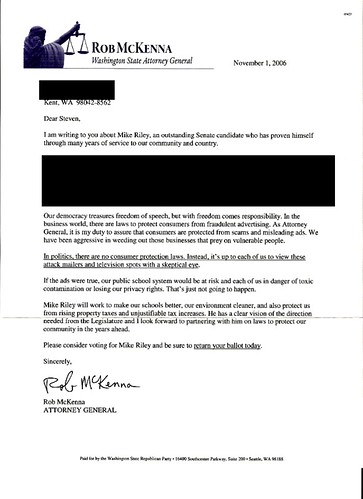
 ABUSE OF POWER Inspired by Rob McKenna's Fake Attorney General Letterhead GIF of Letter |


PNW TOPIC HOTLIST


Recommended Diaries
- Political Graphics 101: 34th LD lit deconstructed
As part of my highly opinionated, ruthlessly honest series on political graphics, I zero in on campaign lit from the 34th.
By dinazina (6 comments) - Gulliver's Travels
Jeb Bush came to town today and stopped by to speak with the Microsoft Political Action Committee. Most memorable metaphor on
By BryceM (8 comments) - WA Insurance Commissioner Says: Don't Believe the Hype (Yes on R -67)
Today I received the email copied below from Mike Kreidler, Washington State's Insurance Commissioner. It contrasts interestingly with the letter full
By noemie maxwell (2 comments) - Here in Douglas County who you are still seems to carry a lot of clout.
Commissioner Dane Keane has done it again! This time he has damaged a county vehicle while apparently under the influence. Although
By Dixie (3 comments) - John Edwards In Seattle - Why You Should Be There
Hello everyone. My name is Michael, I live in Puyallup, and this is my first time posting here. I wanted to
By Michael 4 Edwards (14 comments) - West Seattle Neighbors' 9-11 Antiwar newspaper ad
ON 9-11-07, the Robinson newspapers (West Seattle Herald, etc) will display this half-page ad, paid for by West Seattle Neigbors
By dinazina (9 comments)
Recent Diaries
By gibney (2 comments)
By Dixie (2 comments)
By bltfsk (3 comments)
By IvyTodd (0 comments)
By gibney (3 comments)
By Dixie (0 comments)
By BryceM (0 comments)
By dlaw (8 comments)
By bltfsk (0 comments)
By Dixie (1 comments)
By The Left Shue (4 comments)
By lanscot (3 comments)
Related Links
+ Executive Director of Washington's Commission on African American Affairs+ More on Building the base
+ Also by noemie maxwell
Washblog RSS Feeds
Political Contacts
Local Media
 Coastal/Grays Harbor
Aberdeen Daily World
Chinook Observer
Montesano Vidette
Pacific County Press
Willapa Harbor Herald
KXRO 1320 AM
Olympic Peninsula
Peninsula Daily News
Bremerton Sun
Bremerton Chronicle
Gig Harbor Gateway
Port Orchard Independent
Port Townsend Leader
North Kitsap Herald
Squim Gazette
Central Kitsap Reporter
Business Examiner
KONP 1450 AM
Sound and Islands
Anacortes American
Bainbridge Review
Voice Of Bainbridge
San Juan Journal
The Islands' Sounder
Whidbey NewsTimes
South Whidbey Record
Stanwood/Camano News
Vashon Beachcomber
Voice Of Vashon
KLKI 1340 AM
North Puget Sound
Bellingham Herald
The Northern Light
Everett Herald
Skagit Valley Herald
Lynden Tribune
The Enterprise
Snohomish County Tribune
Snohomish County Business Journal
The Monroe Monitor
The Edmonds Beacon
KGMI 790 AM
KELA 1470 AM
KRKO 1380 AM
Central Puget Sound
King County Journal
Issaquah Press
Mukilteo Beacon
Voice of the Valley
Federal Way Mirror
Bothell/Kenmore Reporter
Kirkland courier
Mercer Island Reporter
Woodinville Weekly
Greater Seattle
Seattle PI
Seattle Times
KOMO TV 4
KIRO TV 7
KING 5 TV
KTBW TV 22
KCTS 9
UW Daily
The Stranger
Seattle Weekly
Capitol Hill Times
Madison Park Times
Seattle Journal of Commerce
NW Asian Weekly
West Seattle Herald
North Seattle Herald-Outlook
South Seattle Star
Magnolia News
Beacon Hill News
KIRO 710 AM
KOMO AM 1000
KEXP 90.3 FM
KUOW 94.9 FM
KVI 570 AM
South Puget Sound
The Columbian
Longview Daily News
Nisqually Valley News
Lewis County News
The Reflector
Eatonville Dispatch
Tacoma News Tribune
Tacoma Weekly
Puyallup Herald
Enumclaw Courier-Herald
The Olympian
KAOS 89.3 FM
KCPQ 13
KOWA FM 106.5
UPN 11
Cascade/Okanogan
Ellensburg Daily Record
Levenworth Echo
Cle Elum Tribune
Snoqualmie Valley Record
Methow Valley News
Lake Chelan Mirror
Omak chronicle
The Newport Miner
Spokane/Palouse
The Spokesman-Review
KREM 2 TV Spokane
KXLY News 4 Spokane
KHQ 6 Spokane
KSPS Spokane
Statesman-Examiner
Othello Outlook
Cheney Free Press
Camas PostRecord
The South County sun
White Salmon Enterprise
Palouse Boomerang
Columbia Basin Herald
Grand Coulee Star
Walla Walla Union-Bulletin
Yakima Herald-Republic
KIMA 29 Yakima
KAPP TV 35 Yakima
KYVE Yakima
Wenatchee World
Tri-City Herald
TVEW TV 42 Tri-cities
KTNW Richland
KEPR 19 Pasco
Daily Sun News
Prosser Record-Bulletin
KTCR 1340 AM
KWSU Pullman
Moscow-Pullman Daily News
|
|